Buncombe County elections board approves bulk of provisional, absentee, military and overseas ballots; disapproves a handful and rejects one absentee ballot for
November 09, 2024 | Buncombe County, North Carolina
This article was created by AI summarizing key points discussed. AI makes mistakes, so for full details and context, please refer to the video of the full meeting. Please report any errors so we can fix them. Report an error »
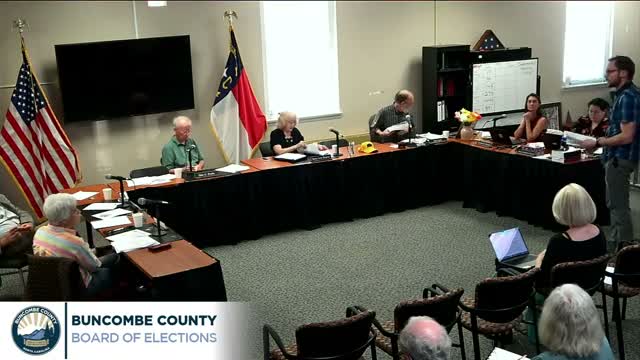
The Buncombe County Board of Elections reviewed and approved the bulk of ballots presented at a meeting that reviewed provisional and absentee paperwork, supplemental ballots, and military and overseas submissions while also resolving a number of challenges and a high-profile rejected absentee ballot.
At the meeting, staff walked the board through weeks of post-election processing and contingency plans for a likely recount in one close statewide race and a close Black Mountain City Council contest. "I think that we're likely to have one," Director Duncan said when describing the close statewide margin and the board set an "if-needed" recount session to start at 8 a.m. on Tuesday if a recount request is filed.
Why it matters: the session moved hundreds of ballots closer to final tabulation. After staff presentations and case-by-case reviews, the board approved nearly all of the provisional and absentee ballots brought before it that night, accepted 39 military ballots and 148 overseas civilian ballots presented by staff, and approved a large tranche of photo ID exception forms for provisional ballots. Board members also entered challenges on 57 ballots — most commonly for incorrect ballot style caused by printer/ExpressLink/ExpressVote header queuing or insertion errors — and removed or disapproved a handful of ballots that failed legal requirements.
Votes and formal actions at a glance
- Approved four provisional ballots whose photo ID exception forms were properly executed (motion carried 5-0).
- Returned six provisional ballots to staff and directed outreach so voters could "cure" deficiencies (motion carried 5-0).
- After debate about whether signatures on an application-to-vote (ATV) suffice where a photo ID exception form lacks a signature, the board approved two ballots on a 3–2 vote where the ATV had a voter signature but the separate exception form did not.
- Withheld one provisional ballot that lacked both the ATV signature and the exception-form signature and directed staff to notify the voter (motion carried 5-0).
- Entered challenges on 57 ballots presented by staff so the board could adjudicate race-by-race eligibility (motion carried by voice vote; staff will send notices to affected voters).
- Disapproved two ballots where voters cast ballots on another person’s record (unregistered voters) and removed 13 ballots from tabulation for voters who had died since casting their ballots (both motions carried 5-0).
- Approved 17 board-pending absentee ballots and approved 39 military ballots and 148 overseas civilian ballots that staff presented (each motion carried 5-0).
- Approved a large batch of photo ID exception forms (237 forms approved as presented).
- Reviewed 449 civilian absentee ballots and approved 445 while disapproving 4 (board summary reported those final counts as staff presented them).
- Approved the absentee ballot abstract for the night (motion carried 5-0).
Signature and photo-ID disputes
A recurring theme was how to treat missing or inconsistent signatures on the photo ID exception forms that accompany provisional and absentee ballots. Staff repeatedly cited state guidance and memos about the limited ways some deficiencies can be cured; one board exchange centered on whether a signed application-to-vote could stand in for a missing signature on the exception form. After deliberation the board allowed two ballots to proceed where the ATV was signed but the separate photo ID exception form lacked the signature — a decision that passed 3–2 after members read the applicable language and discussed process improvements.
Public comment and a denied absentee ballot
A caller identifying herself as Darlene spoke by phone to the board describing trouble receiving an absentee ballot in time (she said she lost her home to a hurricane) and explained that, in her case, two witnesses had signed the ballots that were placed together but one of the two required witness signatures was missing on her envelope. "My ballot is legitimate," she told the board, urging they accept it. Board members and staff said the law requires two witness signatures on that type of absentee return envelope and noted there is no statutory cure available after election day in that scenario. A motion to disapprove that ballot carried 4–0 with one member abstaining; Darlene said she will seek further remedies offline.
Staff follow-up and next steps
Staff said they will carry out the outreach required by the board for ballots designated for cure and that letters will be sent to voters who could not be reached by phone. Staff also noted the largest challenge category (wrong ballot style) affected a small fraction of voters overall but required targeted fixes; the board stressed continuing poll-worker reminders to use the ballot-matching guns and correct ExpressLink workflows to keep cascade errors down.
The board approved the absentee-ballot abstract for the night and confirmed additional sessions: the sample audit Monday morning and an "if-needed" meeting to begin 8 a.m. on Tuesday for potential recount work and further canvass activity.
What we learned
- Most provisional and absentee ballots brought to the board were approved after staff review and board adjudication.
- The two signature-policy decisions (a 3–2 vote to allow two ballots where the ATV was signed even though the separate exception form lacked a signature, and other unanimous decisions to return ballots for cure) highlight tension between strict statutory form requirements and operational realities at precincts.
- One voter’s appeal underscored how mail delays and post-hurricane displacement can complicate absentee voting and limit cure options under current state rules.
Where this goes next
Staff will notify voters eligible for a cure and will resume processing ballots that are cured and returned in time. The board left the record open for required notices and scheduled the follow-up sessions it needs to handle any recounts and remaining canvass items. The meeting concluded after the board signed abstracts and confirmed the next public meetings and audit dates.
At the meeting, staff walked the board through weeks of post-election processing and contingency plans for a likely recount in one close statewide race and a close Black Mountain City Council contest. "I think that we're likely to have one," Director Duncan said when describing the close statewide margin and the board set an "if-needed" recount session to start at 8 a.m. on Tuesday if a recount request is filed.
Why it matters: the session moved hundreds of ballots closer to final tabulation. After staff presentations and case-by-case reviews, the board approved nearly all of the provisional and absentee ballots brought before it that night, accepted 39 military ballots and 148 overseas civilian ballots presented by staff, and approved a large tranche of photo ID exception forms for provisional ballots. Board members also entered challenges on 57 ballots — most commonly for incorrect ballot style caused by printer/ExpressLink/ExpressVote header queuing or insertion errors — and removed or disapproved a handful of ballots that failed legal requirements.
Votes and formal actions at a glance
- Approved four provisional ballots whose photo ID exception forms were properly executed (motion carried 5-0).
- Returned six provisional ballots to staff and directed outreach so voters could "cure" deficiencies (motion carried 5-0).
- After debate about whether signatures on an application-to-vote (ATV) suffice where a photo ID exception form lacks a signature, the board approved two ballots on a 3–2 vote where the ATV had a voter signature but the separate exception form did not.
- Withheld one provisional ballot that lacked both the ATV signature and the exception-form signature and directed staff to notify the voter (motion carried 5-0).
- Entered challenges on 57 ballots presented by staff so the board could adjudicate race-by-race eligibility (motion carried by voice vote; staff will send notices to affected voters).
- Disapproved two ballots where voters cast ballots on another person’s record (unregistered voters) and removed 13 ballots from tabulation for voters who had died since casting their ballots (both motions carried 5-0).
- Approved 17 board-pending absentee ballots and approved 39 military ballots and 148 overseas civilian ballots that staff presented (each motion carried 5-0).
- Approved a large batch of photo ID exception forms (237 forms approved as presented).
- Reviewed 449 civilian absentee ballots and approved 445 while disapproving 4 (board summary reported those final counts as staff presented them).
- Approved the absentee ballot abstract for the night (motion carried 5-0).
Signature and photo-ID disputes
A recurring theme was how to treat missing or inconsistent signatures on the photo ID exception forms that accompany provisional and absentee ballots. Staff repeatedly cited state guidance and memos about the limited ways some deficiencies can be cured; one board exchange centered on whether a signed application-to-vote could stand in for a missing signature on the exception form. After deliberation the board allowed two ballots to proceed where the ATV was signed but the separate photo ID exception form lacked the signature — a decision that passed 3–2 after members read the applicable language and discussed process improvements.
Public comment and a denied absentee ballot
A caller identifying herself as Darlene spoke by phone to the board describing trouble receiving an absentee ballot in time (she said she lost her home to a hurricane) and explained that, in her case, two witnesses had signed the ballots that were placed together but one of the two required witness signatures was missing on her envelope. "My ballot is legitimate," she told the board, urging they accept it. Board members and staff said the law requires two witness signatures on that type of absentee return envelope and noted there is no statutory cure available after election day in that scenario. A motion to disapprove that ballot carried 4–0 with one member abstaining; Darlene said she will seek further remedies offline.
Staff follow-up and next steps
Staff said they will carry out the outreach required by the board for ballots designated for cure and that letters will be sent to voters who could not be reached by phone. Staff also noted the largest challenge category (wrong ballot style) affected a small fraction of voters overall but required targeted fixes; the board stressed continuing poll-worker reminders to use the ballot-matching guns and correct ExpressLink workflows to keep cascade errors down.
The board approved the absentee-ballot abstract for the night and confirmed additional sessions: the sample audit Monday morning and an "if-needed" meeting to begin 8 a.m. on Tuesday for potential recount work and further canvass activity.
What we learned
- Most provisional and absentee ballots brought to the board were approved after staff review and board adjudication.
- The two signature-policy decisions (a 3–2 vote to allow two ballots where the ATV was signed even though the separate exception form lacked a signature, and other unanimous decisions to return ballots for cure) highlight tension between strict statutory form requirements and operational realities at precincts.
- One voter’s appeal underscored how mail delays and post-hurricane displacement can complicate absentee voting and limit cure options under current state rules.
Where this goes next
Staff will notify voters eligible for a cure and will resume processing ballots that are cured and returned in time. The board left the record open for required notices and scheduled the follow-up sessions it needs to handle any recounts and remaining canvass items. The meeting concluded after the board signed abstracts and confirmed the next public meetings and audit dates.
View the Full Meeting & All Its Details
This article offers just a summary. Unlock complete video, transcripts, and insights as a Founder Member.
✓
Watch full, unedited meeting videos
✓
Search every word spoken in unlimited transcripts
✓
AI summaries & real-time alerts (all government levels)
✓
Permanent access to expanding government content
30-day money-back guarantee
