Buncombe elections board approves hundreds of absentee, military and overseas ballots; schedules follow-up to finish review
October 30, 2024 | Buncombe County, North Carolina
This article was created by AI summarizing key points discussed. AI makes mistakes, so for full details and context, please refer to the video of the full meeting. Please report any errors so we can fix them. Report an error »
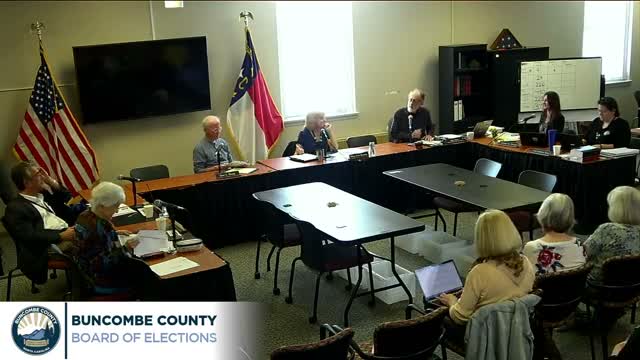
The Buncombe County Board of Elections moved through a large batch of absentee-business on Oct. 29, voting on several categories of ballots and setting a schedule to complete the remainder before Election Day.
Staff presented board-pending ballots, and the board approved 89 such ballots in a single vote. The board disapproved two ballots brought for separate review: one lacked signatures and another had an illegible second-witness name; the disapproval motion carried. After staff review, the board unanimously approved 29 military absentee ballots and 226 overseas civilian ballots.
Staff presented three ballots requiring board discussion: one with an ID-exception form missing the voter's name was disapproved; a ballot whose CIV number did not match any corresponding ballot for that meeting was disapproved under board policy; and a ballot with a witness-signature placement issue was accepted after staff confirmed the voter and address, with that motion passing 4-1.
The board then approved 448 absentee-by-mail ballots that included ID exception forms after staff verification; the motion carried 5-0. Director Duncan told the board there remained roughly 2,285 civilian (CIV) absentee ballots with photo IDs to review. To estimate throughput and plan follow-up work the board ran a 30-minute time trial: they reviewed 352 CIV envelopes in approximately 34 minutes and completed scanning in about an hour, which staff used to project that full review of the remaining CIVs would take roughly three hours of board time plus staff scanning and tagging.
Because duplication and precinct balancing must also occur in meeting sessions, the board scheduled continuation meetings and agreed to reconvene at 03:30 the following day and work through the evening (board members indicated an approximate target to conclude around 08:30). Staff noted some ballots were hand-delivered by postal workers after delivery issues; those were secured for follow-up.
Board members repeatedly emphasized procedural safeguards: ballots lacking required signatures were disapproved, mismatched CIVs followed existing board policy, and duplication of spoiled ballots would be done in bipartisan fashion and verified before scanning.
Staff presented board-pending ballots, and the board approved 89 such ballots in a single vote. The board disapproved two ballots brought for separate review: one lacked signatures and another had an illegible second-witness name; the disapproval motion carried. After staff review, the board unanimously approved 29 military absentee ballots and 226 overseas civilian ballots.
Staff presented three ballots requiring board discussion: one with an ID-exception form missing the voter's name was disapproved; a ballot whose CIV number did not match any corresponding ballot for that meeting was disapproved under board policy; and a ballot with a witness-signature placement issue was accepted after staff confirmed the voter and address, with that motion passing 4-1.
The board then approved 448 absentee-by-mail ballots that included ID exception forms after staff verification; the motion carried 5-0. Director Duncan told the board there remained roughly 2,285 civilian (CIV) absentee ballots with photo IDs to review. To estimate throughput and plan follow-up work the board ran a 30-minute time trial: they reviewed 352 CIV envelopes in approximately 34 minutes and completed scanning in about an hour, which staff used to project that full review of the remaining CIVs would take roughly three hours of board time plus staff scanning and tagging.
Because duplication and precinct balancing must also occur in meeting sessions, the board scheduled continuation meetings and agreed to reconvene at 03:30 the following day and work through the evening (board members indicated an approximate target to conclude around 08:30). Staff noted some ballots were hand-delivered by postal workers after delivery issues; those were secured for follow-up.
Board members repeatedly emphasized procedural safeguards: ballots lacking required signatures were disapproved, mismatched CIVs followed existing board policy, and duplication of spoiled ballots would be done in bipartisan fashion and verified before scanning.
Don't Miss a Word: See the Full Meeting!
Go beyond summaries. Unlock every video, transcript, and key insight with a Founder Membership.
✓
Get instant access to full meeting videos
✓
Search and clip any phrase from complete transcripts
✓
Receive AI-powered summaries & custom alerts
✓
Enjoy lifetime, unrestricted access to government data
30-day money-back guarantee
