CalSTRS Compensation Committee approves salary-range updates, defers incentive increases for further review
February 05, 2026 | California State Teachers Retirement System, Agencies under Office of the Governor, Executive, California
This article was created by AI summarizing key points discussed. AI makes mistakes, so for full details and context, please refer to the video of the full meeting. Please report any errors so we can fix them. Report an error »
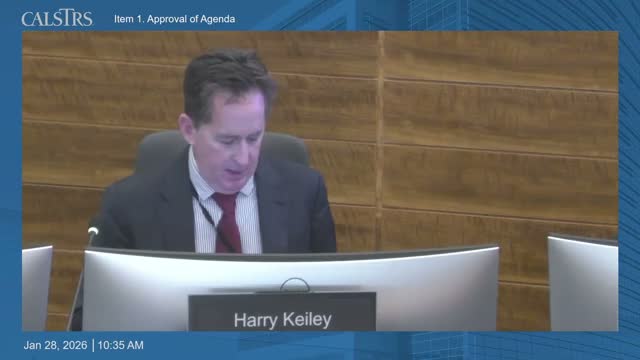
The California State Teachers' Retirement System (CalSTRS) Compensation Committee voted to approve adjustments to salary ranges for selected executive and investment positions while deferring a decision on raising incentive maximums until more information is provided at a future meeting.
The committee approved Mercer's recommendation to move salary-range midpoints closer to market medians, a change staff said would take effect Feb. 1 at the CEO's discretion. Mercer and McLaughlin Aon told the committee that, on several key roles, CalSTRS' current midpoints trail peer medians by double-digit percentages; presenters said adjusting ranges would improve CalSTRS' competitiveness for recruitment and retention.
"Base salary is what is used to calculate your retirement," Crystal Turco, CalSTRS staff, told the committee when distinguishing base pay from incentive compensation. Maureen Reilly of McLaughlin Aon summarized the analysis of 12 executive and investment roles and said examples included the CEO midpoint moving from roughly 16% below market median to about 3% below if the recommended midpoint change were made.
Committee members debated the timing and scope of changes. Sharon Hendricks moved to approve only the salary-range adjustments ("part A") now and defer increases to incentive maximums so the controller's office and other members could review additional information; Steve Juarez seconded the motion. Chair Keeley limited the immediate vote to the salary-range motion. Discussion highlighted the investment branch's recruitment risks and vacancies: Mercer and staff reported the investment branch has roughly 49 vacancies and a notably higher vacancy rate than CalSTRS overall.
During roll call, the representative for the director of finance, Ms. Perrault, and the state controller, Deborah Gallegos, recorded abstentions; Mr. Tang, Ms. Hendricks, Mr. Gunning and Chair Keeley voted in favor. The motion carried.
The committee also agreed to defer the second action (proposed increases to incentive maximums). Mercer had proposed that incentive maximum changes, if approved, would take effect July 1 with the first possible payout in 2027. Ms. Gallegos requested additional analysis and asked staff to bring the incentive item back in March. The committee asked staff to provide further materials, including data on where investment recruits have historically been hired from and rationale or comparator data for adding incentives to roles such as the general counsel.
The committee approved the minutes from the prior meeting and adjourned. Staff said they will return with the requested information and that Mercer will support a policy review of comparator groups and whether to benchmark total cash versus total compensation.
What happened next: the committee directed staff to provide the follow-up materials requested by members for the March meeting; no changes to individual employee base salaries were made at the meeting as a result of the range update (staff emphasized range changes do not automatically alter existing employee salaries).
The committee approved Mercer's recommendation to move salary-range midpoints closer to market medians, a change staff said would take effect Feb. 1 at the CEO's discretion. Mercer and McLaughlin Aon told the committee that, on several key roles, CalSTRS' current midpoints trail peer medians by double-digit percentages; presenters said adjusting ranges would improve CalSTRS' competitiveness for recruitment and retention.
"Base salary is what is used to calculate your retirement," Crystal Turco, CalSTRS staff, told the committee when distinguishing base pay from incentive compensation. Maureen Reilly of McLaughlin Aon summarized the analysis of 12 executive and investment roles and said examples included the CEO midpoint moving from roughly 16% below market median to about 3% below if the recommended midpoint change were made.
Committee members debated the timing and scope of changes. Sharon Hendricks moved to approve only the salary-range adjustments ("part A") now and defer increases to incentive maximums so the controller's office and other members could review additional information; Steve Juarez seconded the motion. Chair Keeley limited the immediate vote to the salary-range motion. Discussion highlighted the investment branch's recruitment risks and vacancies: Mercer and staff reported the investment branch has roughly 49 vacancies and a notably higher vacancy rate than CalSTRS overall.
During roll call, the representative for the director of finance, Ms. Perrault, and the state controller, Deborah Gallegos, recorded abstentions; Mr. Tang, Ms. Hendricks, Mr. Gunning and Chair Keeley voted in favor. The motion carried.
The committee also agreed to defer the second action (proposed increases to incentive maximums). Mercer had proposed that incentive maximum changes, if approved, would take effect July 1 with the first possible payout in 2027. Ms. Gallegos requested additional analysis and asked staff to bring the incentive item back in March. The committee asked staff to provide further materials, including data on where investment recruits have historically been hired from and rationale or comparator data for adding incentives to roles such as the general counsel.
The committee approved the minutes from the prior meeting and adjourned. Staff said they will return with the requested information and that Mercer will support a policy review of comparator groups and whether to benchmark total cash versus total compensation.
What happened next: the committee directed staff to provide the follow-up materials requested by members for the March meeting; no changes to individual employee base salaries were made at the meeting as a result of the range update (staff emphasized range changes do not automatically alter existing employee salaries).
Don't Miss a Word: See the Full Meeting!
Go beyond summaries. Unlock every video, transcript, and key insight with a Founder Membership.
✓
Get instant access to full meeting videos
✓
Search and clip any phrase from complete transcripts
✓
Receive AI-powered summaries & custom alerts
✓
Enjoy lifetime, unrestricted access to government data
30-day money-back guarantee
