Prescott staff propose balanced FY26 budget, rely on reserves and public‑safety sales tax for capital plan
May 17, 2025 | Prescott City, Yavapai County, Arizona
This article was created by AI summarizing key points discussed. AI makes mistakes, so for full details and context, please refer to the video of the full meeting. Please report any errors so we can fix them. Report an error »
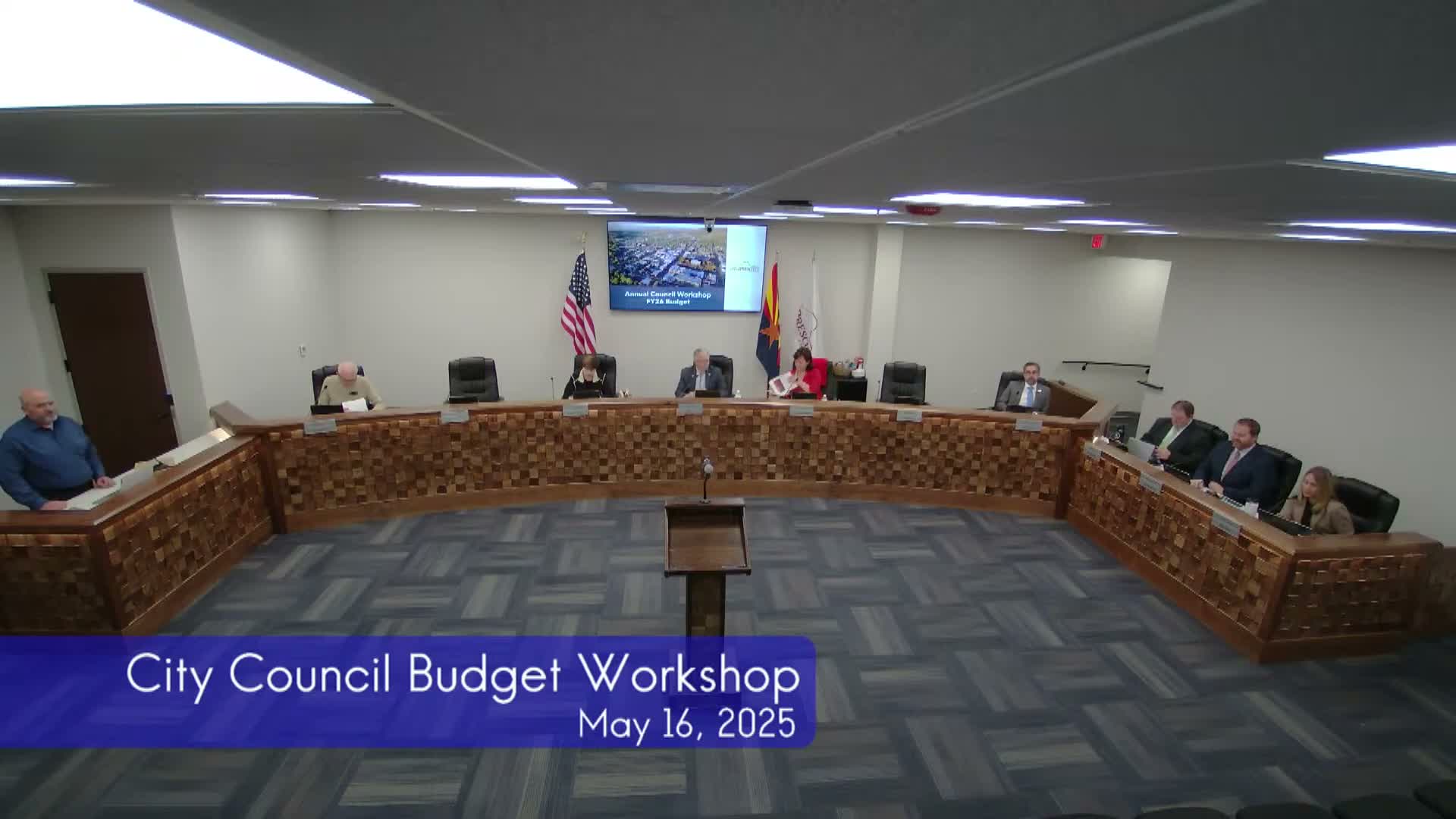
City of Prescott staff presented the proposed fiscal year 2026 budget at a May 16 council workshop, describing a balanced operating proposal, a large five‑year capital plan and the expected first receipts from a new public‑safety sales tax. The presentation framed the proposal as an effort to align spending with the council’s strategic priorities while protecting reserve policies.
Deputy Finance Director Lars Johnson told the council, “The budget before you, the proposal is balanced,” and outlined major line items: operating revenues projected at about $268,000,000, total expenditures of roughly $303,000,000 and an expected draw of about $35,700,000 from accumulated fund balances to cover the difference. Johnson said operating revenues would rise largely because of the new public‑safety privilege tax and increases in charges for services tied to recent rate studies.
Why it matters: the spending plan funds base services and embeds the voter‑approved public‑safety tax into operations and capital planning while preserving the city’s reserve policy (20% of operating revenues in the general fund). Councilmembers pressed staff on where cuts were made, how recurring versus one‑time dollars were classified and which funds would cover new positions and maintenance backlog.
Key budget elements and staff clarifications
- Public‑safety tax: Johnson said the 0.95% privilege tax is expected to generate about $22,300,000 next year, with roughly $3.7 million budgeted for operations and approximately $33.4 million planned for capital projects to be funded by borrowing that the tax will repay. He also showed a public‑facing OpenGov transparency page that will track receipts and expenditures nightly.
- Revenues and reserves: Staff described a conservative forecasting approach using three‑year averages. Enterprise funds (water, wastewater, solid waste) are projected to increase—water by ~$2.2M, wastewater by ~$2.5M and solid waste by ~$1.1M—based on recent rate studies. The city proposes maintaining its general‑fund minimum reserve policy (20% of operating revenues).
- Capital plan and projects: The five‑year capital improvement program includes 168 projects across 21 categories and totals about $591,000,000 for the five‑year window (about $769M including future‑years column). Highlights for FY26 include airport safety projects (ARFF facility, ramp rehabilitation, runway/extension planning), Goldwater Road reconstruction, park field‑light and playground replacements, and library third‑floor remodeling funded from prior impact‑fee balances.
- Property tax levy: Staff proposed increasing the levy only to capture new construction on the rolls (about $37,000), setting the levy at approximately $2,304,514. Because assessed value increased, the tax rate would decrease even with that levy amount. Staff noted statutory constraints that effectively limit annual increases.
Council questions and points of emphasis
Council members queried staff about several specific items: a projected dip then rise in state shared revenues (staff said the 2024 bump was nonrecurring and tied to a prior change in state distributions), the assumed permit pipeline behind impact‑fee revenue increases (staff said projections follow the rate‑study assumptions), and a visible multi‑year reduction in street preservation funding driven in part by loss of residential rental tax revenue. When asked about bringing striping in‑house, staff described a plan to procure equipment and hire staff midyear to reduce reliance on a single regional contractor.
No formal votes occurred at the workshop. Staff said the approved‑expenditure list included with the agenda would allow procurement within specified thresholds and that council will review that list before tentative adoption.
What’s next
Staff scheduled tentative budget consideration for June 10 and final budget adoption for June 24. The budget and detailed capital plan are posted on the City of Prescott OpenGov site, and staff said they will provide training for council and the public on June 10 to navigate the site and the transparency tools.
No public commenters spoke during the workshop.
Deputy Finance Director Lars Johnson told the council, “The budget before you, the proposal is balanced,” and outlined major line items: operating revenues projected at about $268,000,000, total expenditures of roughly $303,000,000 and an expected draw of about $35,700,000 from accumulated fund balances to cover the difference. Johnson said operating revenues would rise largely because of the new public‑safety privilege tax and increases in charges for services tied to recent rate studies.
Why it matters: the spending plan funds base services and embeds the voter‑approved public‑safety tax into operations and capital planning while preserving the city’s reserve policy (20% of operating revenues in the general fund). Councilmembers pressed staff on where cuts were made, how recurring versus one‑time dollars were classified and which funds would cover new positions and maintenance backlog.
Key budget elements and staff clarifications
- Public‑safety tax: Johnson said the 0.95% privilege tax is expected to generate about $22,300,000 next year, with roughly $3.7 million budgeted for operations and approximately $33.4 million planned for capital projects to be funded by borrowing that the tax will repay. He also showed a public‑facing OpenGov transparency page that will track receipts and expenditures nightly.
- Revenues and reserves: Staff described a conservative forecasting approach using three‑year averages. Enterprise funds (water, wastewater, solid waste) are projected to increase—water by ~$2.2M, wastewater by ~$2.5M and solid waste by ~$1.1M—based on recent rate studies. The city proposes maintaining its general‑fund minimum reserve policy (20% of operating revenues).
- Capital plan and projects: The five‑year capital improvement program includes 168 projects across 21 categories and totals about $591,000,000 for the five‑year window (about $769M including future‑years column). Highlights for FY26 include airport safety projects (ARFF facility, ramp rehabilitation, runway/extension planning), Goldwater Road reconstruction, park field‑light and playground replacements, and library third‑floor remodeling funded from prior impact‑fee balances.
- Property tax levy: Staff proposed increasing the levy only to capture new construction on the rolls (about $37,000), setting the levy at approximately $2,304,514. Because assessed value increased, the tax rate would decrease even with that levy amount. Staff noted statutory constraints that effectively limit annual increases.
Council questions and points of emphasis
Council members queried staff about several specific items: a projected dip then rise in state shared revenues (staff said the 2024 bump was nonrecurring and tied to a prior change in state distributions), the assumed permit pipeline behind impact‑fee revenue increases (staff said projections follow the rate‑study assumptions), and a visible multi‑year reduction in street preservation funding driven in part by loss of residential rental tax revenue. When asked about bringing striping in‑house, staff described a plan to procure equipment and hire staff midyear to reduce reliance on a single regional contractor.
No formal votes occurred at the workshop. Staff said the approved‑expenditure list included with the agenda would allow procurement within specified thresholds and that council will review that list before tentative adoption.
What’s next
Staff scheduled tentative budget consideration for June 10 and final budget adoption for June 24. The budget and detailed capital plan are posted on the City of Prescott OpenGov site, and staff said they will provide training for council and the public on June 10 to navigate the site and the transparency tools.
No public commenters spoke during the workshop.
Don't Miss a Word: See the Full Meeting!
Go beyond summaries. Unlock every video, transcript, and key insight with a Founder Membership.
✓
Get instant access to full meeting videos
✓
Search and clip any phrase from complete transcripts
✓
Receive AI-powered summaries & custom alerts
✓
Enjoy lifetime, unrestricted access to government data
30-day money-back guarantee
