Prescott committee reviews density bonuses, fee waivers and other incentives to spur workforce housing
February 05, 2026 | Prescott City, Yavapai County, Arizona
This article was created by AI summarizing key points discussed. AI makes mistakes, so for full details and context, please refer to the video of the full meeting. Please report any errors so we can fix them. Report an error »
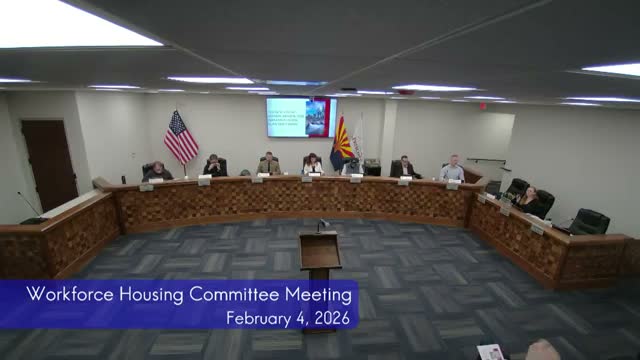
The Prescott City Workforce Housing Committee spent the meeting reviewing an implementation strategy aimed at closing the gap between construction costs and what local workers can afford. Consultant Rick Merritt told the committee the strategy centers on code amendments and incentives designed to make workforce projects financially feasible, naming density bonuses in the 15% to 20% range and selective fee waivers as focal tools.
"We're looking at that and trying to figure out the levels of density incentive, which really are basically at no cost to the city, that will make this feasible," Merritt said, adding that a 15% to 20% density bonus is likely to make the biggest difference. He used a 96-unit example to illustrate cost pressures, saying developers estimated about $130,000 in permit fees and roughly $1.6 million in impact fees for that project.
The consultant emphasized the program design goal: enable workforce units without having market-rate units in the same project subsidize them. "We don't want the market-rate units to subsidize the workforce units," Merritt said, and he urged the committee to consider a mix of incentives that could include fee waivers and density bonuses alongside limited direct public subsidy.
Committee members pushed on how to balance density and open space, suggesting developer-funded park or open-space funds as a possible compromise. Merritt said such ideas were not uncommon but had not been a focal point of his prior council conversations.
The presentation included program-design elements to preserve affordability over the long term: income targeting (committee and staff discussed workforce defined roughly as 60% to 120% of area median income), monitoring and reporting requirements for participating projects, and deed restrictions or equity-sharing mechanisms to avoid conversions to market rate after initial affordability periods.
Merritt also raised adaptive-use options such as converting small hotels or motels into smaller ownership units or apartments where feasible, but said technical constraints such as water meters, sewer laterals and parking can require code amendments.
Staff and the consultant said existing programs such as down-payment assistance (including WISH programs referenced in the discussion) and community land-trust models could complement incentives. Merritt offered to meet individually with developers to show pro forma results under 10%, 15% and 20% density scenarios.
Next steps: staff will incorporate committee feedback into the implementation strategy and bring the plan to City Council; the committee was invited to attend the Council meeting scheduled for March 10.
"We're looking at that and trying to figure out the levels of density incentive, which really are basically at no cost to the city, that will make this feasible," Merritt said, adding that a 15% to 20% density bonus is likely to make the biggest difference. He used a 96-unit example to illustrate cost pressures, saying developers estimated about $130,000 in permit fees and roughly $1.6 million in impact fees for that project.
The consultant emphasized the program design goal: enable workforce units without having market-rate units in the same project subsidize them. "We don't want the market-rate units to subsidize the workforce units," Merritt said, and he urged the committee to consider a mix of incentives that could include fee waivers and density bonuses alongside limited direct public subsidy.
Committee members pushed on how to balance density and open space, suggesting developer-funded park or open-space funds as a possible compromise. Merritt said such ideas were not uncommon but had not been a focal point of his prior council conversations.
The presentation included program-design elements to preserve affordability over the long term: income targeting (committee and staff discussed workforce defined roughly as 60% to 120% of area median income), monitoring and reporting requirements for participating projects, and deed restrictions or equity-sharing mechanisms to avoid conversions to market rate after initial affordability periods.
Merritt also raised adaptive-use options such as converting small hotels or motels into smaller ownership units or apartments where feasible, but said technical constraints such as water meters, sewer laterals and parking can require code amendments.
Staff and the consultant said existing programs such as down-payment assistance (including WISH programs referenced in the discussion) and community land-trust models could complement incentives. Merritt offered to meet individually with developers to show pro forma results under 10%, 15% and 20% density scenarios.
Next steps: staff will incorporate committee feedback into the implementation strategy and bring the plan to City Council; the committee was invited to attend the Council meeting scheduled for March 10.
Don't Miss a Word: See the Full Meeting!
Go beyond summaries. Unlock every video, transcript, and key insight with a Founder Membership.
✓
Get instant access to full meeting videos
✓
Search and clip any phrase from complete transcripts
✓
Receive AI-powered summaries & custom alerts
✓
Enjoy lifetime, unrestricted access to government data
30-day money-back guarantee
