Committee presses staff for turnover costs and down-payment options as next steps for workforce housing
February 05, 2026 | Prescott City, Yavapai County, Arizona
This article was created by AI summarizing key points discussed. AI makes mistakes, so for full details and context, please refer to the video of the full meeting. Please report any errors so we can fix them. Report an error »
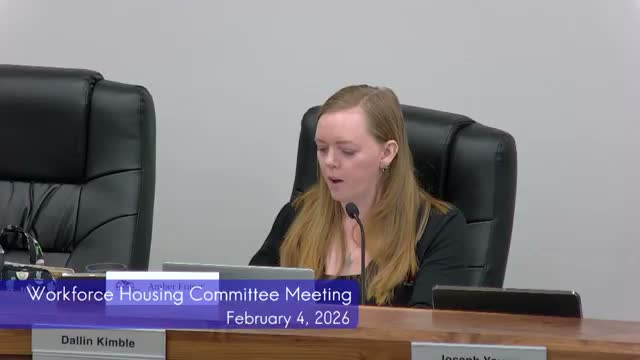
Committee members prioritized concrete, short-term steps and data to support the implementation strategy and potential budget requests. Staff said they have collected preliminary human-resources numbers and will format them for council use.
"Our average annual turnover rate is 15.3%," Amber told the committee, reporting additional figures staff collected for 2025: a 14% turnover rate for 2025 specifically, five employees who left citing housing costs, and 35 job offers declined because applicants cited housing as a reason. Staff said they are compiling recruitment time and training costs to estimate savings if turnover is reduced.
Members pressed for immediate programs that could be stood up quickly, including down-payment assistance for city employees and employer-assisted programs. Amber said options such as existing WISH-style programs or partnerships with banks could be used and that some options would require a city budget allocation while others might be implemented through partnerships without direct city funding.
Planning Manager Alex Grama said a broader land development code overhaul is under way with a 1-to-2-year horizon, but that limited interim code changes could be prioritized if council directs. Committee members asked staff to identify "low-hanging fruit"—actions that could be implemented quickly to make an early impact.
Staff asked committee members to submit feedback by Friday the 13th and noted the implementation strategy will return to City Council as a voting item on March 10 at 3 p.m.; staff said that item should be expected to go on the council agenda for a vote after committee and council review.
The meeting closed with an announcement of a public panel on missing-middle housing on Feb. 17 at the Rolley P. Simmons Adult Center and with the chair adjourning the session.
"Our average annual turnover rate is 15.3%," Amber told the committee, reporting additional figures staff collected for 2025: a 14% turnover rate for 2025 specifically, five employees who left citing housing costs, and 35 job offers declined because applicants cited housing as a reason. Staff said they are compiling recruitment time and training costs to estimate savings if turnover is reduced.
Members pressed for immediate programs that could be stood up quickly, including down-payment assistance for city employees and employer-assisted programs. Amber said options such as existing WISH-style programs or partnerships with banks could be used and that some options would require a city budget allocation while others might be implemented through partnerships without direct city funding.
Planning Manager Alex Grama said a broader land development code overhaul is under way with a 1-to-2-year horizon, but that limited interim code changes could be prioritized if council directs. Committee members asked staff to identify "low-hanging fruit"—actions that could be implemented quickly to make an early impact.
Staff asked committee members to submit feedback by Friday the 13th and noted the implementation strategy will return to City Council as a voting item on March 10 at 3 p.m.; staff said that item should be expected to go on the council agenda for a vote after committee and council review.
The meeting closed with an announcement of a public panel on missing-middle housing on Feb. 17 at the Rolley P. Simmons Adult Center and with the chair adjourning the session.
Don't Miss a Word: See the Full Meeting!
Go beyond summaries. Unlock every video, transcript, and key insight with a Founder Membership.
✓
Get instant access to full meeting videos
✓
Search and clip any phrase from complete transcripts
✓
Receive AI-powered summaries & custom alerts
✓
Enjoy lifetime, unrestricted access to government data
30-day money-back guarantee
