MSDE: Scholarship enrollment surged, freeze driven by budget limits; agency urges policy changes and prioritization
February 05, 2026 | Ways and Means Committee, HOUSE OF REPRESENTATIVES, Committees, Legislative, Maryland
This article was created by AI summarizing key points discussed. AI makes mistakes, so for full details and context, please refer to the video of the full meeting. Please report any errors so we can fix them. Report an error »
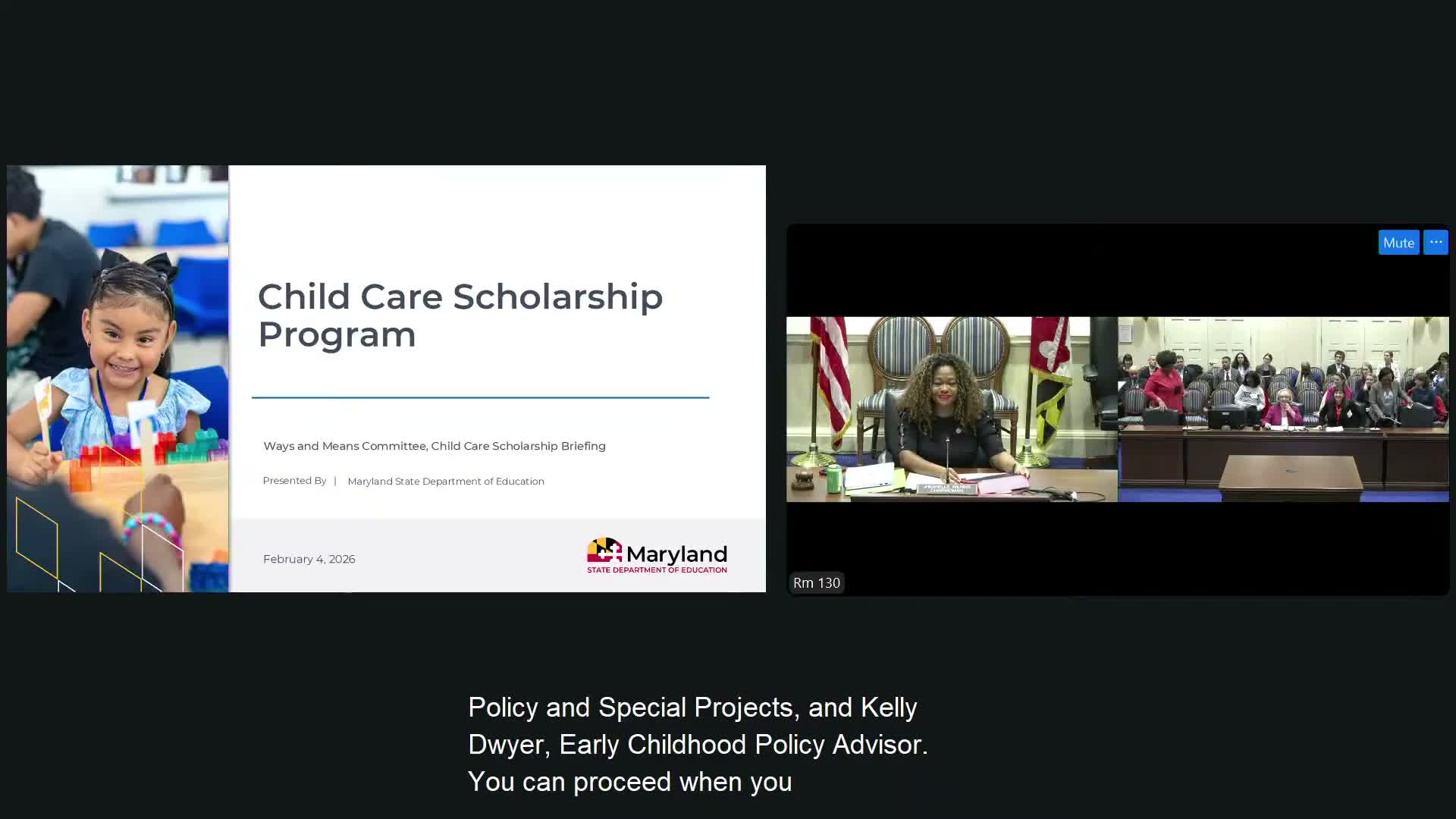
Maryland State Superintendent Dr. Carrie Wright and assistant state superintendent Sarah Neville Morgan told the Ways and Means Committee that rapidly rising enrollment in the childcare scholarship program has outpaced available funding and forced a partial enrollment freeze.
"Between July 2022 and June 2025, the number of children receiving scholarships each month more than doubled from nearly 19,000 children in July 2022 to over 47,000 in June 2025," Dr. Wright said, citing recent historic state investments. MSDE said the governor's FY2027 budget proposes $414,000,000 in state funding for the scholarship program, and combined with federal Child Care and Development Fund resources the total support would exceed $500 million.
MSDE officials said the freeze—implemented May 1—was driven by fiscal constraints. Sarah Neville Morgan said the agency expected enrollment to decline by natural attrition but instead enrollment briefly peaked near 48,000 in June after a surge of applications in the week before the freeze. She reported December enrollment at 41,148 and said nearly 5,000 children were on the wait list in January.
MSDE offered three policy recommendations to the legislature. First, the agency urged reconsidering the state's presumptive eligibility or "fast track" policy because internal data show many fast‑track applicants never complete the full application or are later found ineligible; MSDE estimated roughly $12.5 million was spent in FY25 on fast‑track cases that did not continue to full eligibility. Second, MSDE requested an alternative oversight model that would give the department more flexibility to implement administrative actions (including enrollment timing) without triggering application surges tied to legislative notification requirements. Third, the agency proposed establishing a formal wait‑list prioritization (homeless families, those transitioning from temporary cash assistance or SSI, and the lowest‑income households) to target scarce slots to the most vulnerable.
MSDE provided cost estimates to illustrate the gap between funding and demand: about $68,000,000 annually to bring the roughly 5,000 children currently on the wait list into the program, and an estimated $680,000,000 per year to serve 50,000 children—roughly $165,000,000 above current enacted funding levels, according to agency testimony.
Officials also flagged federal uncertainty: the U.S. Department of Health and Human Services had issued a notice of proposed rulemaking that could change requirements related to advanced provider payments, attendance versus enrollment payments, and family co‑payment caps. MSDE said it would track federal developments and adapt program rules as needed.
Committee members pressed MSDE on data details, geographic distribution of applicants, and whether the 50,000 figure represented a planning target. MSDE said the 50,000 figure is a reference point pending a statewide needs assessment and committed to providing county‑level methodology behind slide figures.
The agency said co‑payments remain very low—flat amounts of $1, $2, or $3 per week depending on the family bracket—and characterized Maryland as having among the lowest family co‑payments in the nation. MSDE also confirmed that some categories—families on temporary cash assistance, recipients of SSI, and siblings added to existing cases—were exempt from the partial freeze and continued to receive scholarships.
MSDE officials emphasized they would work with the General Assembly on options to balance stewardship of public funds with the need to serve families most in need, and said the department welcomed the committee's partnership to identify sustainable approaches.
Next steps: MSDE will follow up with requested county‑level data, a needs‑assessment timeline, and additional analyses on fast‑track outcomes; lawmakers signaled they will weigh agency recommendations as legislation is introduced this session.
"Between July 2022 and June 2025, the number of children receiving scholarships each month more than doubled from nearly 19,000 children in July 2022 to over 47,000 in June 2025," Dr. Wright said, citing recent historic state investments. MSDE said the governor's FY2027 budget proposes $414,000,000 in state funding for the scholarship program, and combined with federal Child Care and Development Fund resources the total support would exceed $500 million.
MSDE officials said the freeze—implemented May 1—was driven by fiscal constraints. Sarah Neville Morgan said the agency expected enrollment to decline by natural attrition but instead enrollment briefly peaked near 48,000 in June after a surge of applications in the week before the freeze. She reported December enrollment at 41,148 and said nearly 5,000 children were on the wait list in January.
MSDE offered three policy recommendations to the legislature. First, the agency urged reconsidering the state's presumptive eligibility or "fast track" policy because internal data show many fast‑track applicants never complete the full application or are later found ineligible; MSDE estimated roughly $12.5 million was spent in FY25 on fast‑track cases that did not continue to full eligibility. Second, MSDE requested an alternative oversight model that would give the department more flexibility to implement administrative actions (including enrollment timing) without triggering application surges tied to legislative notification requirements. Third, the agency proposed establishing a formal wait‑list prioritization (homeless families, those transitioning from temporary cash assistance or SSI, and the lowest‑income households) to target scarce slots to the most vulnerable.
MSDE provided cost estimates to illustrate the gap between funding and demand: about $68,000,000 annually to bring the roughly 5,000 children currently on the wait list into the program, and an estimated $680,000,000 per year to serve 50,000 children—roughly $165,000,000 above current enacted funding levels, according to agency testimony.
Officials also flagged federal uncertainty: the U.S. Department of Health and Human Services had issued a notice of proposed rulemaking that could change requirements related to advanced provider payments, attendance versus enrollment payments, and family co‑payment caps. MSDE said it would track federal developments and adapt program rules as needed.
Committee members pressed MSDE on data details, geographic distribution of applicants, and whether the 50,000 figure represented a planning target. MSDE said the 50,000 figure is a reference point pending a statewide needs assessment and committed to providing county‑level methodology behind slide figures.
The agency said co‑payments remain very low—flat amounts of $1, $2, or $3 per week depending on the family bracket—and characterized Maryland as having among the lowest family co‑payments in the nation. MSDE also confirmed that some categories—families on temporary cash assistance, recipients of SSI, and siblings added to existing cases—were exempt from the partial freeze and continued to receive scholarships.
MSDE officials emphasized they would work with the General Assembly on options to balance stewardship of public funds with the need to serve families most in need, and said the department welcomed the committee's partnership to identify sustainable approaches.
Next steps: MSDE will follow up with requested county‑level data, a needs‑assessment timeline, and additional analyses on fast‑track outcomes; lawmakers signaled they will weigh agency recommendations as legislation is introduced this session.
View the Full Meeting & All Its Details
This article offers just a summary. Unlock complete video, transcripts, and insights as a Founder Member.
✓
Watch full, unedited meeting videos
✓
Search every word spoken in unlimited transcripts
✓
AI summaries & real-time alerts (all government levels)
✓
Permanent access to expanding government content
30-day money-back guarantee
