Arvada council delays overhaul of meeting rules after hours of public comment and debate
February 05, 2026 | Arvada, Jefferson County, Colorado
This article was created by AI summarizing key points discussed. AI makes mistakes, so for full details and context, please refer to the video of the full meeting. Please report any errors so we can fix them. Report an error »
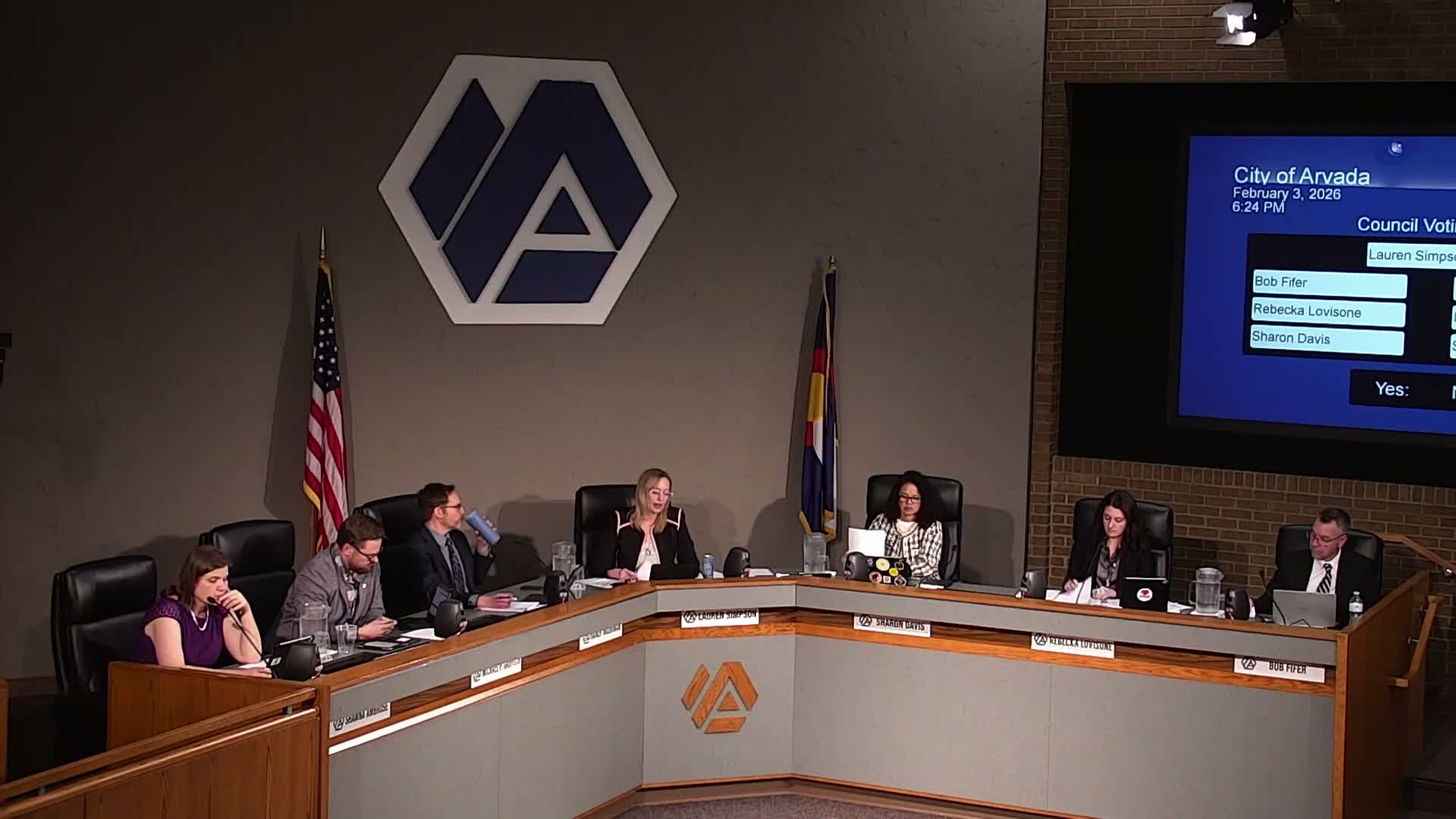
Mayor Simpson opened what became a months-in-the-making review of the city’s rules of procedure with a staff presentation and a lengthy public-comment period before council debate.
The city team presented proposed bylaws intended to simplify and reorganize the council’s current rules and recommended adoption of Bob’s Rules of Order for Colorado local governments to replace Robert’s Rules. Staff framed three change-areas for the council to consider: whether to set an overall time limit for the first regular public-comment period; whether to limit the topics allowed during that period; and whether to prioritize Arvada residents for early speakers. Staff also proposed allowing pooling of public-hearing speakers and preserving existing per-speaker time limits (3 minutes/first period, 5 minutes/second period).
Dozens of residents used the first public-comment period to oppose any limits on the city’s public-comment opportunities. “That’s not an efficiency tweak. That’s a structural change to how the public participates in this body,” Patty Shannon told the council, urging preservation of the current system so residents can speak before council deliberations. Veil Alish told the council that limiting comment would “exclude working residents, parents, caregivers, people with disabilities, and anyone with limited evening availability.”
Councilmembers sought technical clarifications from staff on several points, including whether public-hearing comment would change (staff said it would not, except for permitting pooling), enforcement of any residency priority, the effect of a 11:30 p.m. cutoff in the existing rules, and how amendments (so-called “friendly amendments”) would be handled under the proposed parliamentary rules. Council members debated trade-offs between giving the public maximal opportunity to speak early in meetings and ensuring that legally required public hearings — which can involve property rights and quasi-judicial processes — are heard at a reasonable hour for affected residents and applicants.
On specific recorded motions, the council voted 4–3 to keep the current practice of no overall time limit for the first public-comment period. A separate motion to move public hearings ahead of the first regular public-comment period failed 4–3. The council unanimously (7–0) agreed to retain the city’s current approach on topic scope and to keep the presiding officer’s discretion on resident priority. Following staff agreement to remove a 60-minute limit in the public-hearing text, clarify that council members may question applicants during public hearings, and address the 11:30 p.m. language, the council voted 7–0 to postpone final adoption of R26-009 to April 21, 2026 to allow additional public engagement and to return a revised draft.
Next steps: staff will incorporate the committee and council directions and return a revised draft for final consideration on the April 21 date certain. The council emphasized the desire to preserve public access while improving clarity about how and when comment will be scheduled.
The city team presented proposed bylaws intended to simplify and reorganize the council’s current rules and recommended adoption of Bob’s Rules of Order for Colorado local governments to replace Robert’s Rules. Staff framed three change-areas for the council to consider: whether to set an overall time limit for the first regular public-comment period; whether to limit the topics allowed during that period; and whether to prioritize Arvada residents for early speakers. Staff also proposed allowing pooling of public-hearing speakers and preserving existing per-speaker time limits (3 minutes/first period, 5 minutes/second period).
Dozens of residents used the first public-comment period to oppose any limits on the city’s public-comment opportunities. “That’s not an efficiency tweak. That’s a structural change to how the public participates in this body,” Patty Shannon told the council, urging preservation of the current system so residents can speak before council deliberations. Veil Alish told the council that limiting comment would “exclude working residents, parents, caregivers, people with disabilities, and anyone with limited evening availability.”
Councilmembers sought technical clarifications from staff on several points, including whether public-hearing comment would change (staff said it would not, except for permitting pooling), enforcement of any residency priority, the effect of a 11:30 p.m. cutoff in the existing rules, and how amendments (so-called “friendly amendments”) would be handled under the proposed parliamentary rules. Council members debated trade-offs between giving the public maximal opportunity to speak early in meetings and ensuring that legally required public hearings — which can involve property rights and quasi-judicial processes — are heard at a reasonable hour for affected residents and applicants.
On specific recorded motions, the council voted 4–3 to keep the current practice of no overall time limit for the first public-comment period. A separate motion to move public hearings ahead of the first regular public-comment period failed 4–3. The council unanimously (7–0) agreed to retain the city’s current approach on topic scope and to keep the presiding officer’s discretion on resident priority. Following staff agreement to remove a 60-minute limit in the public-hearing text, clarify that council members may question applicants during public hearings, and address the 11:30 p.m. language, the council voted 7–0 to postpone final adoption of R26-009 to April 21, 2026 to allow additional public engagement and to return a revised draft.
Next steps: staff will incorporate the committee and council directions and return a revised draft for final consideration on the April 21 date certain. The council emphasized the desire to preserve public access while improving clarity about how and when comment will be scheduled.
View the Full Meeting & All Its Details
This article offers just a summary. Unlock complete video, transcripts, and insights as a Founder Member.
✓
Watch full, unedited meeting videos
✓
Search every word spoken in unlimited transcripts
✓
AI summaries & real-time alerts (all government levels)
✓
Permanent access to expanding government content
30-day money-back guarantee
