OHA trustees approve 2026 state legislative positions after brief debate; separate consideration for one bill
February 05, 2026 | Task Force Created by Act 170, Executive , Hawaii
This article was created by AI summarizing key points discussed. AI makes mistakes, so for full details and context, please refer to the video of the full meeting. Please report any errors so we can fix them. Report an error »
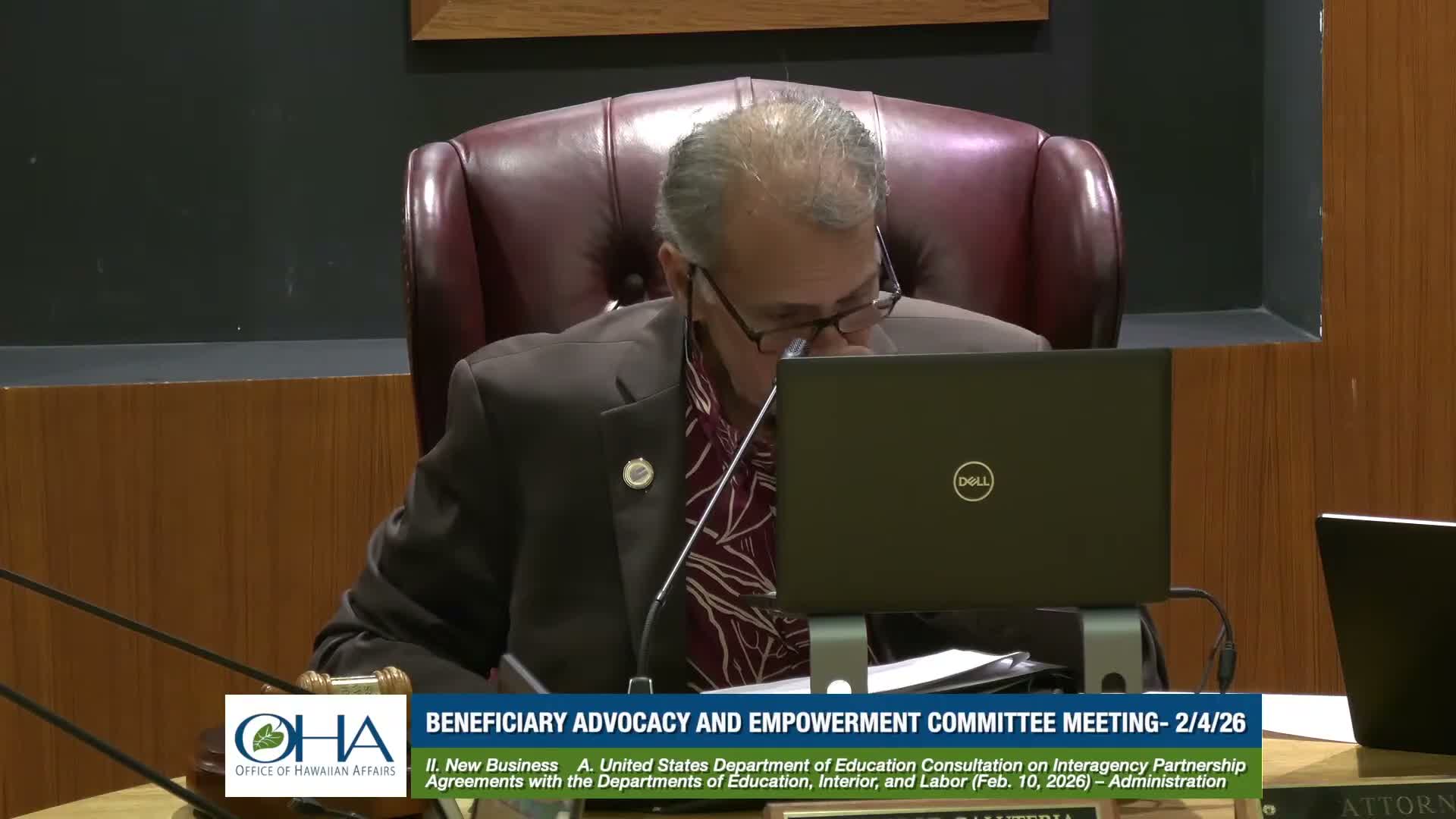
The Office of Hawaiian Affairs' Committee on Beneficiary, Advocacy, and Empowerment on took up and approved its 2026 state legislative bill package across nine matrices, voting to bifurcate one bill for separate consideration and to adopt staff-recommended positions, with several items noted for amendment or comment.
Trustees voted to separate HB2105 from the main package so it could be discussed independently; the bifurcation motion carried unanimously among those voting. After discussion the committee approved Matrix 1 (the OHA state legislative bill package as filed) with the bifurcation in place. Leanne Stender and the clerk recorded the roll calls and tallies during proceedings.
Why it mattered: the votes lock in OHA's formal stances as bills move to committee hearings in the Legislature and set the advocacy team's marching orders for testimony. Staff flagged several bills for attention: HB2104 (island burial councils), which staff said is scheduled for a 9 a.m. hearing the following day; HB1917, HB2582 and HB284 (appropriations to support the Public Land Trust working group); and proposals affecting how public lands and military leases may be extended or disposed.
On Matrix 2, staff described amendments to preserve OHA representation and voting power on the public land trust working group and proposed guardrails for any added community member, requiring financial expertise and familiarity with Native Hawaiian history. Staff also briefed trustees on a cultural trust concept modeled on an Oregon program that would allow state, federal, county and private monies to be pooled; the draft language would direct 50% of account proceeds to OHA to support Native Hawaiian artists and institutions, contingent on funding and program rules.
Public land trust bills drew sustained trustee attention. Staff advised a comment position on SB2759 rather than an outright oppose vote, proposing to change mandatory language in the bill ("shall") to discretionary language ("may") to preserve Board of Land and Natural Resources discretion in the limited circumstance of completing an environmental impact statement. Public commenters and several trustees pressed for stronger protections and clearer notice or prior-approval triggers when public trust lands are exchanged or disposed.
Votes at a glance: the committee recorded affirmative roll-call approvals on Matrix 1 (after bifurcation), Matrix 2 (with amendments), Matrix 3 (public land trust positions), and subsequent matrices covering natural resources, housing, health, education, economic stability and historic preservation; tallies reported during the meeting ranged from eight to nine yes votes depending on the item and attendance.
What comes next: staff said they will provide amended testimony and follow-up clarifications as bills are scheduled for committee hearings. Trustees asked staff to continue monitoring hearings and to provide room numbers and testimony logistics for trustees who plan to attend in person.
Trustees voted to separate HB2105 from the main package so it could be discussed independently; the bifurcation motion carried unanimously among those voting. After discussion the committee approved Matrix 1 (the OHA state legislative bill package as filed) with the bifurcation in place. Leanne Stender and the clerk recorded the roll calls and tallies during proceedings.
Why it mattered: the votes lock in OHA's formal stances as bills move to committee hearings in the Legislature and set the advocacy team's marching orders for testimony. Staff flagged several bills for attention: HB2104 (island burial councils), which staff said is scheduled for a 9 a.m. hearing the following day; HB1917, HB2582 and HB284 (appropriations to support the Public Land Trust working group); and proposals affecting how public lands and military leases may be extended or disposed.
On Matrix 2, staff described amendments to preserve OHA representation and voting power on the public land trust working group and proposed guardrails for any added community member, requiring financial expertise and familiarity with Native Hawaiian history. Staff also briefed trustees on a cultural trust concept modeled on an Oregon program that would allow state, federal, county and private monies to be pooled; the draft language would direct 50% of account proceeds to OHA to support Native Hawaiian artists and institutions, contingent on funding and program rules.
Public land trust bills drew sustained trustee attention. Staff advised a comment position on SB2759 rather than an outright oppose vote, proposing to change mandatory language in the bill ("shall") to discretionary language ("may") to preserve Board of Land and Natural Resources discretion in the limited circumstance of completing an environmental impact statement. Public commenters and several trustees pressed for stronger protections and clearer notice or prior-approval triggers when public trust lands are exchanged or disposed.
Votes at a glance: the committee recorded affirmative roll-call approvals on Matrix 1 (after bifurcation), Matrix 2 (with amendments), Matrix 3 (public land trust positions), and subsequent matrices covering natural resources, housing, health, education, economic stability and historic preservation; tallies reported during the meeting ranged from eight to nine yes votes depending on the item and attendance.
What comes next: staff said they will provide amended testimony and follow-up clarifications as bills are scheduled for committee hearings. Trustees asked staff to continue monitoring hearings and to provide room numbers and testimony logistics for trustees who plan to attend in person.
View the Full Meeting & All Its Details
This article offers just a summary. Unlock complete video, transcripts, and insights as a Founder Member.
✓
Watch full, unedited meeting videos
✓
Search every word spoken in unlimited transcripts
✓
AI summaries & real-time alerts (all government levels)
✓
Permanent access to expanding government content
30-day money-back guarantee
