Planning Commission hears training on infill development, zoning tradeoffs
February 05, 2026 | Planning Commission , Reno, Washoe County, Nevada
This article was created by AI summarizing key points discussed. AI makes mistakes, so for full details and context, please refer to the video of the full meeting. Please report any errors so we can fix them. Report an error »
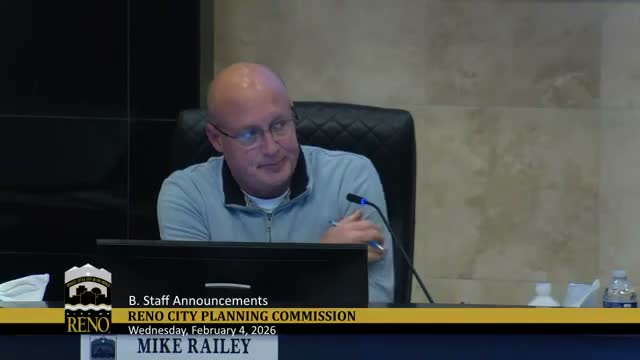
Angela Foos, assistant director of development services, told the Reno City Planning Commission on Feb. 4 that “infill” covers a range of projects in already-developed urban areas, from accessory dwelling units to multi-story mixed-use buildings, and that the city’s master plan endorses infill to increase walkability.
Foos said infill can reduce the need for new roads, fire stations and utility extensions but often requires costly upgrades to existing sewer and water lines. She noted the city’s zoning code recently added incentives, including a density bonus for affordable housing and a separate density bonus to encourage infill. "We have had a handful of developers take us up on that, and they're not bringing in hundreds of units," she said, adding that smaller increases — "if I can just get two more units, I can make this pencil" — are common.
Foos described protections intended to limit neighborhood impacts: screening and stepped-back building requirements for any story above the second floor, size and height limits for accessory dwelling units under the city's ADU ordinance, and landscaping or walls where taller infill abuts single-family homes.
Commissioners questioned how staff determine whether a proposal is "infill" or a different development type and asked for clearer classification in staff reports. Commissioner Christina Delviar said it would be helpful to know "what kind of infill" is proposed so the commission can evaluate walkability, transit access and infrastructure needs. Commissioner Manny Becerra suggested adding an explicit infill field to standard project summaries and staff reports so decision-makers can see at a glance whether a site meets the city’s infill goals.
Foos said zoning and the regional plan guide where the city encourages denser development — for example, much of downtown allows greater density and fewer parking requirements — but that staff’s role is to mitigate impacts and assess whether a project meets code. She said areas within the McCarran ring are a particular focus, though many parts of the city could qualify as infill depending on existing services and built context.
The training included examples of tradeoffs commissioners should weigh when reviewing projects, such as parking demand, neighborhood character and infrastructure capacity. Foos and commissioners agreed to package the training materials into a packet for future commissioners to use as a reference.
Foos said infill can reduce the need for new roads, fire stations and utility extensions but often requires costly upgrades to existing sewer and water lines. She noted the city’s zoning code recently added incentives, including a density bonus for affordable housing and a separate density bonus to encourage infill. "We have had a handful of developers take us up on that, and they're not bringing in hundreds of units," she said, adding that smaller increases — "if I can just get two more units, I can make this pencil" — are common.
Foos described protections intended to limit neighborhood impacts: screening and stepped-back building requirements for any story above the second floor, size and height limits for accessory dwelling units under the city's ADU ordinance, and landscaping or walls where taller infill abuts single-family homes.
Commissioners questioned how staff determine whether a proposal is "infill" or a different development type and asked for clearer classification in staff reports. Commissioner Christina Delviar said it would be helpful to know "what kind of infill" is proposed so the commission can evaluate walkability, transit access and infrastructure needs. Commissioner Manny Becerra suggested adding an explicit infill field to standard project summaries and staff reports so decision-makers can see at a glance whether a site meets the city’s infill goals.
Foos said zoning and the regional plan guide where the city encourages denser development — for example, much of downtown allows greater density and fewer parking requirements — but that staff’s role is to mitigate impacts and assess whether a project meets code. She said areas within the McCarran ring are a particular focus, though many parts of the city could qualify as infill depending on existing services and built context.
The training included examples of tradeoffs commissioners should weigh when reviewing projects, such as parking demand, neighborhood character and infrastructure capacity. Foos and commissioners agreed to package the training materials into a packet for future commissioners to use as a reference.
View the Full Meeting & All Its Details
This article offers just a summary. Unlock complete video, transcripts, and insights as a Founder Member.
✓
Watch full, unedited meeting videos
✓
Search every word spoken in unlimited transcripts
✓
AI summaries & real-time alerts (all government levels)
✓
Permanent access to expanding government content
30-day money-back guarantee
