House State Affairs committee gives HB 11-16B a due-pass recommendation after constitutional and enforcement debate
February 05, 2026 | 2026 Legislature SD, South Dakota
This article was created by AI summarizing key points discussed. AI makes mistakes, so for full details and context, please refer to the video of the full meeting. Please report any errors so we can fix them. Report an error »
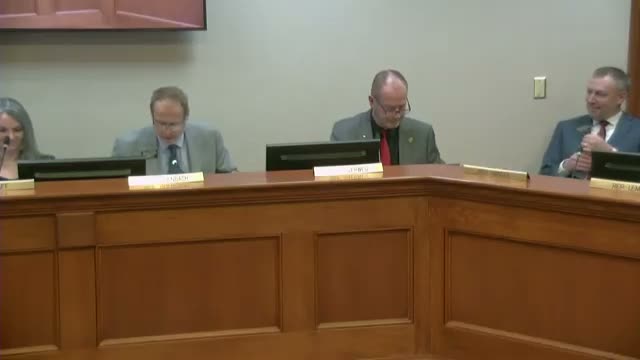
PIERRE, S.D. — The South Dakota House State Affairs Committee voted to send House Bill 11-16B to the floor with a due-pass recommendation on a 7–5 vote after more than an hour of testimony and questioning about whether the bill’s enforcement provisions are constitutional and practically enforceable.
The bill, described in committee as an act to prohibit a video streaming service from transmitting certain advertising during children’s programming and to provide a civil penalty, drew opposition from business and civil-rights groups and a sponsor rebuttal. "While we share in the intent to protect children, the chamber opposes HB 11-16 because it's overly broad in scope, it includes vague definitions, and it has the potential for unintended consequences," said Ryan Budmeyer, president and CEO of the South Dakota Chamber of Commerce and Industry, urging the committee to vote no.
Why it matters: Opponents told the committee the measure as written risks First Amendment challenges and practical enforcement problems. Samantha Chapman, lobbyist for the ACLU of South Dakota, told members the bill is "likely to be found unconstitutional if challenged," invoking the Central Hudson commercial-speech framework and warning the state could face significant litigation costs. Chapman offered to work with the sponsor to tighten language she described as vague, including terms such as "discuss," "promote" and "contain imagery."
Sponsor and industry responses: The prime sponsor, who is not named in the transcript, defended the measure as aligning streaming services with existing rules for video and satellite programming and said civil penalties are consistent with other statutory enforcement. Doug Abraham, an attorney appearing for the Motion Picture Association, cautioned that the bill's current wording appears to grant unilateral authority to the Attorney General to impose civil penalties without a clear enforcement process and suggested clarifying language ("the Attorney General may commence an action to recover a fine" rather than language that reads as an immediate imposition of fines).
Committee questions focused on enforcement mechanics and jurisdiction: Members asked whether the Attorney General's office had been consulted and how complaints would be investigated and proved for web-based services that operate outside South Dakota. The sponsor said he had not met with the Attorney General's staff but had run the language through Legislative Research Council legal reviewers. Committee members noted prior state legislation requiring websites to perform age verification as an example where websites complied with state-by-state rules, but others said widespread internet services would be difficult to police.
Vote at a glance: Representative Heinemann moved the due-pass recommendation and Gosh seconded. The roll call recorded seven ayes (Gosh, Hanson, Heinemann, Lemmes, Schaeffauer, Odenbach and one other listed as "Hi" in the transcript), five nays (Baum Mueller, Emery, Healy, Jamieson, Reich) and one excused member; the committee reported "7 ayes, 5 nays, 1 excused." After the vote, the chair said, "House Bill 11-16 as amended goes to the floor with a due pass recommendation."
What’s next: With a due-pass recommendation, HB 11-16B advances to the House floor for further consideration. The committee record shows opponents and civil-rights advocates offered to help redraft portions of the bill to address constitutional and due-process concerns; those negotiations could affect floor debate or subsequent amendments.
The bill, described in committee as an act to prohibit a video streaming service from transmitting certain advertising during children’s programming and to provide a civil penalty, drew opposition from business and civil-rights groups and a sponsor rebuttal. "While we share in the intent to protect children, the chamber opposes HB 11-16 because it's overly broad in scope, it includes vague definitions, and it has the potential for unintended consequences," said Ryan Budmeyer, president and CEO of the South Dakota Chamber of Commerce and Industry, urging the committee to vote no.
Why it matters: Opponents told the committee the measure as written risks First Amendment challenges and practical enforcement problems. Samantha Chapman, lobbyist for the ACLU of South Dakota, told members the bill is "likely to be found unconstitutional if challenged," invoking the Central Hudson commercial-speech framework and warning the state could face significant litigation costs. Chapman offered to work with the sponsor to tighten language she described as vague, including terms such as "discuss," "promote" and "contain imagery."
Sponsor and industry responses: The prime sponsor, who is not named in the transcript, defended the measure as aligning streaming services with existing rules for video and satellite programming and said civil penalties are consistent with other statutory enforcement. Doug Abraham, an attorney appearing for the Motion Picture Association, cautioned that the bill's current wording appears to grant unilateral authority to the Attorney General to impose civil penalties without a clear enforcement process and suggested clarifying language ("the Attorney General may commence an action to recover a fine" rather than language that reads as an immediate imposition of fines).
Committee questions focused on enforcement mechanics and jurisdiction: Members asked whether the Attorney General's office had been consulted and how complaints would be investigated and proved for web-based services that operate outside South Dakota. The sponsor said he had not met with the Attorney General's staff but had run the language through Legislative Research Council legal reviewers. Committee members noted prior state legislation requiring websites to perform age verification as an example where websites complied with state-by-state rules, but others said widespread internet services would be difficult to police.
Vote at a glance: Representative Heinemann moved the due-pass recommendation and Gosh seconded. The roll call recorded seven ayes (Gosh, Hanson, Heinemann, Lemmes, Schaeffauer, Odenbach and one other listed as "Hi" in the transcript), five nays (Baum Mueller, Emery, Healy, Jamieson, Reich) and one excused member; the committee reported "7 ayes, 5 nays, 1 excused." After the vote, the chair said, "House Bill 11-16 as amended goes to the floor with a due pass recommendation."
What’s next: With a due-pass recommendation, HB 11-16B advances to the House floor for further consideration. The committee record shows opponents and civil-rights advocates offered to help redraft portions of the bill to address constitutional and due-process concerns; those negotiations could affect floor debate or subsequent amendments.
Don't Miss a Word: See the Full Meeting!
Go beyond summaries. Unlock every video, transcript, and key insight with a Founder Membership.
✓
Get instant access to full meeting videos
✓
Search and clip any phrase from complete transcripts
✓
Receive AI-powered summaries & custom alerts
✓
Enjoy lifetime, unrestricted access to government data
30-day money-back guarantee
