Parents press Ann Arbor board for clearer safety communications after Hazely incident; district defends response
February 05, 2026 | Ann Arbor Public Schools, School Boards, Michigan
This article was created by AI summarizing key points discussed. AI makes mistakes, so for full details and context, please refer to the video of the full meeting. Please report any errors so we can fix them. Report an error »
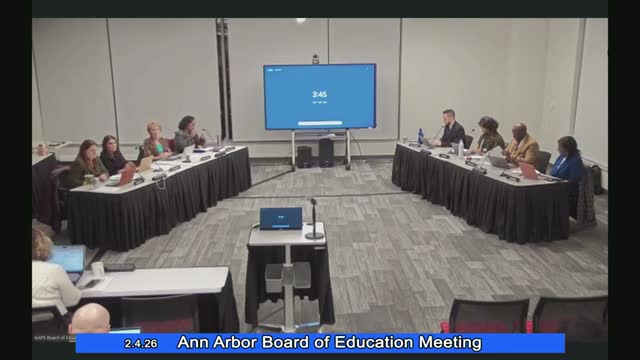
Several parents used the board’s public‑comment period on Feb. 9 to press the Ann Arbor Board of Education for clearer, timelier communications about school safety incidents and to demand accountability.
At the start of public commentary, a Hazely parent described a "deeply disturbing near‑miss incident" and said parents received delayed, vague emails that did not explain corrective actions. “Parents and teachers were not given the full truth,” the speaker said, calling for written explanations of changes and consistent notification protocols when safety events occur.
Other speakers described classroom‑placement concerns, teacher pay issues and student wellbeing. Former AAPS teacher Carolyn Seabert recounted persistent efforts to have an English‑learner moved into Algebra 1, saying school officials repeatedly denied the request citing a low NWEA score despite teacher support. Parent Amy Diebold and a student speaker urged better compensation for teachers and called working conditions unsustainable.
Superintendent Parks responded in a public clarification acknowledging community concern about Hazely, saying the district had collaborated with law enforcement and participated in a post‑incident town hall. Parks emphasized limits on what the district can share when law enforcement is leading an investigation and noted the district has continued outreach to staff and families. “We have continued to communicate … with what we are able to share from the school district standpoint versus what is law enforcement’s purview,” Parks said.
Community groups asked the board to adopt equitable processes for any phone‑use policy. Aspire urged the district to design engagement strategies that include students of color, LGBTQ+ students and families that may face barriers to participation and cautioned that phone bans can have disparate consequences if discipline is not carefully designed.
The board recorded the comments and directed staff to continue conversations about safety protocols, communication improvements and any policy approaches that may arise from community feedback.
At the start of public commentary, a Hazely parent described a "deeply disturbing near‑miss incident" and said parents received delayed, vague emails that did not explain corrective actions. “Parents and teachers were not given the full truth,” the speaker said, calling for written explanations of changes and consistent notification protocols when safety events occur.
Other speakers described classroom‑placement concerns, teacher pay issues and student wellbeing. Former AAPS teacher Carolyn Seabert recounted persistent efforts to have an English‑learner moved into Algebra 1, saying school officials repeatedly denied the request citing a low NWEA score despite teacher support. Parent Amy Diebold and a student speaker urged better compensation for teachers and called working conditions unsustainable.
Superintendent Parks responded in a public clarification acknowledging community concern about Hazely, saying the district had collaborated with law enforcement and participated in a post‑incident town hall. Parks emphasized limits on what the district can share when law enforcement is leading an investigation and noted the district has continued outreach to staff and families. “We have continued to communicate … with what we are able to share from the school district standpoint versus what is law enforcement’s purview,” Parks said.
Community groups asked the board to adopt equitable processes for any phone‑use policy. Aspire urged the district to design engagement strategies that include students of color, LGBTQ+ students and families that may face barriers to participation and cautioned that phone bans can have disparate consequences if discipline is not carefully designed.
The board recorded the comments and directed staff to continue conversations about safety protocols, communication improvements and any policy approaches that may arise from community feedback.
Don't Miss a Word: See the Full Meeting!
Go beyond summaries. Unlock every video, transcript, and key insight with a Founder Membership.
✓
Get instant access to full meeting videos
✓
Search and clip any phrase from complete transcripts
✓
Receive AI-powered summaries & custom alerts
✓
Enjoy lifetime, unrestricted access to government data
30-day money-back guarantee
