Georgia House approves $42.3 billion amended FY2026 budget with $850 million homeowner relief; passes by 167-5
February 05, 2026 | HOUSE OF REPRESENTATIVES, Committees, Legislative, Georgia
This article was created by AI summarizing key points discussed. AI makes mistakes, so for full details and context, please refer to the video of the full meeting. Please report any errors so we can fix them. Report an error »
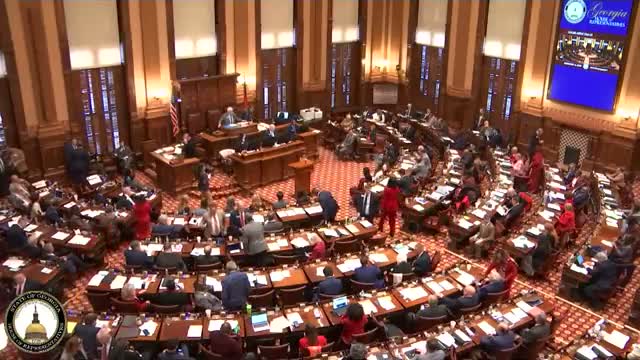
The Georgia House approved an amended fiscal year 2026 budget on Feb. 5, passing House Bill 973 after committee-of-the-whole consideration and floor action.
Chairman Hatchett, chair of the Appropriations Committee, presented the amended budget and said revised revenue estimates and surplus funds allowed new investments while maintaining structural balance. He told members the plan raises the revised revenue estimate to $42.3 billion and reallocates $850 million to a homeowner tax relief grant program. "This grant will reduce next year's tax bills for homeowners and we will continue to work to eliminate property taxes on your home," Hatchett said.
The budget includes a one-time $2,000 salary supplement to full-time regular state employees and school personnel, targeted capital investments (including $29.8 million to create a new College of Optometry at Georgia Southern University and $27 million for design and construction of a regional mental health hospital), and a $220 million cash investment for a private prison expansion that the chair said will add 480 beds without increasing baseline capacity. The package also earmarks transportation projects, including $1.7 billion for the I-75 express lanes expansion and additional funds for local bridge and road projects.
Members asked targeted questions about funding for HBCUs, the scope of school staff supplements, and early care funding; Hatchett answered that several items are one-time allocations and that base-budget changes would be considered in the subsequent fiscal year. Chairlady Dempsey seconded the committee’s motion on the floor and urged support: "I rise to second the motion ... to support this budget that is built with fidelity that each of us should be very proud to support."
The committee substitute was adopted, the House ordered the previous question, and the clerk announced the roll-call result: yeas 167, nays 5. The bill having received the requisite constitutional majority was declared passed and was ordered immediately transmitted to the Senate.
Next steps: The bill was passed by the House and transmitted to the Senate as recorded on the floor; any Senate amendments or the conference process were not reflected in the House transcript.
Chairman Hatchett, chair of the Appropriations Committee, presented the amended budget and said revised revenue estimates and surplus funds allowed new investments while maintaining structural balance. He told members the plan raises the revised revenue estimate to $42.3 billion and reallocates $850 million to a homeowner tax relief grant program. "This grant will reduce next year's tax bills for homeowners and we will continue to work to eliminate property taxes on your home," Hatchett said.
The budget includes a one-time $2,000 salary supplement to full-time regular state employees and school personnel, targeted capital investments (including $29.8 million to create a new College of Optometry at Georgia Southern University and $27 million for design and construction of a regional mental health hospital), and a $220 million cash investment for a private prison expansion that the chair said will add 480 beds without increasing baseline capacity. The package also earmarks transportation projects, including $1.7 billion for the I-75 express lanes expansion and additional funds for local bridge and road projects.
Members asked targeted questions about funding for HBCUs, the scope of school staff supplements, and early care funding; Hatchett answered that several items are one-time allocations and that base-budget changes would be considered in the subsequent fiscal year. Chairlady Dempsey seconded the committee’s motion on the floor and urged support: "I rise to second the motion ... to support this budget that is built with fidelity that each of us should be very proud to support."
The committee substitute was adopted, the House ordered the previous question, and the clerk announced the roll-call result: yeas 167, nays 5. The bill having received the requisite constitutional majority was declared passed and was ordered immediately transmitted to the Senate.
Next steps: The bill was passed by the House and transmitted to the Senate as recorded on the floor; any Senate amendments or the conference process were not reflected in the House transcript.
Don't Miss a Word: See the Full Meeting!
Go beyond summaries. Unlock every video, transcript, and key insight with a Founder Membership.
✓
Get instant access to full meeting videos
✓
Search and clip any phrase from complete transcripts
✓
Receive AI-powered summaries & custom alerts
✓
Enjoy lifetime, unrestricted access to government data
30-day money-back guarantee
