Committee reviews $829.7 million DAIL budget, flags heavy reliance on Global Commitment/Medicaid
February 05, 2026 | Human Services, HOUSE OF REPRESENTATIVES, Committees, Legislative , Vermont
This article was created by AI summarizing key points discussed. AI makes mistakes, so for full details and context, please refer to the video of the full meeting. Please report any errors so we can fix them. Report an error »
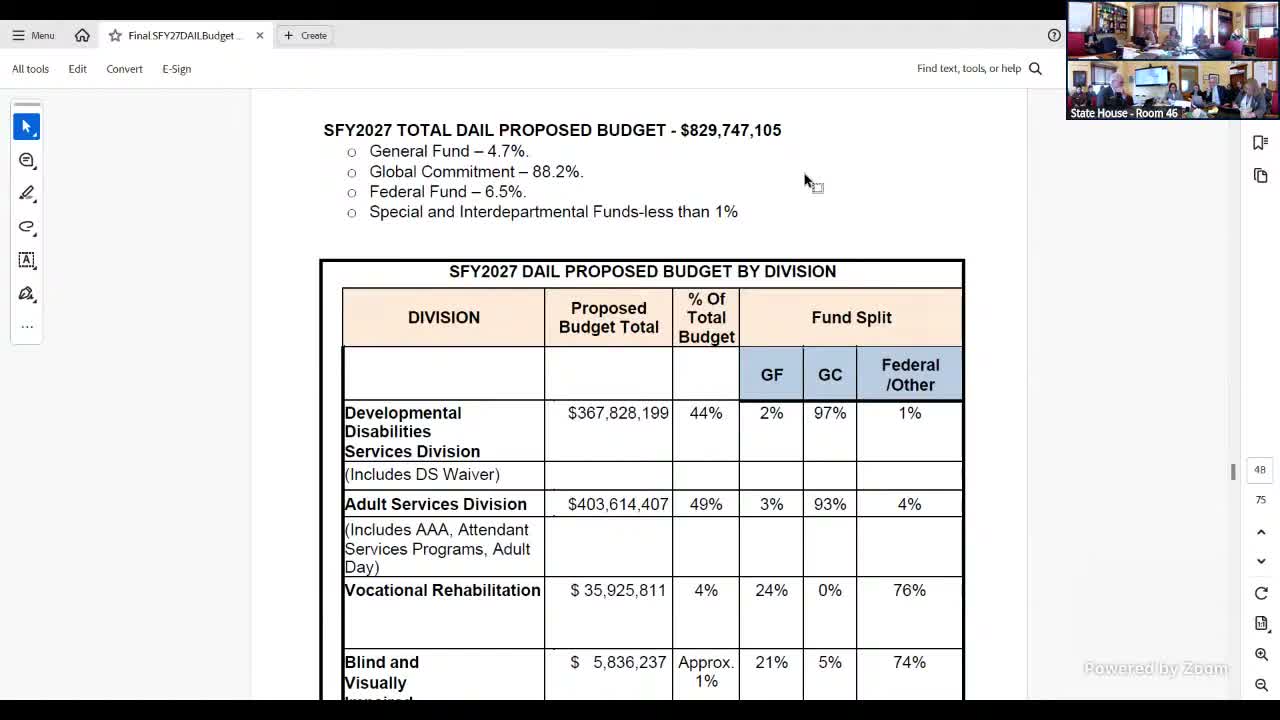
The House committee spent its morning examining the Department of Disabilities, Aging, and Independent Living’s (DAIL) proposed FY27 budget of $829,747,105, with members stressing how heavily the department depends on Global Commitment (the Medicaid financing vehicle) and other federal funds.
DAIL staff presented a fund-source breakdown showing 88.2% of the budget under Global Commitment, 6.5% federal funds, 4.7% general fund and under 1% special and interdepartmental funds. "When you lose a dollar of general fund in this program, you are often losing $3," Speaker 2 told the committee, underscoring how state decisions can cascade through federal matching dollars.
The department outlined major program totals: developmental disability services just under $368 million (about 44% of DAIL’s total, with roughly 97% of that line from Global Commitment), the adult services division at $403,614,407 (about 49% of DAIL, 93% Global Commitment), vocational rehabilitation (HireAbility) at just under $36 million (roughly 76% federal, 24% general fund), a blind and visually impaired line near $6 million and a licensing and protection line under $8 million. The commissioner’s office was shown at about $8.5 million and chiefly supported from general fund.
Staff walked members through technical changes between FY26 and FY27, including a $31,346,555 net increase departmentwide and several budget-to-actual reconciliations that adjust spending authority without creating new program money. For example, the adult services division shows a budget-to-actuals reconciliation of about $3.35 million; staff described that as aligning spending authority with federal receipts rather than new appropriation.
Committee members also pressed staff about staffing counts. After an initial back-and-forth, Speaker 4 corrected earlier testimony and said the change from last year to this year is an increase of eight limited-service positions tied to specific grants and programs (including positions related to Money Follows the Person and VR counseling). Staff emphasized these are largely limited-service hires and do not represent a large new ongoing baseline.
The committee closed by noting available program-level data in the packet (program descriptions, populations served and performance measures) and setting a timetable: budget teams will make recommendations to the full appropriations committee, and members aim to complete recommendations by February.
Next steps: budget teams will follow up with suggested community partners to testify and the committee will continue its deliberations at subsequent sessions.
DAIL staff presented a fund-source breakdown showing 88.2% of the budget under Global Commitment, 6.5% federal funds, 4.7% general fund and under 1% special and interdepartmental funds. "When you lose a dollar of general fund in this program, you are often losing $3," Speaker 2 told the committee, underscoring how state decisions can cascade through federal matching dollars.
The department outlined major program totals: developmental disability services just under $368 million (about 44% of DAIL’s total, with roughly 97% of that line from Global Commitment), the adult services division at $403,614,407 (about 49% of DAIL, 93% Global Commitment), vocational rehabilitation (HireAbility) at just under $36 million (roughly 76% federal, 24% general fund), a blind and visually impaired line near $6 million and a licensing and protection line under $8 million. The commissioner’s office was shown at about $8.5 million and chiefly supported from general fund.
Staff walked members through technical changes between FY26 and FY27, including a $31,346,555 net increase departmentwide and several budget-to-actual reconciliations that adjust spending authority without creating new program money. For example, the adult services division shows a budget-to-actuals reconciliation of about $3.35 million; staff described that as aligning spending authority with federal receipts rather than new appropriation.
Committee members also pressed staff about staffing counts. After an initial back-and-forth, Speaker 4 corrected earlier testimony and said the change from last year to this year is an increase of eight limited-service positions tied to specific grants and programs (including positions related to Money Follows the Person and VR counseling). Staff emphasized these are largely limited-service hires and do not represent a large new ongoing baseline.
The committee closed by noting available program-level data in the packet (program descriptions, populations served and performance measures) and setting a timetable: budget teams will make recommendations to the full appropriations committee, and members aim to complete recommendations by February.
Next steps: budget teams will follow up with suggested community partners to testify and the committee will continue its deliberations at subsequent sessions.
View the Full Meeting & All Its Details
This article offers just a summary. Unlock complete video, transcripts, and insights as a Founder Member.
✓
Watch full, unedited meeting videos
✓
Search every word spoken in unlimited transcripts
✓
AI summaries & real-time alerts (all government levels)
✓
Permanent access to expanding government content
30-day money-back guarantee
