Massachusetts and Nova Scotia sign MOU to cooperate on Atlantic offshore wind
February 05, 2026 | Office of the Governor, Executive , Massachusetts
This article was created by AI summarizing key points discussed. AI makes mistakes, so for full details and context, please refer to the video of the full meeting. Please report any errors so we can fix them. Report an error »
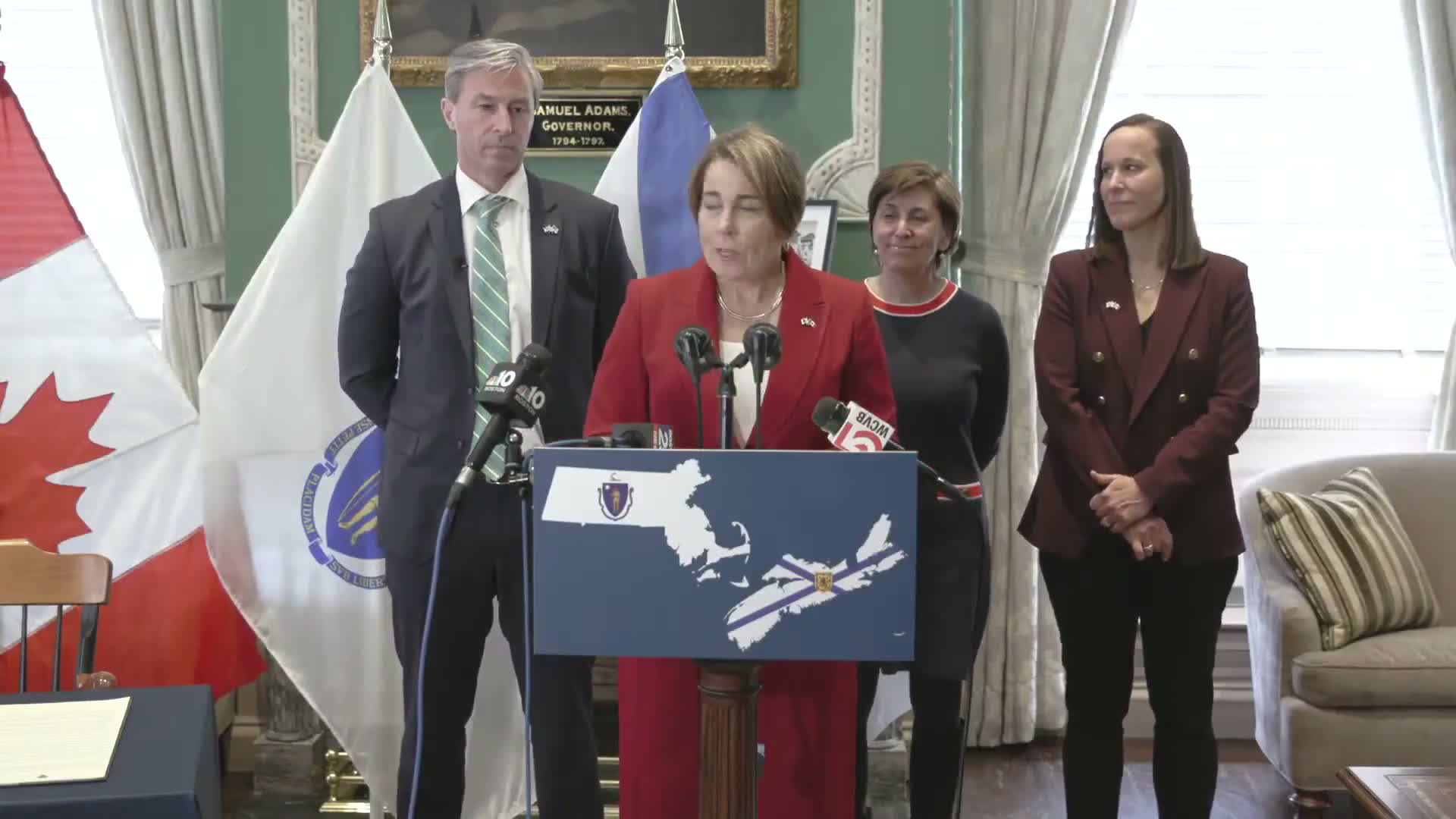
The governor of Massachusetts and Premier Tim Houston of Nova Scotia signed a memorandum of understanding in Massachusetts to advance offshore wind in the Atlantic, officials said at a joint event. The governor said the agreement will guide development strategies on transmission, supply‑chain coordination and workforce planning across the region.
"We join today with Premier Houston to sign a memorandum of understanding between Massachusetts and Nova Scotia to advance offshore wind power in the Atlantic," the governor said, describing the pact as a way to increase supply, lower costs and bring economic development to port communities.
Premier Tim Houston, speaking for Nova Scotia, emphasized the province's offshore potential, saying Nova Scotia uses roughly 2 gigawatts at peak demand but that its offshore resources could produce "40, 50, 60 gigawatts," creating surplus energy for export if transmission can be routed to markets. "We'll have a lot of excess energy," Premier Houston said, and the MOU will start formal talks about market assessment, feasibility and routing.
Rebecca Tepper, Massachusetts' secretary of energy and environmental affairs, said teams from both governments will form workgroups to address the issues outlined in the MOU and "report back to both energy secretaries." Tepper also cited Vineyard Wind as an example of the state's offshore work, saying, "Vineyard Wind performed very well this winter," and adding that additional similar projects would have reduced prices and supported reliability.
The governor linked the MOU to a broader state strategy. He described an "all‑of‑the‑above" energy approach involving wind, solar, hydro, nuclear, gas and storage, and said he is pressing the legislature to pass an energy affordability bill he characterized as "$13,000,000,000 in savings." He said teams will explore bulk purchasing and other procurement strategies alongside renewable deployment.
Organizers said the MOU does not set specific procurement volumes. Secretary Tepper said there is "no specific amount" yet for how much energy Massachusetts would procure from Nova Scotia; determining availability and timelines is a stated goal of the workgroups. The MOU sets a framework for technical collaboration, transmission studies and supply‑chain coordination rather than immediate project approvals.
Participants completed a formal signing and photographed the delegation after the remarks. The officials said next steps include staff‑level workgroups that will provide recommendations to energy leadership in both jurisdictions.
The event included references to long‑standing ties between Massachusetts and Nova Scotia, including historic mutual aid after the 1917 Halifax explosion and recent mutual assistance following a Gloucester fishing‑vessel loss. Canadian consul general Bernadette Jordan attended, and Massachusetts officials named several staff who will participate in implementation discussions.
"We join today with Premier Houston to sign a memorandum of understanding between Massachusetts and Nova Scotia to advance offshore wind power in the Atlantic," the governor said, describing the pact as a way to increase supply, lower costs and bring economic development to port communities.
Premier Tim Houston, speaking for Nova Scotia, emphasized the province's offshore potential, saying Nova Scotia uses roughly 2 gigawatts at peak demand but that its offshore resources could produce "40, 50, 60 gigawatts," creating surplus energy for export if transmission can be routed to markets. "We'll have a lot of excess energy," Premier Houston said, and the MOU will start formal talks about market assessment, feasibility and routing.
Rebecca Tepper, Massachusetts' secretary of energy and environmental affairs, said teams from both governments will form workgroups to address the issues outlined in the MOU and "report back to both energy secretaries." Tepper also cited Vineyard Wind as an example of the state's offshore work, saying, "Vineyard Wind performed very well this winter," and adding that additional similar projects would have reduced prices and supported reliability.
The governor linked the MOU to a broader state strategy. He described an "all‑of‑the‑above" energy approach involving wind, solar, hydro, nuclear, gas and storage, and said he is pressing the legislature to pass an energy affordability bill he characterized as "$13,000,000,000 in savings." He said teams will explore bulk purchasing and other procurement strategies alongside renewable deployment.
Organizers said the MOU does not set specific procurement volumes. Secretary Tepper said there is "no specific amount" yet for how much energy Massachusetts would procure from Nova Scotia; determining availability and timelines is a stated goal of the workgroups. The MOU sets a framework for technical collaboration, transmission studies and supply‑chain coordination rather than immediate project approvals.
Participants completed a formal signing and photographed the delegation after the remarks. The officials said next steps include staff‑level workgroups that will provide recommendations to energy leadership in both jurisdictions.
The event included references to long‑standing ties between Massachusetts and Nova Scotia, including historic mutual aid after the 1917 Halifax explosion and recent mutual assistance following a Gloucester fishing‑vessel loss. Canadian consul general Bernadette Jordan attended, and Massachusetts officials named several staff who will participate in implementation discussions.
View the Full Meeting & All Its Details
This article offers just a summary. Unlock complete video, transcripts, and insights as a Founder Member.
✓
Watch full, unedited meeting videos
✓
Search every word spoken in unlimited transcripts
✓
AI summaries & real-time alerts (all government levels)
✓
Permanent access to expanding government content
30-day money-back guarantee
