Briefing outlines three common career and technical education operation models and tuition issues
February 05, 2026 | Education, SENATE, Committees, Legislative , Vermont
This article was created by AI summarizing key points discussed. AI makes mistakes, so for full details and context, please refer to the video of the full meeting. Please report any errors so we can fix them. Report an error »
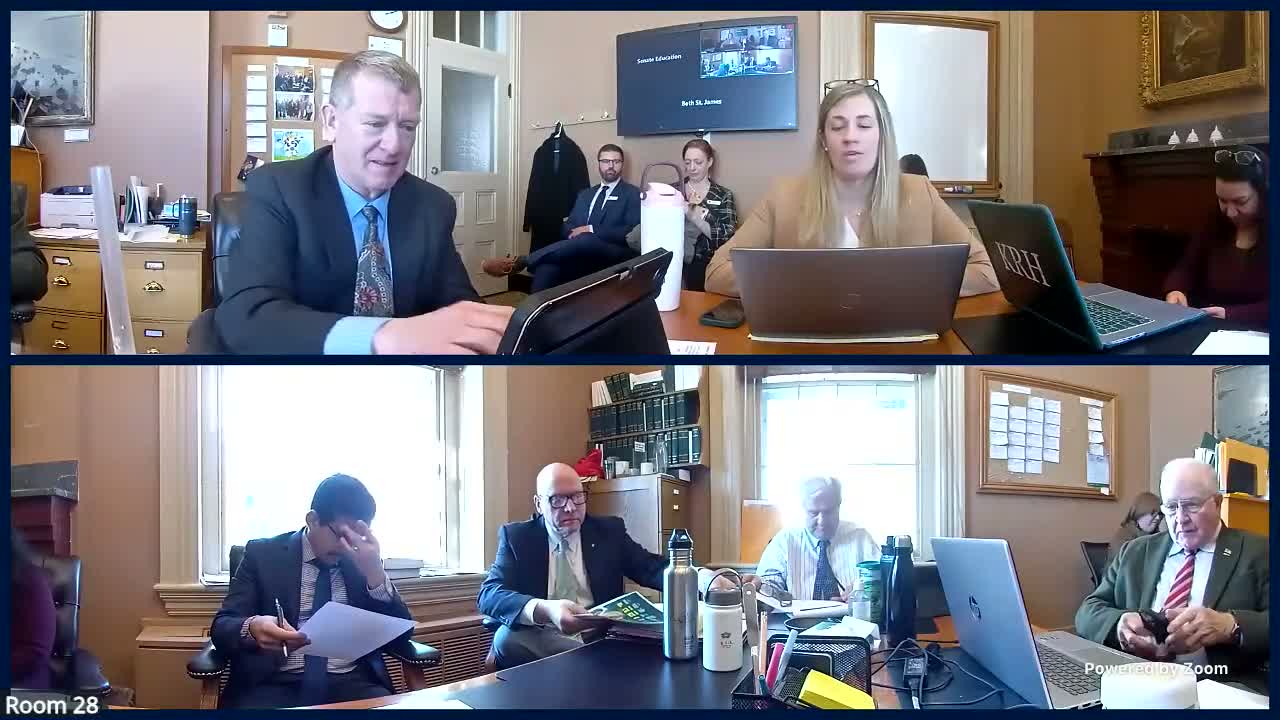
On Feb. 5 the committee heard a detailed primer on how Vermont’s career and technical education (CTE) programs are organized and funded.
An unidentified presenter told the committee the most common model is a CTE center run by a local school board, with a required regional advisory board that advises on programming. The presenter described two other models: comprehensive high schools that include CTE programming (including a small number of independently operated schools) and regional career and technical center school districts that function like standalone districts but do not add taxing capacity.
"The most common operation model is a center operated by a local school board," the presenter said, and added that regional advisory boards have a consultation role while tuition for CTE centers is set under state board rule.
The presenter reviewed relevant law in Title 16, chapter 37, noting that regional CTE districts adopt budgets and then calculate each member district’s share pursuant to the tuition statute; upon notice, that share becomes a legal obligation of the member district without a voter referendum. The briefing also covered part-time proration rules and state-board calculations used to set CTE tuition.
Speaker and committee members raised access concerns: the presenter described Section 18 of last year’s Act 72, which allows secondary students to apply to programs outside their assigned service region when a program is unavailable locally and clarified that sending districts remain responsible for tuition under an agreement. The presenter confirmed that a regional CTE vendor may provide transportation to and from programs, language intended to reduce barriers for students who otherwise face long commutes or wait lists.
Members questioned why per-pupil tuition at some CTE centers can exceed the district net cost per pupil; the presenter explained that the state-board formula and rolling averages intended to smooth costs can, in low-enrollment centers, yield higher apparent per-pupil figures until enrollment changes register in the multi-year calculation.
The presenter offered to share maps and modeling overlays (commute patterns and slot availability) and recommended follow-up with the Agency of Education for technical implementation questions. The committee did not adopt policy at the briefing; members requested further data and possible return testimony.
An unidentified presenter told the committee the most common model is a CTE center run by a local school board, with a required regional advisory board that advises on programming. The presenter described two other models: comprehensive high schools that include CTE programming (including a small number of independently operated schools) and regional career and technical center school districts that function like standalone districts but do not add taxing capacity.
"The most common operation model is a center operated by a local school board," the presenter said, and added that regional advisory boards have a consultation role while tuition for CTE centers is set under state board rule.
The presenter reviewed relevant law in Title 16, chapter 37, noting that regional CTE districts adopt budgets and then calculate each member district’s share pursuant to the tuition statute; upon notice, that share becomes a legal obligation of the member district without a voter referendum. The briefing also covered part-time proration rules and state-board calculations used to set CTE tuition.
Speaker and committee members raised access concerns: the presenter described Section 18 of last year’s Act 72, which allows secondary students to apply to programs outside their assigned service region when a program is unavailable locally and clarified that sending districts remain responsible for tuition under an agreement. The presenter confirmed that a regional CTE vendor may provide transportation to and from programs, language intended to reduce barriers for students who otherwise face long commutes or wait lists.
Members questioned why per-pupil tuition at some CTE centers can exceed the district net cost per pupil; the presenter explained that the state-board formula and rolling averages intended to smooth costs can, in low-enrollment centers, yield higher apparent per-pupil figures until enrollment changes register in the multi-year calculation.
The presenter offered to share maps and modeling overlays (commute patterns and slot availability) and recommended follow-up with the Agency of Education for technical implementation questions. The committee did not adopt policy at the briefing; members requested further data and possible return testimony.
View the Full Meeting & All Its Details
This article offers just a summary. Unlock complete video, transcripts, and insights as a Founder Member.
✓
Watch full, unedited meeting videos
✓
Search every word spoken in unlimited transcripts
✓
AI summaries & real-time alerts (all government levels)
✓
Permanent access to expanding government content
30-day money-back guarantee
