Cleveland committee hears financial case for closing Burke Lakefront Airport
February 05, 2026 | Cleveland, Cuyahoga County, Ohio
This article was created by AI summarizing key points discussed. AI makes mistakes, so for full details and context, please refer to the video of the full meeting. Please report any errors so we can fix them. Report an error »
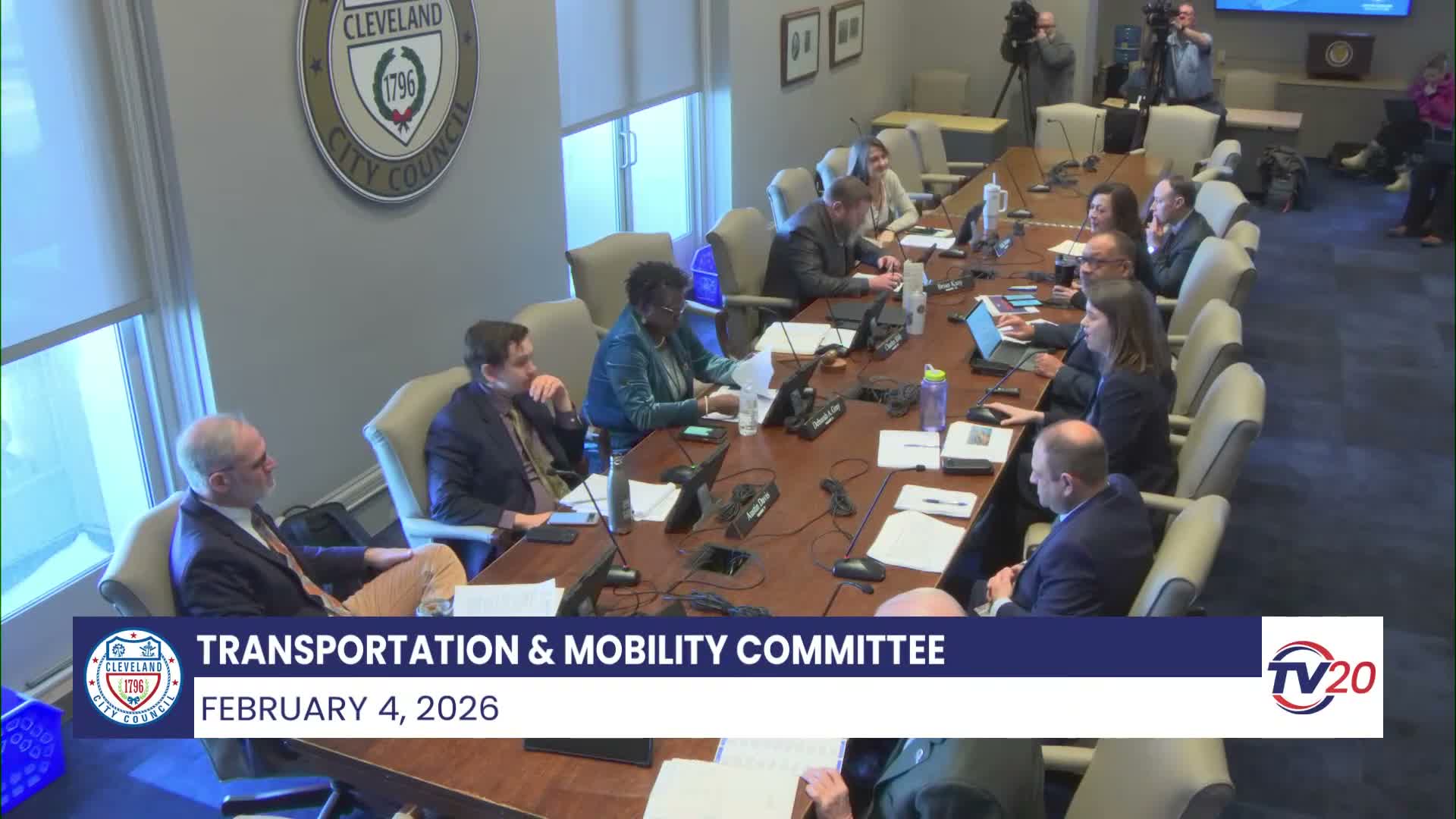
At a Transportation and Mobility Committee hearing, city finance and port‑control officials laid out the operational and budgetary picture for Burke Lakefront Airport and the potential financial implications of closing and redeveloping the 450‑acre site.
Jessica Trevazzano, deputy chief of staff and chief strategy officer for the city, told the committee the presentation was meant to ground future decisions in "a clear fact based understanding of the legal, financial, operational, and market realities associated with Burke Lakefront Airport" and noted the FAA forecasts continued declines in operations through 2050.
Bryant Francis, director of port control, and Christine Gilmartin, assistant director of finance and procurement for port control, said Burke averages about 40,000 aircraft operations per year (peaking in the late 1990s), houses 15 tenants (roughly half non‑aviation), and has limited developable acreage because most of the 450 acres are airfield. "Most of our leases are 1 to 2 year terms," Francis said, and Gilmartin added that parking is the airport’s main revenue stream.
Gilmartin summarized Burke’s budget history: "Since 2006, the average operating deficit has been approximately $900,000. Burke has maintained an operating deficit every single year going back 20 plus years." She said the 2025 deficit was about $1,700,000, driven in part by an unforeseen underground water leak and a $320,000 HVAC control system replacement.
Finance director Paul Barrett presented two analyses of the city’s direct revenue exposure: a third‑party economic‑impact study that estimated roughly $500,000 annually in income, property and parking taxes tied to Burke (with about $250,000 of that likely retained by the city), and the finance office’s own, more conservative estimate that direct net impact to the city would be closer to $200,000 annually. Barrett said, depending on assumptions, the permanent direct impact could range "between $50,000 and $100,000 annually."
Tre vazzano described higher‑impact redevelopment scenarios generated by the administration’s planning work: a low‑intensity (park/green space) scenario with an estimated ~$400,000 in direct tax benefit and a mixed‑use scenario with an estimated ~$3.3 million in direct tax benefit. She said the administration expects outcomes between those two extremes and is focused on public access, financial viability, and private financing options where possible.
On stakeholder positions, Tre vazzano told the committee staff had briefed the city’s signatory airlines and "have consensus from all of them that if Burke was to close, they would not be opposed." Francis added staff had "very positive conversations" with the carriers and that airlines saw potential benefit in shifting the financial burden tied to Burke off their books.
Committee members pressed staff for more granular cost and subsidy estimates: how much public subsidy a redevelopment would require, where break‑even points lie, the square footage and lease expirations for hangars and terminal tenants, and whether the county airport could absorb displaced operations. Staff said many of those questions will be addressed in later hearings focused on regulatory closure pathways and detailed market and engineering studies.
Council members also questioned the consequences for events and parking revenue tied to downtown activity. The administration said special events (including Rock Hall inductions and other summers events) account for spikes in parking revenue and that the airshow’s ticket revenue does not accrue to the city (the organization is tax‑exempt); staff estimated airshow‑related parking tax at roughly $15,000–$30,000.
Officials emphasized the financial model for the airport system: port control operates as a fully residual enterprise model in which signatory airlines take on remaining costs after non‑airline revenues (parking, concessions) are applied. "None of the funds are city funds," Gilmartin said, noting the airport system does not draw on the general fund for Burke’s deficits.
Next steps: the chair reminded the committee this is the first in a series of hearings; the regulatory process for closure will be heard April 1, and a meeting on April 15 will address market absorption and redevelopment specifics. Staff offered to arrange site tours in March for council members.
Ending: Committee members agreed they will need detailed cost estimates, lease inventories, and redevelopment scenarios before any vote; no legislation to close Burke was before the committee at the hearing and no formal vote on closure occurred.
Jessica Trevazzano, deputy chief of staff and chief strategy officer for the city, told the committee the presentation was meant to ground future decisions in "a clear fact based understanding of the legal, financial, operational, and market realities associated with Burke Lakefront Airport" and noted the FAA forecasts continued declines in operations through 2050.
Bryant Francis, director of port control, and Christine Gilmartin, assistant director of finance and procurement for port control, said Burke averages about 40,000 aircraft operations per year (peaking in the late 1990s), houses 15 tenants (roughly half non‑aviation), and has limited developable acreage because most of the 450 acres are airfield. "Most of our leases are 1 to 2 year terms," Francis said, and Gilmartin added that parking is the airport’s main revenue stream.
Gilmartin summarized Burke’s budget history: "Since 2006, the average operating deficit has been approximately $900,000. Burke has maintained an operating deficit every single year going back 20 plus years." She said the 2025 deficit was about $1,700,000, driven in part by an unforeseen underground water leak and a $320,000 HVAC control system replacement.
Finance director Paul Barrett presented two analyses of the city’s direct revenue exposure: a third‑party economic‑impact study that estimated roughly $500,000 annually in income, property and parking taxes tied to Burke (with about $250,000 of that likely retained by the city), and the finance office’s own, more conservative estimate that direct net impact to the city would be closer to $200,000 annually. Barrett said, depending on assumptions, the permanent direct impact could range "between $50,000 and $100,000 annually."
Tre vazzano described higher‑impact redevelopment scenarios generated by the administration’s planning work: a low‑intensity (park/green space) scenario with an estimated ~$400,000 in direct tax benefit and a mixed‑use scenario with an estimated ~$3.3 million in direct tax benefit. She said the administration expects outcomes between those two extremes and is focused on public access, financial viability, and private financing options where possible.
On stakeholder positions, Tre vazzano told the committee staff had briefed the city’s signatory airlines and "have consensus from all of them that if Burke was to close, they would not be opposed." Francis added staff had "very positive conversations" with the carriers and that airlines saw potential benefit in shifting the financial burden tied to Burke off their books.
Committee members pressed staff for more granular cost and subsidy estimates: how much public subsidy a redevelopment would require, where break‑even points lie, the square footage and lease expirations for hangars and terminal tenants, and whether the county airport could absorb displaced operations. Staff said many of those questions will be addressed in later hearings focused on regulatory closure pathways and detailed market and engineering studies.
Council members also questioned the consequences for events and parking revenue tied to downtown activity. The administration said special events (including Rock Hall inductions and other summers events) account for spikes in parking revenue and that the airshow’s ticket revenue does not accrue to the city (the organization is tax‑exempt); staff estimated airshow‑related parking tax at roughly $15,000–$30,000.
Officials emphasized the financial model for the airport system: port control operates as a fully residual enterprise model in which signatory airlines take on remaining costs after non‑airline revenues (parking, concessions) are applied. "None of the funds are city funds," Gilmartin said, noting the airport system does not draw on the general fund for Burke’s deficits.
Next steps: the chair reminded the committee this is the first in a series of hearings; the regulatory process for closure will be heard April 1, and a meeting on April 15 will address market absorption and redevelopment specifics. Staff offered to arrange site tours in March for council members.
Ending: Committee members agreed they will need detailed cost estimates, lease inventories, and redevelopment scenarios before any vote; no legislation to close Burke was before the committee at the hearing and no formal vote on closure occurred.
View the Full Meeting & All Its Details
This article offers just a summary. Unlock complete video, transcripts, and insights as a Founder Member.
✓
Watch full, unedited meeting videos
✓
Search every word spoken in unlimited transcripts
✓
AI summaries & real-time alerts (all government levels)
✓
Permanent access to expanding government content
30-day money-back guarantee
