County team proposes signature‑pad pilot to cut printing and speed in‑person signings
February 05, 2026 | Franklin County, Pennsylvania
This article was created by AI summarizing key points discussed. AI makes mistakes, so for full details and context, please refer to the video of the full meeting. Please report any errors so we can fix them. Report an error »
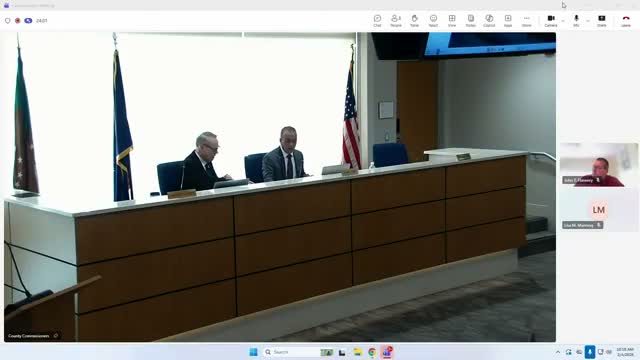
A team from the county's 2025 leadership development program presented a proposal to adopt signature pads for in‑person signing to reduce printing, shredding and staff time.
Ashley Meisner (Domestic Relations), Christina Hawkins (Children and Youth) and Daphne Blair (as recorded) said they surveyed departments and found more than half of staff still print documents to obtain signatures; about one‑fifth of those printed documents were shredded, and staff report spending about an hour and a half per week on printing, scanning and tracking signatures. "More than half of staff still print documents just to get a signature," the presenters said.
Presenters demonstrated a signature pad that plugs in via USB, provides a natural signing experience with a stylus, works with Word, Excel and PDF files and is HIPAA compliant for sensitive information. They contrasted the pad with Adobe Sign, noting Adobe Sign is well suited for remote and multi‑party workflows but can carry higher licensing and per‑transaction costs and requires reliable internet access.
On cost and deployment, presenters said pads come with bundled software and estimated a one‑time hardware cost of about $130–$140 per pad. They suggested starting with a small number of units—presenters said an aging‑services team would like 10 units but the recommendation was to begin with four and share units across field staff as needed. Presenters estimated that, based on printing and shredding costs and staff time, the pads could pay for themselves within about six months compared with continuing paper processes or using Adobe Sign at higher annual licensing costs.
Commissioners asked detailed questions about upfront costs, compatibility, additional software needs, how many devices would be needed and the return on investment. Presenters said no additional software purchase would be necessary because the pad includes required software and that the devices are USB and portable for field staff use. One commissioner cautioned that residual paper retention and archival practices could add costs and emphasized a need to consider long‑term storage and records management as the county transitions.
The commission did not take a vote on the proposal during this meeting; staff were asked to continue planning and provide implementation details, cost estimates and an evaluation plan.
Ashley Meisner (Domestic Relations), Christina Hawkins (Children and Youth) and Daphne Blair (as recorded) said they surveyed departments and found more than half of staff still print documents to obtain signatures; about one‑fifth of those printed documents were shredded, and staff report spending about an hour and a half per week on printing, scanning and tracking signatures. "More than half of staff still print documents just to get a signature," the presenters said.
Presenters demonstrated a signature pad that plugs in via USB, provides a natural signing experience with a stylus, works with Word, Excel and PDF files and is HIPAA compliant for sensitive information. They contrasted the pad with Adobe Sign, noting Adobe Sign is well suited for remote and multi‑party workflows but can carry higher licensing and per‑transaction costs and requires reliable internet access.
On cost and deployment, presenters said pads come with bundled software and estimated a one‑time hardware cost of about $130–$140 per pad. They suggested starting with a small number of units—presenters said an aging‑services team would like 10 units but the recommendation was to begin with four and share units across field staff as needed. Presenters estimated that, based on printing and shredding costs and staff time, the pads could pay for themselves within about six months compared with continuing paper processes or using Adobe Sign at higher annual licensing costs.
Commissioners asked detailed questions about upfront costs, compatibility, additional software needs, how many devices would be needed and the return on investment. Presenters said no additional software purchase would be necessary because the pad includes required software and that the devices are USB and portable for field staff use. One commissioner cautioned that residual paper retention and archival practices could add costs and emphasized a need to consider long‑term storage and records management as the county transitions.
The commission did not take a vote on the proposal during this meeting; staff were asked to continue planning and provide implementation details, cost estimates and an evaluation plan.
View the Full Meeting & All Its Details
This article offers just a summary. Unlock complete video, transcripts, and insights as a Founder Member.
✓
Watch full, unedited meeting videos
✓
Search every word spoken in unlimited transcripts
✓
AI summaries & real-time alerts (all government levels)
✓
Permanent access to expanding government content
30-day money-back guarantee
