State historic preservation office updates underwater-preserve program, warns of safety and access concerns
February 05, 2026 | Corrections & Institutions, HOUSE OF REPRESENTATIVES, Committees, Legislative , Vermont
This article was created by AI summarizing key points discussed. AI makes mistakes, so for full details and context, please refer to the video of the full meeting. Please report any errors so we can fix them. Report an error »
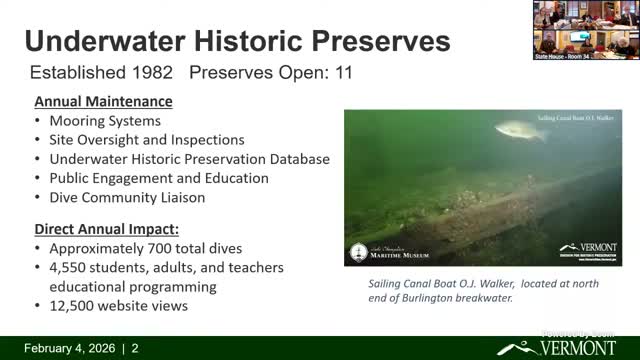
Laura Trishman, the state historic preservation officer, updated the House Corrections and Institutions Committee on the Division for Historic Preservation's underwater-preserves program on Feb. 4. "This was established in 1982," she said, and described a program that funds mooring systems, site inspections, a preservation database, outreach and community liaisons to manage growing public interest and protect submerged cultural resources.
Trishman told lawmakers the program has expanded to 11 preserves that are open annually and that the program supports about 700 dives a year plus educational outreach to roughly 4,500 students and teachers. She said the division also offers non-diving educational resources, including 3D models of wrecks and online materials, that reach broad audiences beyond divers.
Committee members pressed Trishman on how climate conditions affect access. In response she said drought has made some wrecks more accessible, increasing both recreational visits and the risk to fragile sites. Trishman noted the division funds repairs and replacement of moorings, buoy systems and signage and works with the Lake Champlain Maritime Museum on stewardship: the museum receives subgrant funding and acts as the maritime archives that manages public visits.
Trishman also said the state owns artifacts lying on the lakebed on the Vermont side and that federal support has helped expand the program; she cited a U.S. maritime grant supporting work on the Providence Island Canal site and said one newly listed underwater site is being added to the National Register of Historic Places. She warned that easier access can prompt illegal souvenir-taking and underscored coordination with the U.S. Coast Guard and local authorities to ensure diver safety.
The committee discussed modest budget adjustments identified in the governor's proposal, including a recommendation to reclaim $31,000 from older accounts for unmarked-burial work while preserving about $50,000 to cover ongoing program needs. Trishman characterized the change as part of routine fund management rather than a new spending request.
Trishman told lawmakers the program has expanded to 11 preserves that are open annually and that the program supports about 700 dives a year plus educational outreach to roughly 4,500 students and teachers. She said the division also offers non-diving educational resources, including 3D models of wrecks and online materials, that reach broad audiences beyond divers.
Committee members pressed Trishman on how climate conditions affect access. In response she said drought has made some wrecks more accessible, increasing both recreational visits and the risk to fragile sites. Trishman noted the division funds repairs and replacement of moorings, buoy systems and signage and works with the Lake Champlain Maritime Museum on stewardship: the museum receives subgrant funding and acts as the maritime archives that manages public visits.
Trishman also said the state owns artifacts lying on the lakebed on the Vermont side and that federal support has helped expand the program; she cited a U.S. maritime grant supporting work on the Providence Island Canal site and said one newly listed underwater site is being added to the National Register of Historic Places. She warned that easier access can prompt illegal souvenir-taking and underscored coordination with the U.S. Coast Guard and local authorities to ensure diver safety.
The committee discussed modest budget adjustments identified in the governor's proposal, including a recommendation to reclaim $31,000 from older accounts for unmarked-burial work while preserving about $50,000 to cover ongoing program needs. Trishman characterized the change as part of routine fund management rather than a new spending request.
Don't Miss a Word: See the Full Meeting!
Go beyond summaries. Unlock every video, transcript, and key insight with a Founder Membership.
✓
Get instant access to full meeting videos
✓
Search and clip any phrase from complete transcripts
✓
Receive AI-powered summaries & custom alerts
✓
Enjoy lifetime, unrestricted access to government data
30-day money-back guarantee
