Committee questions value of supervisory fees as DOC data show low recovery, asks for budget impact
February 05, 2026 | Corrections & Institutions, HOUSE OF REPRESENTATIVES, Committees, Legislative , Vermont
This article was created by AI summarizing key points discussed. AI makes mistakes, so for full details and context, please refer to the video of the full meeting. Please report any errors so we can fix them. Report an error »
The House Corrections and Institutions Committee on Feb. 4 debated H.B. 635, a bill that would repeal supervisory fees charged to people under supervision and wipe outstanding balances.
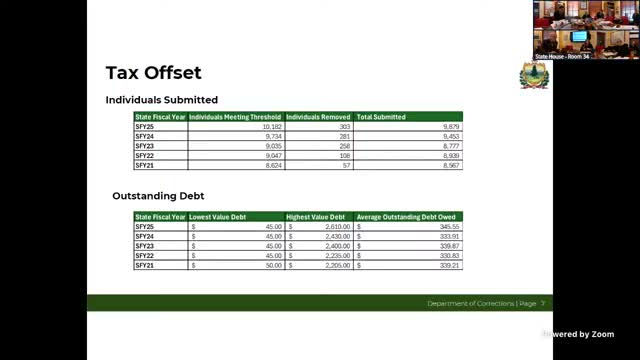
Deputy Commissioner Kristin Calvert of the Department of Corrections told the committee the department submits a yearly certification to the state tax office for a tax‑offset program that targets individuals 90 or more days in arrears and owing at least $45. Calvert said DOC reported 9,879 people meeting that threshold in fiscal 2025 and described data‑quality limits that force DOC to remove records with missing or incorrect dates of birth or Social Security numbers.
Committee members pressed Calvert on how money is collected and how much is actually recovered. Calvert said offsets apply to tax refunds and that other obligations (child support, property taxes) generally take priority; she added DOC has roughly $3.5 million in accumulated supervisory‑fee debt but annual net collections have declined in recent years. DOC also estimated about $50,000 in on‑account payments that would be refunded if the state forgave outstanding fees.
Members raised both practical and philosophical objections to the fee. Several argued supervision is a state service and charging people for basic supervision risks harming reentry prospects — for example, by adding to DMV reinstatement obligations that can block employment and transportation. One committee member (Speaker 8) said, in describing the accounts receivable, “I would bet everything I have on the fact that we are never gonna receive the 3 and a half made up,” arguing the outstanding balance is unlikely to be collected.
Calvert described administrative costs and recent investments: DOC added an electronic payment portal under a statewide contract (pay‑by‑use), which increased operating costs; DOC said those portal costs are assessed by usage and that eliminating the fee would remove the portal costs but not necessarily reduce full‑time staffing because staff perform other duties. DOC provided an estimate that allocating staff time to the fee program amounted to roughly $540,000 in general fund staff time (an allocation estimate across central business office staff, probation and parole officers, and administrators).
On statutory authority and fee history, Calvert said state law allows the commissioner to collect up to $30 per month and that the current $15 assessment dates to administrative practice beginning around 2007. The bill language discussed would affirm that failure to pay supervisory fees is not a condition of release and would direct DOC to cease collection methods such as tax set‑off and wage garnishment if the bill becomes law.
Committee members asked for a delayed effective date so agencies could operationalize a forgiveness process and to reduce immediate budget disruption. The committee agreed to seek a fiscal analysis from budget staff (questions were assigned to committee members Kevin and Sean) on the revenue loss the POC budget would face; members proposed moving the bill’s effective date to July 1 of a later fiscal year to allow planning. The committee deferred final action on H.B. 635 until it receives that budget impact information.
The committee record shows the administration did not include repeal language in the governor’s recommended budget and therefore is not taking an official supportive position, though DOC offered to provide the committee with additional details to aid deliberation.
Next steps: the committee will receive the requested fiscal analysis and revisit the effective date and operational questions before taking further action on H.B. 635.
Deputy Commissioner Kristin Calvert of the Department of Corrections told the committee the department submits a yearly certification to the state tax office for a tax‑offset program that targets individuals 90 or more days in arrears and owing at least $45. Calvert said DOC reported 9,879 people meeting that threshold in fiscal 2025 and described data‑quality limits that force DOC to remove records with missing or incorrect dates of birth or Social Security numbers.
Committee members pressed Calvert on how money is collected and how much is actually recovered. Calvert said offsets apply to tax refunds and that other obligations (child support, property taxes) generally take priority; she added DOC has roughly $3.5 million in accumulated supervisory‑fee debt but annual net collections have declined in recent years. DOC also estimated about $50,000 in on‑account payments that would be refunded if the state forgave outstanding fees.
Members raised both practical and philosophical objections to the fee. Several argued supervision is a state service and charging people for basic supervision risks harming reentry prospects — for example, by adding to DMV reinstatement obligations that can block employment and transportation. One committee member (Speaker 8) said, in describing the accounts receivable, “I would bet everything I have on the fact that we are never gonna receive the 3 and a half made up,” arguing the outstanding balance is unlikely to be collected.
Calvert described administrative costs and recent investments: DOC added an electronic payment portal under a statewide contract (pay‑by‑use), which increased operating costs; DOC said those portal costs are assessed by usage and that eliminating the fee would remove the portal costs but not necessarily reduce full‑time staffing because staff perform other duties. DOC provided an estimate that allocating staff time to the fee program amounted to roughly $540,000 in general fund staff time (an allocation estimate across central business office staff, probation and parole officers, and administrators).
On statutory authority and fee history, Calvert said state law allows the commissioner to collect up to $30 per month and that the current $15 assessment dates to administrative practice beginning around 2007. The bill language discussed would affirm that failure to pay supervisory fees is not a condition of release and would direct DOC to cease collection methods such as tax set‑off and wage garnishment if the bill becomes law.
Committee members asked for a delayed effective date so agencies could operationalize a forgiveness process and to reduce immediate budget disruption. The committee agreed to seek a fiscal analysis from budget staff (questions were assigned to committee members Kevin and Sean) on the revenue loss the POC budget would face; members proposed moving the bill’s effective date to July 1 of a later fiscal year to allow planning. The committee deferred final action on H.B. 635 until it receives that budget impact information.
The committee record shows the administration did not include repeal language in the governor’s recommended budget and therefore is not taking an official supportive position, though DOC offered to provide the committee with additional details to aid deliberation.
Next steps: the committee will receive the requested fiscal analysis and revisit the effective date and operational questions before taking further action on H.B. 635.
Don't Miss a Word: See the Full Meeting!
Go beyond summaries. Unlock every video, transcript, and key insight with a Founder Membership.
✓
Get instant access to full meeting videos
✓
Search and clip any phrase from complete transcripts
✓
Receive AI-powered summaries & custom alerts
✓
Enjoy lifetime, unrestricted access to government data
30-day money-back guarantee
