State police and prosecutor urge licensure to curb illicit massage parlors and protect victims
February 05, 2026 | Government Operations & Military Affairs, HOUSE OF REPRESENTATIVES, Committees, Legislative , Vermont
This article was created by AI summarizing key points discussed. AI makes mistakes, so for full details and context, please refer to the video of the full meeting. Please report any errors so we can fix them. Report an error »
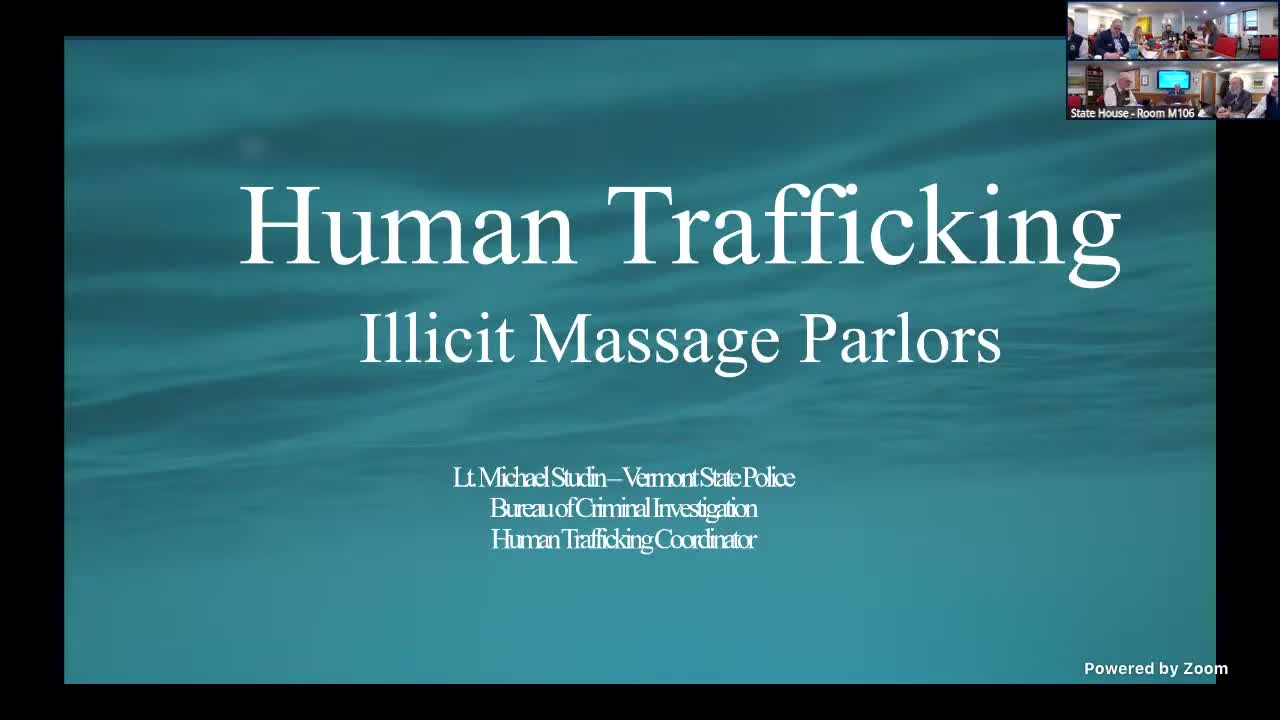
Montpelier — State police and a county prosecutor told the Government Operations & Military Affairs Committee on Feb. 4 that illicit massage establishments in Vermont operate as organized, cash-driven enterprises that frequently exploit female workers and that licensure of massage professionals and businesses would give regulators a practical way to hold operators accountable.
Lieutenant Michael Steuben of the Vermont State Police’s Bureau of Criminal Investigation described the parlors’ common features — blacked‑out storefronts, cropped advertising photos and a reliance on seclusion and privacy — and outlined the business model, victim profile and enforcement obstacles. "They're extremely profitable," Steuben said, and he estimated that a smaller parlor could take in "over a half million dollars" in cash. He told the committee most workers he encounters are Chinese and Korean women who face language barriers, live in crowded employer‑provided housing, and may be tightly controlled by operators.
The testimony underscored prosecution hurdles. Steuben said victims often move or disappear before cases can be developed and that current regulatory and licensing systems place the onus on individual workers rather than on the businesses that run the operations. "We're trying not to penalize the victims for the crimes that they're asked to commit," he said, explaining that many investigations founder without cooperating witnesses.
Wyndham County State's Attorney Steve Brown told the committee his office views the women in these investigations as victims and warned that criminal cases are costly and often impractical to pursue. "This is a really important bill, and I think this bill will enhance public safety," Brown said, arguing that licensure would allow background checks and provide an administrative means to shut down or sanction illegitimate businesses. He contrasted H588, described to the committee as a registration approach, with H623, which would create licensure and inspection powers.
Committee members pressed for specifics on how licensure would be enforced and whether licensing would allow regulators to verify that all employees working in a licensed facility are themselves licensed. Brown and Steuben said licensure would simplify enforcement by giving regulators a clear standard to inspect and a complaint‑driven path to investigate businesses rather than relying on lengthy undercover operations. Steuben noted existing investigative barriers including language obstacles and the high cost of long undercover investigations.
Committee members also raised victim‑support questions. Witnesses said law enforcement attempts to connect victims to services but cautioned that confinement, debt for transportation and living fees, and lack of options make exit difficult. Steuben described transportation costs for some workers as "$400, $600" that workers may be required to pay or work off.
The committee did not take a vote on either bill during the session. Chair (Speaker 1) paused the meeting to reconvene at 10:00 a.m. for the next agenda item.
Next steps: The committee indicated it will continue reviewing language in H588 and H623, consult with the Secretary of State's Office and OPR about regulatory mechanics, and seek clarity on enforcement provisions before further action.
Lieutenant Michael Steuben of the Vermont State Police’s Bureau of Criminal Investigation described the parlors’ common features — blacked‑out storefronts, cropped advertising photos and a reliance on seclusion and privacy — and outlined the business model, victim profile and enforcement obstacles. "They're extremely profitable," Steuben said, and he estimated that a smaller parlor could take in "over a half million dollars" in cash. He told the committee most workers he encounters are Chinese and Korean women who face language barriers, live in crowded employer‑provided housing, and may be tightly controlled by operators.
The testimony underscored prosecution hurdles. Steuben said victims often move or disappear before cases can be developed and that current regulatory and licensing systems place the onus on individual workers rather than on the businesses that run the operations. "We're trying not to penalize the victims for the crimes that they're asked to commit," he said, explaining that many investigations founder without cooperating witnesses.
Wyndham County State's Attorney Steve Brown told the committee his office views the women in these investigations as victims and warned that criminal cases are costly and often impractical to pursue. "This is a really important bill, and I think this bill will enhance public safety," Brown said, arguing that licensure would allow background checks and provide an administrative means to shut down or sanction illegitimate businesses. He contrasted H588, described to the committee as a registration approach, with H623, which would create licensure and inspection powers.
Committee members pressed for specifics on how licensure would be enforced and whether licensing would allow regulators to verify that all employees working in a licensed facility are themselves licensed. Brown and Steuben said licensure would simplify enforcement by giving regulators a clear standard to inspect and a complaint‑driven path to investigate businesses rather than relying on lengthy undercover operations. Steuben noted existing investigative barriers including language obstacles and the high cost of long undercover investigations.
Committee members also raised victim‑support questions. Witnesses said law enforcement attempts to connect victims to services but cautioned that confinement, debt for transportation and living fees, and lack of options make exit difficult. Steuben described transportation costs for some workers as "$400, $600" that workers may be required to pay or work off.
The committee did not take a vote on either bill during the session. Chair (Speaker 1) paused the meeting to reconvene at 10:00 a.m. for the next agenda item.
Next steps: The committee indicated it will continue reviewing language in H588 and H623, consult with the Secretary of State's Office and OPR about regulatory mechanics, and seek clarity on enforcement provisions before further action.
View the Full Meeting & All Its Details
This article offers just a summary. Unlock complete video, transcripts, and insights as a Founder Member.
✓
Watch full, unedited meeting videos
✓
Search every word spoken in unlimited transcripts
✓
AI summaries & real-time alerts (all government levels)
✓
Permanent access to expanding government content
30-day money-back guarantee
