Stephen Banks, mayor's nominee for corporation counsel, pledges review of cases and to defend council as members press him on staffing, shelter lawsuits and 9/
February 05, 2026 | New York City Council, New York City, New York County, New York
This article was created by AI summarizing key points discussed. AI makes mistakes, so for full details and context, please refer to the video of the full meeting. Please report any errors so we can fix them. Report an error »
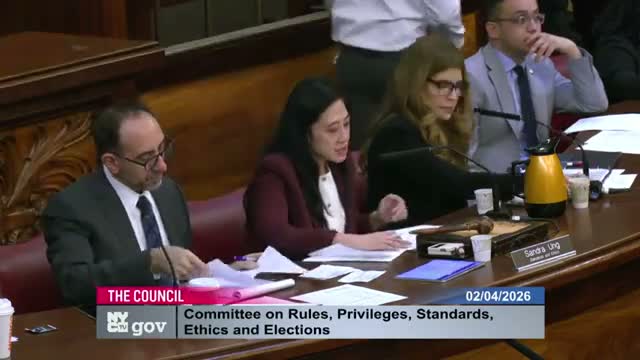
Stephen Banks, the mayor’s nominee for New York City corporation counsel, told the City Council committee that if confirmed he will be “the lawyer for the City of New York,” oversee a review of outstanding representations and records, and work with elected officials and the administration to rebuild a depleted law department.
Banks made the comments during a public confirmation hearing before the City Council Committee on Rules, Privileges, Elections, Standards and Ethics. Committee members pressed him on a range of issues including staffing shortfalls in the law department, the city’s litigation stance on the CityFEPs shelter and rental-assistance litigation, the representation of a former mayoral aide in civil suits, the status of 9/11‑era records, and the balance between the law department’s obligations to the mayor and to the council.
Banks outlined his career in public-interest law and city government and framed his approach as fidelity to the rule of law. “I’m the lawyer for the City of New York, not the lawyer for the mayor, not the lawyer for any particular elected official,” he said. He emphasized early engagement with council sponsors and agencies, risk mitigation to reduce judgments and claims, and a staffing review to determine where additional attorneys are most needed. The committee was told the law department comprises roughly 850 attorneys; Banks said he would work with the mayor on phased hiring while acknowledging the city’s reported fiscal constraints.
On specific controversies, Banks committed to reviewing the law department’s representation decisions. When asked about ongoing civil suits that reportedly have cost more than $620,000 in outside counsel fees, he said, “I will be reviewing that kind of representation,” and promised a follow-up with the council. On the CityFEPs litigation over the council’s 2023 package of homelessness and rental‑assistance laws, Banks — who helped design the program when he was a commissioner — said the administration is seeking a negotiated settlement that preserves program goals while addressing fiscal concerns.
Members pressed Banks on release of 9/11‑era files. He said his office will “review what records there are and release what records can be released,” while noting privacy and legal limits on certain documents. He also pledged that the law department would continue to defend the city’s sanctuary laws: “I’m going to work to continue to defend the law that was enacted by the council,” he said.
Supporters appeared during the public testimony portion. Twila Carter, chief executive of the Legal Aid Society, told the committee Banks’ record makes him a fitting choice and urged him to enforce the CityFEPs expansion and other rights‑protecting measures. Bridal McGuire, a WilmerHale partner and former chief counsel to the mayor, praised Banks’ combination of advocacy and pragmatism. A public commenter later alleged litigation misconduct involving Banks and said he had filed a motion in Federal court; the committee proceeded to close public testimony after standard procedural reminders.
The hearing included lengthy exchanges about attorney‑client confidentiality and whether the law department should seek court intervention before challenged local laws take effect. Banks said ethical screens and confidentiality are central, but added that some tools — such as temporary restraining orders — might sometimes be appropriate to avoid protracted litigation. He also agreed with council members that the mayor’s use of emergency executive powers should be rare and narrowly tailored.
The committee did not vote during this hearing. Members repeatedly asked for follow‑up on staffing plans, the review of specific representations, and the law department’s plan for early review of substantive council bills. Banks repeatedly pledged to be accessible to members and to make decisions after review rather than offer preemptive commitments in public testimony.
The hearing’s next steps are procedural: the committee may schedule additional follow‑up or markups and the council will decide whether to provide advice and consent on the nomination in a subsequent proceeding.
Banks made the comments during a public confirmation hearing before the City Council Committee on Rules, Privileges, Elections, Standards and Ethics. Committee members pressed him on a range of issues including staffing shortfalls in the law department, the city’s litigation stance on the CityFEPs shelter and rental-assistance litigation, the representation of a former mayoral aide in civil suits, the status of 9/11‑era records, and the balance between the law department’s obligations to the mayor and to the council.
Banks outlined his career in public-interest law and city government and framed his approach as fidelity to the rule of law. “I’m the lawyer for the City of New York, not the lawyer for the mayor, not the lawyer for any particular elected official,” he said. He emphasized early engagement with council sponsors and agencies, risk mitigation to reduce judgments and claims, and a staffing review to determine where additional attorneys are most needed. The committee was told the law department comprises roughly 850 attorneys; Banks said he would work with the mayor on phased hiring while acknowledging the city’s reported fiscal constraints.
On specific controversies, Banks committed to reviewing the law department’s representation decisions. When asked about ongoing civil suits that reportedly have cost more than $620,000 in outside counsel fees, he said, “I will be reviewing that kind of representation,” and promised a follow-up with the council. On the CityFEPs litigation over the council’s 2023 package of homelessness and rental‑assistance laws, Banks — who helped design the program when he was a commissioner — said the administration is seeking a negotiated settlement that preserves program goals while addressing fiscal concerns.
Members pressed Banks on release of 9/11‑era files. He said his office will “review what records there are and release what records can be released,” while noting privacy and legal limits on certain documents. He also pledged that the law department would continue to defend the city’s sanctuary laws: “I’m going to work to continue to defend the law that was enacted by the council,” he said.
Supporters appeared during the public testimony portion. Twila Carter, chief executive of the Legal Aid Society, told the committee Banks’ record makes him a fitting choice and urged him to enforce the CityFEPs expansion and other rights‑protecting measures. Bridal McGuire, a WilmerHale partner and former chief counsel to the mayor, praised Banks’ combination of advocacy and pragmatism. A public commenter later alleged litigation misconduct involving Banks and said he had filed a motion in Federal court; the committee proceeded to close public testimony after standard procedural reminders.
The hearing included lengthy exchanges about attorney‑client confidentiality and whether the law department should seek court intervention before challenged local laws take effect. Banks said ethical screens and confidentiality are central, but added that some tools — such as temporary restraining orders — might sometimes be appropriate to avoid protracted litigation. He also agreed with council members that the mayor’s use of emergency executive powers should be rare and narrowly tailored.
The committee did not vote during this hearing. Members repeatedly asked for follow‑up on staffing plans, the review of specific representations, and the law department’s plan for early review of substantive council bills. Banks repeatedly pledged to be accessible to members and to make decisions after review rather than offer preemptive commitments in public testimony.
The hearing’s next steps are procedural: the committee may schedule additional follow‑up or markups and the council will decide whether to provide advice and consent on the nomination in a subsequent proceeding.
View the Full Meeting & All Its Details
This article offers just a summary. Unlock complete video, transcripts, and insights as a Founder Member.
✓
Watch full, unedited meeting videos
✓
Search every word spoken in unlimited transcripts
✓
AI summaries & real-time alerts (all government levels)
✓
Permanent access to expanding government content
30-day money-back guarantee
