Bridgeport operations committee weighs asking city and state for $44 million; staff outlines $61 million original request
February 05, 2026 | Bridgeport School District, School Districts, Connecticut
This article was created by AI summarizing key points discussed. AI makes mistakes, so for full details and context, please refer to the video of the full meeting. Please report any errors so we can fix them. Report an error »
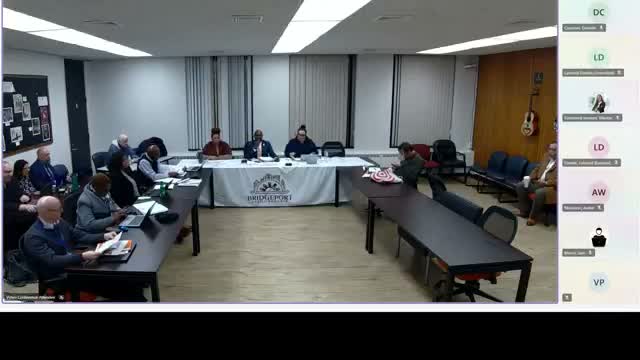
The Bridgeport School District operations committee met Feb. 4 to review options for the fiscal year 2026–27 budget and to set a recommendation for the full board. Staff walked members through an initial superintendent request of about $61.6 million in additional needs and the adjustments—both one‑time and recurring—that produced the staff recommendation of a $44 million ask.
Why it matters: The committee must choose how aggressively to pursue additional city and state funding. Board members pressed staff for precise dollar tags for rehiring and program restorations and voiced competing strategies: pursue the smaller, more defensible number recommended by staff, or seek the larger ask to restore positions and programs cut in earlier years.
Finance staff presented the budget drivers behind the $61.6 million figure and the specific steps used to reduce it. Staff identified a mix of recurring cost increases (transportation, utilities, out‑of‑district tuition, software) and increased compensation and benefits as major components. A notable element is the use of internal service fund (ISF) balances and timing differences in reimbursements: "one of the big ones being the use of internal service fund surplus fund of 9,500,000.0," staff said, noting that such uses are nonrecurring.
Staff also described how changes in health‑insurance assumptions affected the total. The budget was drafted with a 20% health‑insurance increase assumption, later revised to a 14% estimate using an actuarial vendor; staff said that reduction in the assumed rate lowered the projected cost by several million dollars. Nestor, the district finance staff member who led the walkthrough, summarized the grant‑to‑operating impacts: grant‑funded staff who receive raises and higher benefits next year would add roughly $5.9 million to the operating budget if grants remain flat.
To move from the $61.6 million starting point to the recommended $44 million staff proposal, the district identified roughly $17.5 million in reductions and offsets, including professional‑learning cuts, attrition savings, deferred reimbursement timing, and other operational savings. Staff emphasized that some of the reductions are one‑time or contingent; members repeatedly pressed for reconciliations and documentation. "We're not allowed to run a deficit at the end of this year," staff cautioned when describing use of ISF resources.
Board members focused on how much of the principals' $8 million add‑on (assistant principals, counselors, social workers, multilingual supports) should be included in the official ask. Staff confirmed those items appear in the packet (page 26) and are included in the $61 million scenario but not in the $44 million scenario; several members asked staff to return with a position‑by‑position price list by Monday so the board could pick specific priorities. "There's always going to be negotiations, and you're always gonna settle somewhere below," a board member said as they argued for seeking the higher number in order to restore librarians, guidance counselors and other positions.
Members also debated advocacy strategy. Some urged presenting a realistic, aligned ask tied to measurable district goals; others favored asking for a larger, aspirational amount to signal priorities at the city and state level. The committee agreed to finalize recommendations for both the city ask and the full‑board presentation on Monday.
Procedural actions: The committee approved the Jan. 22 minutes at the start of the meeting by voice vote. At the end, members moved to adjourn; the motion passed and the meeting closed with next steps assigned to staff to provide costed options and reconciliations.
What happens next: Staff committed to provide a reconciled ISF report, a priced list of positions and scenarios (including alternative, larger 'ambitious' asks) and updated packet materials to support a board recommendation at the full meeting scheduled for Monday. The committee will present a city ask and a state advocacy position based on that final recommendation.
Why it matters: The committee must choose how aggressively to pursue additional city and state funding. Board members pressed staff for precise dollar tags for rehiring and program restorations and voiced competing strategies: pursue the smaller, more defensible number recommended by staff, or seek the larger ask to restore positions and programs cut in earlier years.
Finance staff presented the budget drivers behind the $61.6 million figure and the specific steps used to reduce it. Staff identified a mix of recurring cost increases (transportation, utilities, out‑of‑district tuition, software) and increased compensation and benefits as major components. A notable element is the use of internal service fund (ISF) balances and timing differences in reimbursements: "one of the big ones being the use of internal service fund surplus fund of 9,500,000.0," staff said, noting that such uses are nonrecurring.
Staff also described how changes in health‑insurance assumptions affected the total. The budget was drafted with a 20% health‑insurance increase assumption, later revised to a 14% estimate using an actuarial vendor; staff said that reduction in the assumed rate lowered the projected cost by several million dollars. Nestor, the district finance staff member who led the walkthrough, summarized the grant‑to‑operating impacts: grant‑funded staff who receive raises and higher benefits next year would add roughly $5.9 million to the operating budget if grants remain flat.
To move from the $61.6 million starting point to the recommended $44 million staff proposal, the district identified roughly $17.5 million in reductions and offsets, including professional‑learning cuts, attrition savings, deferred reimbursement timing, and other operational savings. Staff emphasized that some of the reductions are one‑time or contingent; members repeatedly pressed for reconciliations and documentation. "We're not allowed to run a deficit at the end of this year," staff cautioned when describing use of ISF resources.
Board members focused on how much of the principals' $8 million add‑on (assistant principals, counselors, social workers, multilingual supports) should be included in the official ask. Staff confirmed those items appear in the packet (page 26) and are included in the $61 million scenario but not in the $44 million scenario; several members asked staff to return with a position‑by‑position price list by Monday so the board could pick specific priorities. "There's always going to be negotiations, and you're always gonna settle somewhere below," a board member said as they argued for seeking the higher number in order to restore librarians, guidance counselors and other positions.
Members also debated advocacy strategy. Some urged presenting a realistic, aligned ask tied to measurable district goals; others favored asking for a larger, aspirational amount to signal priorities at the city and state level. The committee agreed to finalize recommendations for both the city ask and the full‑board presentation on Monday.
Procedural actions: The committee approved the Jan. 22 minutes at the start of the meeting by voice vote. At the end, members moved to adjourn; the motion passed and the meeting closed with next steps assigned to staff to provide costed options and reconciliations.
What happens next: Staff committed to provide a reconciled ISF report, a priced list of positions and scenarios (including alternative, larger 'ambitious' asks) and updated packet materials to support a board recommendation at the full meeting scheduled for Monday. The committee will present a city ask and a state advocacy position based on that final recommendation.
View the Full Meeting & All Its Details
This article offers just a summary. Unlock complete video, transcripts, and insights as a Founder Member.
✓
Watch full, unedited meeting videos
✓
Search every word spoken in unlimited transcripts
✓
AI summaries & real-time alerts (all government levels)
✓
Permanent access to expanding government content
30-day money-back guarantee
