Vermont agency urges clearer rule language, funding and two staff to stand up H.740 greenhouse-gas reporting program
February 05, 2026 | Environment & Energy, HOUSE OF REPRESENTATIVES, Committees, Legislative , Vermont
This article was created by AI summarizing key points discussed. AI makes mistakes, so for full details and context, please refer to the video of the full meeting. Please report any errors so we can fix them. Report an error »
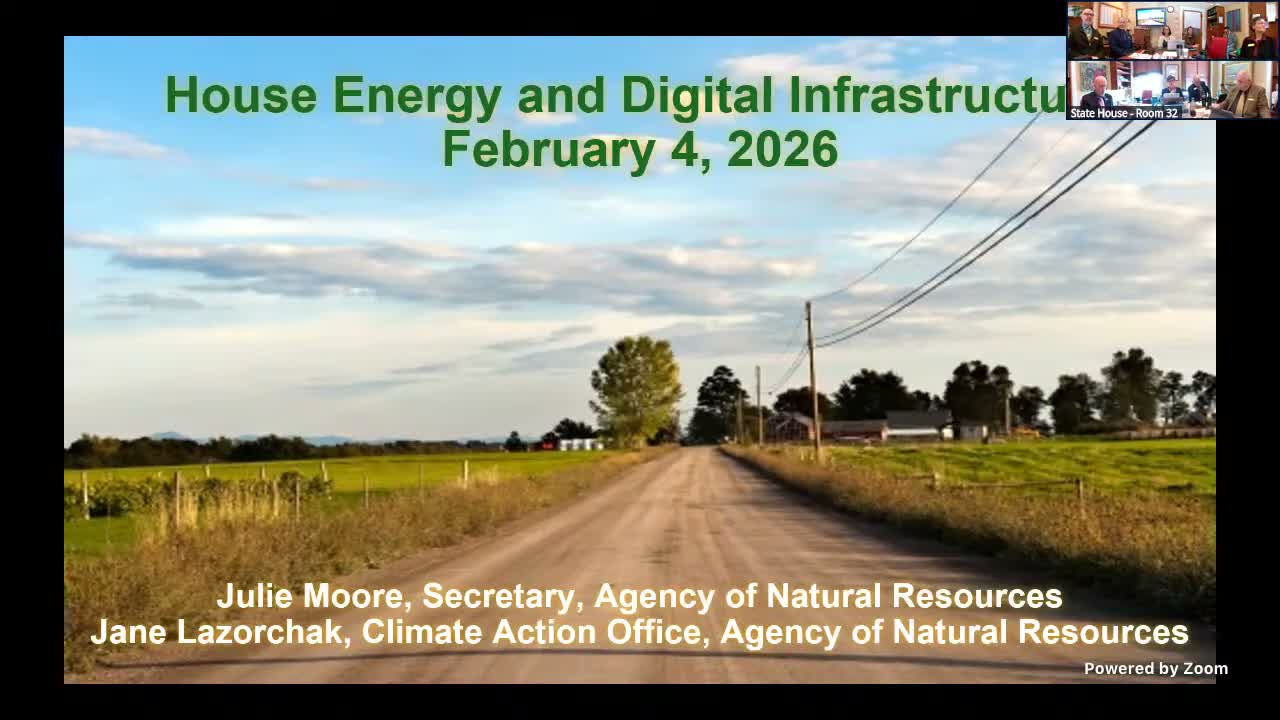
Montpelier — Officials from the Agency of Natural Resources on Wednesday told the House Energy and Digital Infrastructure committee that H.740, a bill to establish a statutory greenhouse-gas reporting program and statewide inventory, should both require rulemaking and allow the agency discretion to set de minimis thresholds.
"As drafted, I think there is concern that this would actually capture all greenhouse gas emitters, of any size and any scale," Julie Moore, secretary of the Agency of Natural Resources, said during testimony. Moore said ANR will propose language that would require the secretary to "adopt a rule that at a minimum includes" specified reporting elements, which would preserve legislative intent while allowing the agency to exclude trivial sources.
Moore and Climate Action Office staff described gaps in current data collection and what a separate reporting program would add. ANR staff said DMV and the Department of Taxes currently provide fuel-volume and vehicle data used in the inventory, but those sources typically lack detail on biofuel content and do not identify individual suppliers. "We don't actually get the who," Jean Lucercek of the Climate Action Office said, noting the new program would link emissions buckets to named suppliers when needed for future regulatory design.
The agency also outlined two possible approaches: a harmonized system that reuses DMV and tax data, or a standalone program that collects reporting directly from suppliers. ANR recommended a standalone system because tax and DMV records do not include biofuel detail and because the tax department has concerns about releasing business-identifiable data. ANR said it will continue to examine "reverse harmonization" (ANR collecting and then sharing data) but is not recommending it as the initial approach.
Thresholds for facility reporting remain unresolved. ANR staff said federal guidance and other states use different numeric cutoffs — EPA guidance often uses a 25,000 metric ton-per-year threshold while New York recently used a 10,000-metric-ton threshold for facilities — and the agency has not yet proposed a firm threshold for Vermont. Members asked ANR to invite representatives from major generators (McNeil and Ryegate) to discuss potential complications such as interactions with renewable-energy credits.
Timing and rule-review procedures also drew questions. ANR asked the committee to replace the bill's March 1, 2027 filing requirement with either a filing-with-ICAR deadline or an "adopt-by" date; ANR proposed adopting the rules by July 1, 2027. Moore said that if rules are adopted in 2027, the first reporting year would be calendar-year 2028 with reports due roughly six months into 2029, and that the rulemaking calendar must accommodate the Global Warming Solutions Act's heightened public-engagement requirements.
The agency requested recurring capacity as well as one-time funding. Moore said ANR's estimate for implementation is two full-time positions (a program manager and a compliance/data-verification specialist), about $200,000 per year in base funding for platform maintenance and verification services, and $300,000 one-time to build the digital reporting tool. "We can't enter into a contract absent having the full resources available," Moore said, urging that the bill acknowledge base funding and positions rather than rely only on one-time dollars.
Committee members expressed broad agreement on the importance of a robust inventory but questioned whether the state can identify recurring dollars this year. Representatives pressed ANR to "sharpen pencils" on what tasks could be deprioritized to free staff time, and suggested exploring automation or other efficiencies to reduce personnel needs.
ANR emphasized a measured enforcement approach: early work would focus on stakeholder engagement, building reporting relationships, and developing third-party verification; the agency does not plan formal enforcement for a number of years to allow entities time to comply.
The hearing concluded with the committee scheduling additional witnesses on the topic and taking a short break before resuming testimony.
The committee did not take a vote or adopt final language during this session. ANR said it will provide proposed bill edits and further detail on costs, thresholds and implementation in follow-up testimony.
"As drafted, I think there is concern that this would actually capture all greenhouse gas emitters, of any size and any scale," Julie Moore, secretary of the Agency of Natural Resources, said during testimony. Moore said ANR will propose language that would require the secretary to "adopt a rule that at a minimum includes" specified reporting elements, which would preserve legislative intent while allowing the agency to exclude trivial sources.
Moore and Climate Action Office staff described gaps in current data collection and what a separate reporting program would add. ANR staff said DMV and the Department of Taxes currently provide fuel-volume and vehicle data used in the inventory, but those sources typically lack detail on biofuel content and do not identify individual suppliers. "We don't actually get the who," Jean Lucercek of the Climate Action Office said, noting the new program would link emissions buckets to named suppliers when needed for future regulatory design.
The agency also outlined two possible approaches: a harmonized system that reuses DMV and tax data, or a standalone program that collects reporting directly from suppliers. ANR recommended a standalone system because tax and DMV records do not include biofuel detail and because the tax department has concerns about releasing business-identifiable data. ANR said it will continue to examine "reverse harmonization" (ANR collecting and then sharing data) but is not recommending it as the initial approach.
Thresholds for facility reporting remain unresolved. ANR staff said federal guidance and other states use different numeric cutoffs — EPA guidance often uses a 25,000 metric ton-per-year threshold while New York recently used a 10,000-metric-ton threshold for facilities — and the agency has not yet proposed a firm threshold for Vermont. Members asked ANR to invite representatives from major generators (McNeil and Ryegate) to discuss potential complications such as interactions with renewable-energy credits.
Timing and rule-review procedures also drew questions. ANR asked the committee to replace the bill's March 1, 2027 filing requirement with either a filing-with-ICAR deadline or an "adopt-by" date; ANR proposed adopting the rules by July 1, 2027. Moore said that if rules are adopted in 2027, the first reporting year would be calendar-year 2028 with reports due roughly six months into 2029, and that the rulemaking calendar must accommodate the Global Warming Solutions Act's heightened public-engagement requirements.
The agency requested recurring capacity as well as one-time funding. Moore said ANR's estimate for implementation is two full-time positions (a program manager and a compliance/data-verification specialist), about $200,000 per year in base funding for platform maintenance and verification services, and $300,000 one-time to build the digital reporting tool. "We can't enter into a contract absent having the full resources available," Moore said, urging that the bill acknowledge base funding and positions rather than rely only on one-time dollars.
Committee members expressed broad agreement on the importance of a robust inventory but questioned whether the state can identify recurring dollars this year. Representatives pressed ANR to "sharpen pencils" on what tasks could be deprioritized to free staff time, and suggested exploring automation or other efficiencies to reduce personnel needs.
ANR emphasized a measured enforcement approach: early work would focus on stakeholder engagement, building reporting relationships, and developing third-party verification; the agency does not plan formal enforcement for a number of years to allow entities time to comply.
The hearing concluded with the committee scheduling additional witnesses on the topic and taking a short break before resuming testimony.
The committee did not take a vote or adopt final language during this session. ANR said it will provide proposed bill edits and further detail on costs, thresholds and implementation in follow-up testimony.
Don't Miss a Word: See the Full Meeting!
Go beyond summaries. Unlock every video, transcript, and key insight with a Founder Membership.
✓
Get instant access to full meeting videos
✓
Search and clip any phrase from complete transcripts
✓
Receive AI-powered summaries & custom alerts
✓
Enjoy lifetime, unrestricted access to government data
30-day money-back guarantee
