DLS: Maryland’s FY27 plan narrows immediate shortfall but leaves multiyear structural gap; key fund shifts hinge on legislation
February 05, 2026 | Education, Energy, and the Environment Committee, SENATE, SENATE, Committees, Legislative, Maryland
This article was created by AI summarizing key points discussed. AI makes mistakes, so for full details and context, please refer to the video of the full meeting. Please report any errors so we can fix them. Report an error »
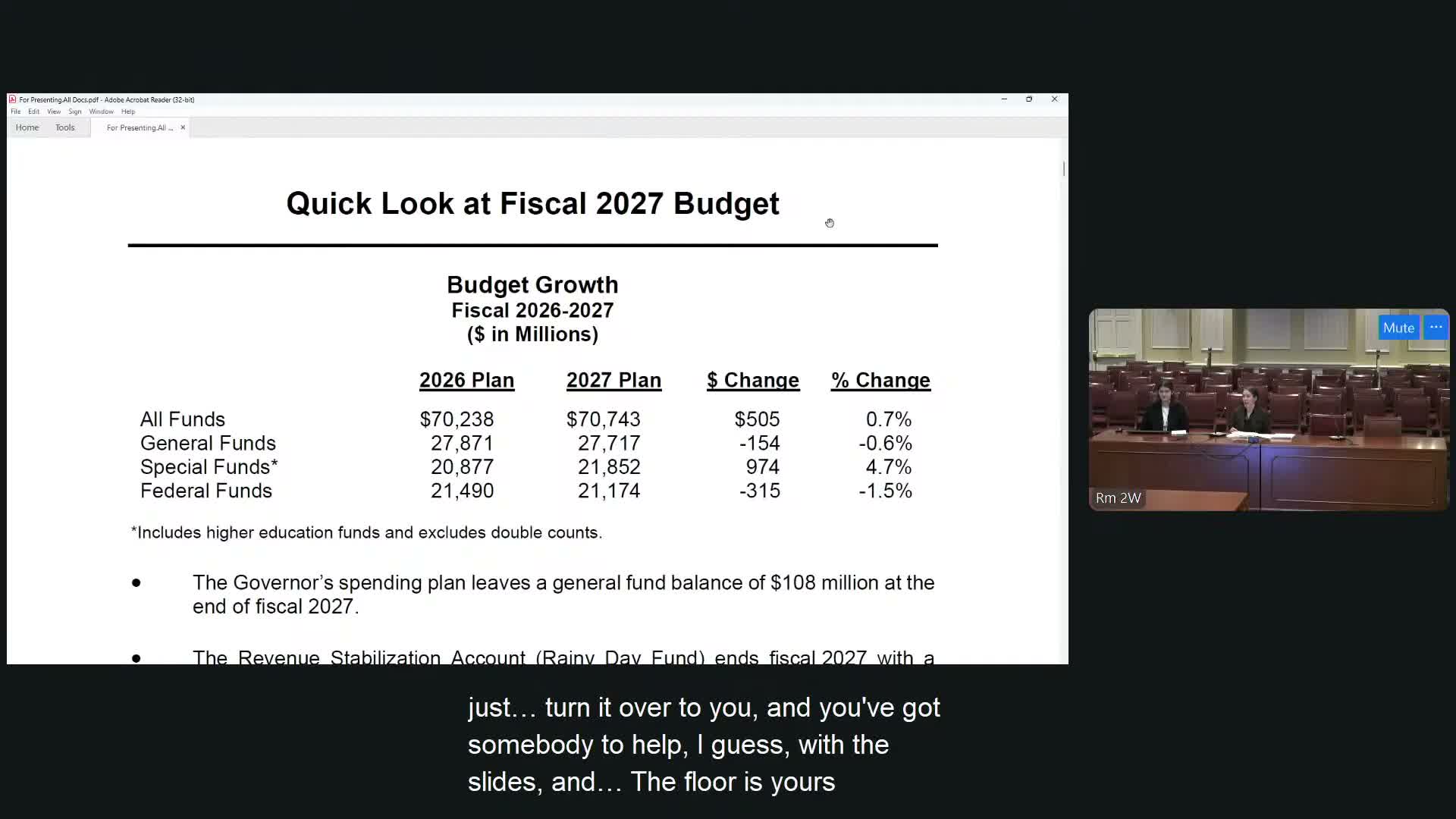
Tanya Zimmerman of the Department of Legislative Services told the committee the governor’s FY27 spending plan would increase overall spending by about $505,000,000 while general funds fall by roughly $154,000,000 and $322,000,000 of general‑fund deficiency appropriations from FY25 remain outstanding. "If you exclude that from the fiscal 2026 spending, the budget would increase by about a $168,000,000 in general funds," Zimmerman said.
Zimmerman said the administration’s plan depends on about $1,500,000,000 of adjustments that are contingent on legislation and includes about $586,000,000 of transfers to the general fund. The largest named transfers she listed were $292,000,000 from the Strategic Energy Investment Fund and $259,000,000 from the Alternative Compliance Payment account; she said roughly $70,000,000 from the Bay Restoration Fund and $13,000,000 from the Waterway Improvement Fund are being replaced with general obligation bonds.
On the expenditure side, Zimmerman's presentation identified about $593,000,000 of spending reductions contingent on enactment of the Budget Reconciliation and Financing Act (BRFA), including a $450,000,000 suspension of the required FY27 rainy day fund appropriation. She said the administration’s plan reduces the projected cash deficit but leaves a structural shortfall of roughly $394,000,000 in FY27, rising to about $2.3 billion in FY28 and exceeding $4 billion in later years.
Zimmerman also noted items that do not require legislative action but reduce spending relative to DLS’s December forecast, including about $171,000,000 related to Medicaid and behavioral health and roughly $150,000,000 of cost containment in the Developmental Disabilities Administration. "The budget also does not provide for rate increases for health or human services providers, and provides a 1.5% COLA rather than 2%," she said.
The DLS analyst warned lawmakers that some of the administration’s solutions would shift near‑term operating costs to capital financings or transfers, and that several components remain contingent on legislation. The committee did not take votes during the briefing; members asked for additional data on the sources and timing of revenue adjustments and the multiyear projections.
The panel recessed and announced a DNR briefing scheduled to follow.
Zimmerman said the administration’s plan depends on about $1,500,000,000 of adjustments that are contingent on legislation and includes about $586,000,000 of transfers to the general fund. The largest named transfers she listed were $292,000,000 from the Strategic Energy Investment Fund and $259,000,000 from the Alternative Compliance Payment account; she said roughly $70,000,000 from the Bay Restoration Fund and $13,000,000 from the Waterway Improvement Fund are being replaced with general obligation bonds.
On the expenditure side, Zimmerman's presentation identified about $593,000,000 of spending reductions contingent on enactment of the Budget Reconciliation and Financing Act (BRFA), including a $450,000,000 suspension of the required FY27 rainy day fund appropriation. She said the administration’s plan reduces the projected cash deficit but leaves a structural shortfall of roughly $394,000,000 in FY27, rising to about $2.3 billion in FY28 and exceeding $4 billion in later years.
Zimmerman also noted items that do not require legislative action but reduce spending relative to DLS’s December forecast, including about $171,000,000 related to Medicaid and behavioral health and roughly $150,000,000 of cost containment in the Developmental Disabilities Administration. "The budget also does not provide for rate increases for health or human services providers, and provides a 1.5% COLA rather than 2%," she said.
The DLS analyst warned lawmakers that some of the administration’s solutions would shift near‑term operating costs to capital financings or transfers, and that several components remain contingent on legislation. The committee did not take votes during the briefing; members asked for additional data on the sources and timing of revenue adjustments and the multiyear projections.
The panel recessed and announced a DNR briefing scheduled to follow.
View the Full Meeting & All Its Details
This article offers just a summary. Unlock complete video, transcripts, and insights as a Founder Member.
✓
Watch full, unedited meeting videos
✓
Search every word spoken in unlimited transcripts
✓
AI summaries & real-time alerts (all government levels)
✓
Permanent access to expanding government content
30-day money-back guarantee
