Maryland officials say underbuilding since 2008 created a 100,000-unit shortfall; proposals focus on zoning and permitting reforms
February 05, 2026 | Education, Energy, and the Environment Committee, SENATE, SENATE, Committees, Legislative, Maryland
This article was created by AI summarizing key points discussed. AI makes mistakes, so for full details and context, please refer to the video of the full meeting. Please report any errors so we can fix them. Report an error »
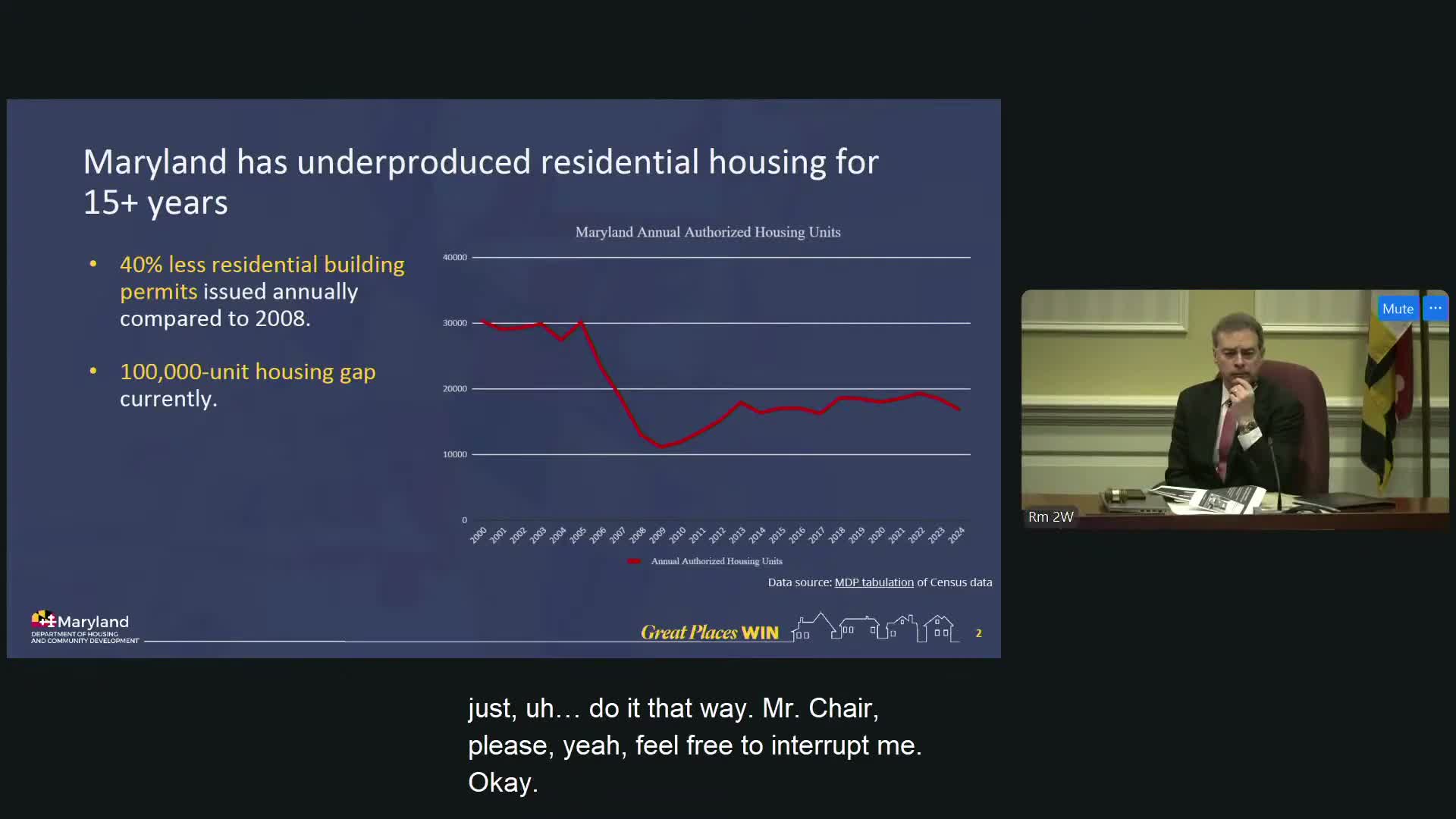
Jake Day, secretary of housing and community development, told the Education, Energy, and the Environment Committee that Maryland has not been building enough homes since the 2008 financial crisis and that the resulting shortfall has become substantial. "Compared to 2008, Maryland issues 40% less residential building permits annually," Day said, and he added that "this decline in production has contributed to a housing gap that has grown to approximately 100,000 units."
Day framed the shortage as a production problem largely within state and local control rather than an issue explainable purely by national factors. He said half of Maryland renters are "cost burdened," paying more than a third of their income for housing, and that only 49% of Maryland households could afford the state's median home price in 2022. "We are hemorrhaging people," Day said, arguing the state risks losing younger workers and the associated tax base unless housing production increases.
To address the gap, Day outlined policy levers that state and local governments can use: enabling accessory dwelling units (ADUs), revising building-code restrictions and minimum lot-size rules that prohibit historically common starter homes, allowing townhomes and other 'missing middle' housing types statewide, and aligning housing finance with permitting and land-use policy. He said federal and state subsidy tools remain critical for deep affordability—citing low-income housing tax credits, state tax-exempt bonds and subsidy programs—but that the market must also produce more smaller, lower-cost units for widespread affordability.
Day also emphasized permitting as a distinct barrier. He presented permitting timelines and examples showing typical multifamily projects take roughly 15 months to plan and permit (and 12 months to build), while in one Maryland county the planning and permitting sequence could take about 42 months. He argued that reducing approval timelines would lower soft costs and increase the number of projects that "pencil" financially, estimating that reform reducing review timelines by 25% could boost housing production by up to a third.
Committee members pressed on the practical tradeoffs and local impacts of zoning changes. Day responded that the goal is not geographic expansion into farmland or ecologically sensitive areas but enabling a broader set of housing types where housing is already zoned and infrastructure exists. He pointed to pending state bills (described in the briefing as the Starter Homes/Silver Homes Act and the Housing Certainty Act) and to a menu of reforms used by other states, including concurrent permit review, digitized application systems and allowing qualified third-party reviewers where agencies cannot meet review timelines.
The committee did not take formal votes during the briefing. The next step described by Day was further legislative work on the bills mentioned and coordination with local jurisdictions to align incentives and regulatory certainty.
Day framed the shortage as a production problem largely within state and local control rather than an issue explainable purely by national factors. He said half of Maryland renters are "cost burdened," paying more than a third of their income for housing, and that only 49% of Maryland households could afford the state's median home price in 2022. "We are hemorrhaging people," Day said, arguing the state risks losing younger workers and the associated tax base unless housing production increases.
To address the gap, Day outlined policy levers that state and local governments can use: enabling accessory dwelling units (ADUs), revising building-code restrictions and minimum lot-size rules that prohibit historically common starter homes, allowing townhomes and other 'missing middle' housing types statewide, and aligning housing finance with permitting and land-use policy. He said federal and state subsidy tools remain critical for deep affordability—citing low-income housing tax credits, state tax-exempt bonds and subsidy programs—but that the market must also produce more smaller, lower-cost units for widespread affordability.
Day also emphasized permitting as a distinct barrier. He presented permitting timelines and examples showing typical multifamily projects take roughly 15 months to plan and permit (and 12 months to build), while in one Maryland county the planning and permitting sequence could take about 42 months. He argued that reducing approval timelines would lower soft costs and increase the number of projects that "pencil" financially, estimating that reform reducing review timelines by 25% could boost housing production by up to a third.
Committee members pressed on the practical tradeoffs and local impacts of zoning changes. Day responded that the goal is not geographic expansion into farmland or ecologically sensitive areas but enabling a broader set of housing types where housing is already zoned and infrastructure exists. He pointed to pending state bills (described in the briefing as the Starter Homes/Silver Homes Act and the Housing Certainty Act) and to a menu of reforms used by other states, including concurrent permit review, digitized application systems and allowing qualified third-party reviewers where agencies cannot meet review timelines.
The committee did not take formal votes during the briefing. The next step described by Day was further legislative work on the bills mentioned and coordination with local jurisdictions to align incentives and regulatory certainty.
View the Full Meeting & All Its Details
This article offers just a summary. Unlock complete video, transcripts, and insights as a Founder Member.
✓
Watch full, unedited meeting videos
✓
Search every word spoken in unlimited transcripts
✓
AI summaries & real-time alerts (all government levels)
✓
Permanent access to expanding government content
30-day money-back guarantee
