Local officials urge caution: smaller units dont automatically mean lower prices, counties stress infrastructure and trade-offs
February 05, 2026 | Education, Energy, and the Environment Committee, SENATE, SENATE, Committees, Legislative, Maryland
This article was created by AI summarizing key points discussed. AI makes mistakes, so for full details and context, please refer to the video of the full meeting. Please report any errors so we can fix them. Report an error »
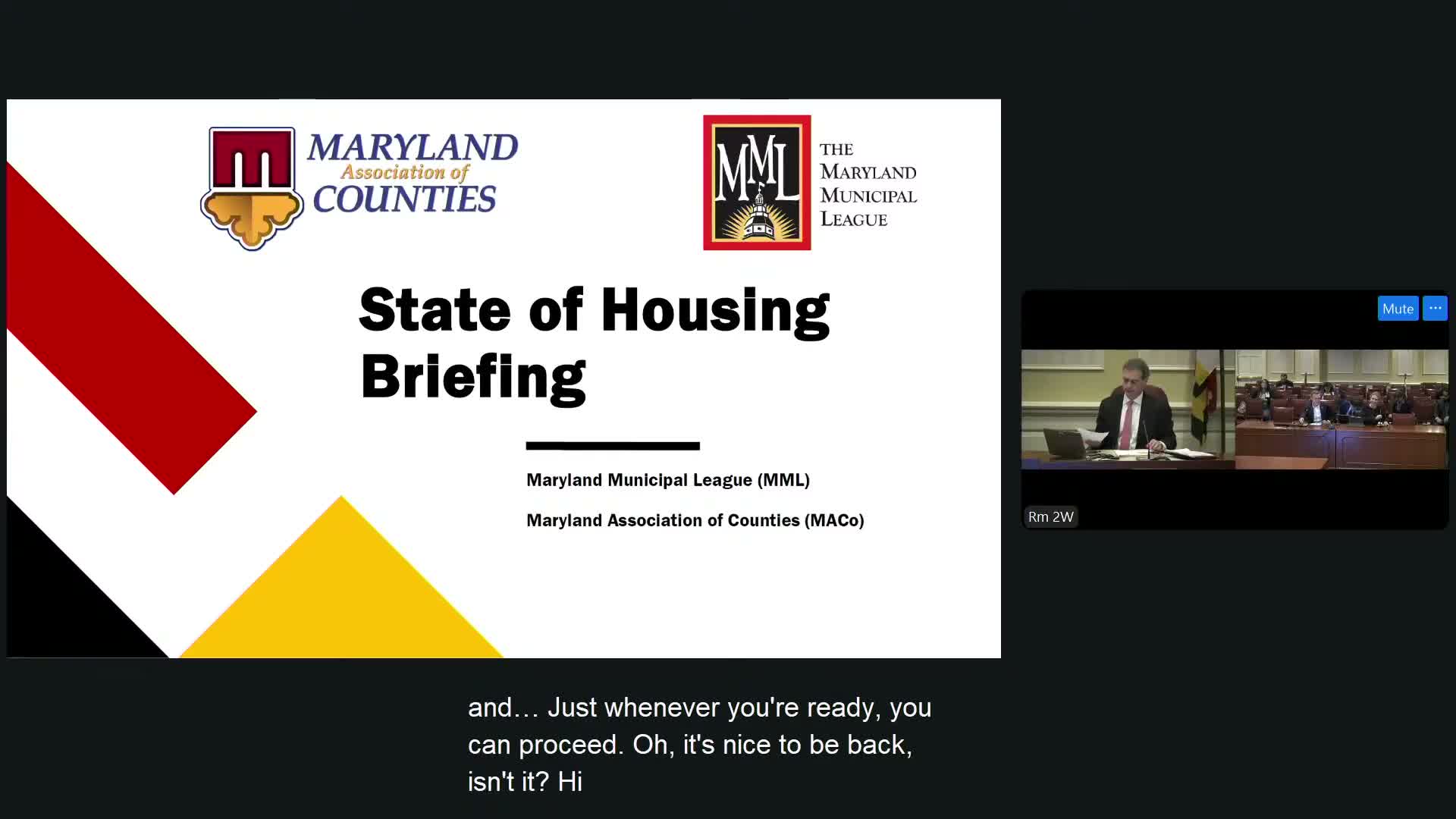
Angelica Bailey Cupari of the Maryland Municipal League and Don Butchko of the Maryland Association of Counties told the Education, Energy, and the Environment Committee that local governments bear practical responsibilities—public hearings, infrastructure, school capacity, waste water systems and administrative capacity—that shape how land-use reforms play out. "Zoning and development decisions are made in public with hearings, with recorded votes by officials who must answer directly to the people that they represent," Bailey Cupari said, stressing democratic accountability.
Both speakers cautioned that producing smaller units alone does not guarantee lower prices. Butchko cited local market dynamics where an $800,000 teardown can be replaced by multiple higher-priced townhomes, and summarized three categories policymakers should weigh: what is fixable now by legislation or local action; trade-offs that entail shifting priorities (infrastructure, environmental standards, public participation); and structural realities outside local control (interest rates, labor, supply chains). "Smaller doesn't necessarily mean cheaper," he said, urging that state policy recognize local fiscal impacts such as property-tax revenue changes.
Local leaders said many small municipalities lack staff and technology to process more permits, and asked that state efforts include support for local IT and administrative capacity. Both organizations said they are participating in this year's policy debates and negotiating on bills (including the Bambi package and several governors bills). They recommended pairing statewide floor-setting with incentives and supports so that local jurisdictions can implement reforms without unintended fiscal stress.
Both speakers cautioned that producing smaller units alone does not guarantee lower prices. Butchko cited local market dynamics where an $800,000 teardown can be replaced by multiple higher-priced townhomes, and summarized three categories policymakers should weigh: what is fixable now by legislation or local action; trade-offs that entail shifting priorities (infrastructure, environmental standards, public participation); and structural realities outside local control (interest rates, labor, supply chains). "Smaller doesn't necessarily mean cheaper," he said, urging that state policy recognize local fiscal impacts such as property-tax revenue changes.
Local leaders said many small municipalities lack staff and technology to process more permits, and asked that state efforts include support for local IT and administrative capacity. Both organizations said they are participating in this year's policy debates and negotiating on bills (including the Bambi package and several governors bills). They recommended pairing statewide floor-setting with incentives and supports so that local jurisdictions can implement reforms without unintended fiscal stress.
Don't Miss a Word: See the Full Meeting!
Go beyond summaries. Unlock every video, transcript, and key insight with a Founder Membership.
✓
Get instant access to full meeting videos
✓
Search and clip any phrase from complete transcripts
✓
Receive AI-powered summaries & custom alerts
✓
Enjoy lifetime, unrestricted access to government data
30-day money-back guarantee
