Austin Energy reports 65% carbon‑free generation, commission presses for full RFP results before any peaker commitment
January 12, 2026 | Austin, Travis County, Texas
This article was created by AI summarizing key points discussed. AI makes mistakes, so for full details and context, please refer to the video of the full meeting. Please report any errors so we can fix them. Report an error »
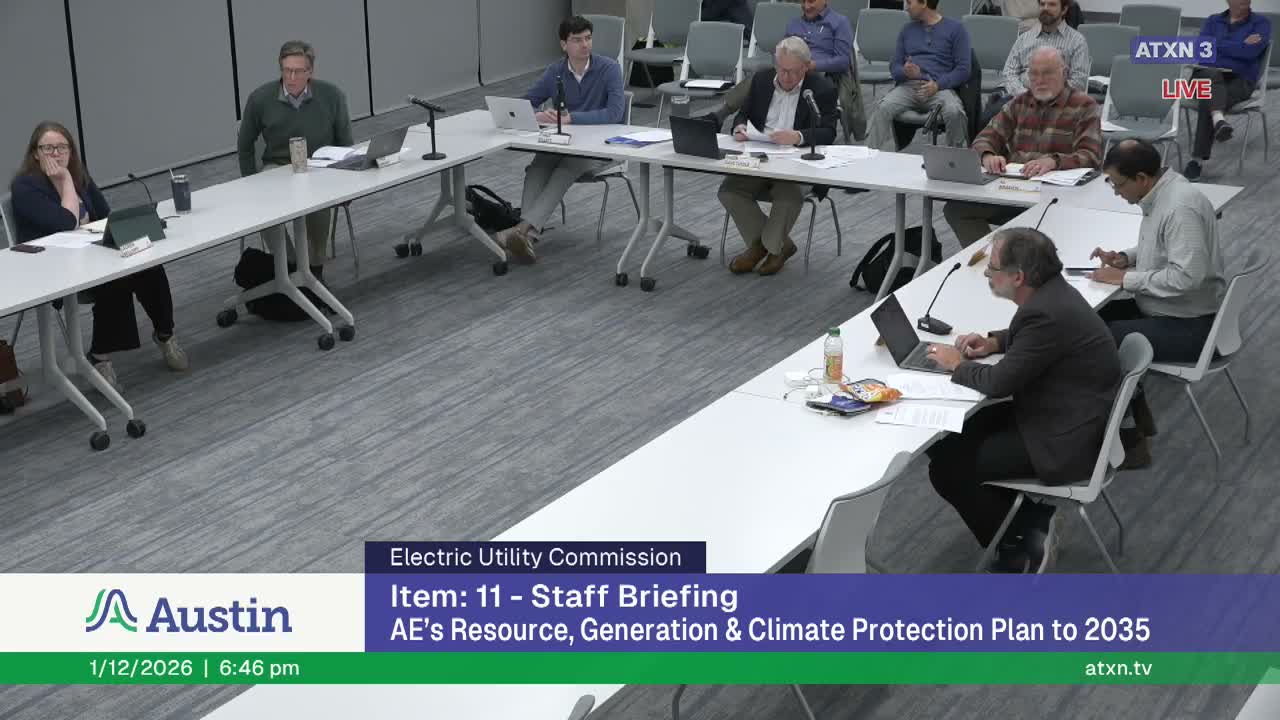
Austin Energy told the Electric Utility Commission on Jan. 12 that its portfolio was 65% carbon‑free as a percentage of load and that preliminary 2025 data show record‑low stack emissions, but staff and commissioners voiced caution about any quick commitment to new natural‑gas peaker plants.
"We're currently sitting at 65%," Lisa Martin, Austin Energy's chief operating officer, said during a semiannual briefing on the utility's Resource Generation and Climate Protection Plan to 2035. Martin said the utility has stabilized recent drops in carbon‑free percentage and pointed to multiple factors — such as curtailments and transmission congestion — that affect the metric.
Martin reviewed recent implementation wins and near‑term actions: 18 megawatts of new local solar in FY25, an estimated 24 MW of energy savings from efficiency work, a signed 100‑MW battery storage contract and an active second battery procurement under negotiation. She also said the utility had renewed a 165‑MW wind power purchase agreement and launched a shovel‑ready RFP to capture projects before federal tax credits change.
Commissioners focused their questions on how the utility will weigh alternatives to new natural‑gas peakers and how transmission projects could alter the mix of feasible options. "One of the reasons that we're doing the initial feasibility phase for peakers is for that owned option, which is obviously an alternative that you would compare to a power purchase agreement option," Martin said, describing the feasibility work she said the utility has performed to evaluate owning generation locally.
Commissioners also flagged the plan language that calls on staff to "avoid retiring local generation prematurely." Martin said that modeling showed portfolios that retired all local generation increased tail‑risk reliability hours and that the plan therefore calls for keeping some local resources available as a backstop while pursuing cleaner, more efficient options.
Several commissioners emphasized transmission as a partial solution to local price and reliability risk. Martin described the STEP/765 kV proposals being reviewed in ERCOT and at the Public Utility Commission of Texas and said such high‑voltage trunks could change import patterns, but she cautioned transmission is not a silver bullet and can itself become congested.
On process, Martin described the timeline for the all‑resource RFP: proposals due late January, a two‑ to three‑month evaluation window, and an earliest possible council recommendation in May. She said that any recommendation on peakers would wait until results of the all‑resource RFP were available.
The commission spent the second half of the meeting debating a draft advisory recommendation to city council that would urge a fuller analysis of alternatives before any Council approval that could effectively precommit money toward acquiring peakers. Commissioners who sponsored the draft said it is intended to ensure the generation plan's steps are followed, to require robust economics and emissions modeling, and to increase community engagement if new thermal generation is considered.
Martin said Austin Energy already performs rigorous project analyses and warned some prescriptive language in the draft runs beyond the plan and could create unnecessary extra work. "My position is that this recommendation is unnecessary," she said, adding that staff is following the plan and that some requested specifics are not spelled out in the plan itself.
Commissioners heard public comment from residents and advocates urging caution about committing to new fossil generation and urging exploration of virtual power plants, batteries and demand‑side solutions. The commission elected not to vote on the draft recommendation at the Jan. 12 meeting and asked staff and commissioners to continue discussion and return the item to a future agenda after more RFP and transmission information becomes available.
Next steps: Austin Energy will analyze all‑resource proposals, continue work on batteries, local generation and transmission submittals, and return with updates as those procurement and planning milestones advance.
"We're currently sitting at 65%," Lisa Martin, Austin Energy's chief operating officer, said during a semiannual briefing on the utility's Resource Generation and Climate Protection Plan to 2035. Martin said the utility has stabilized recent drops in carbon‑free percentage and pointed to multiple factors — such as curtailments and transmission congestion — that affect the metric.
Martin reviewed recent implementation wins and near‑term actions: 18 megawatts of new local solar in FY25, an estimated 24 MW of energy savings from efficiency work, a signed 100‑MW battery storage contract and an active second battery procurement under negotiation. She also said the utility had renewed a 165‑MW wind power purchase agreement and launched a shovel‑ready RFP to capture projects before federal tax credits change.
Commissioners focused their questions on how the utility will weigh alternatives to new natural‑gas peakers and how transmission projects could alter the mix of feasible options. "One of the reasons that we're doing the initial feasibility phase for peakers is for that owned option, which is obviously an alternative that you would compare to a power purchase agreement option," Martin said, describing the feasibility work she said the utility has performed to evaluate owning generation locally.
Commissioners also flagged the plan language that calls on staff to "avoid retiring local generation prematurely." Martin said that modeling showed portfolios that retired all local generation increased tail‑risk reliability hours and that the plan therefore calls for keeping some local resources available as a backstop while pursuing cleaner, more efficient options.
Several commissioners emphasized transmission as a partial solution to local price and reliability risk. Martin described the STEP/765 kV proposals being reviewed in ERCOT and at the Public Utility Commission of Texas and said such high‑voltage trunks could change import patterns, but she cautioned transmission is not a silver bullet and can itself become congested.
On process, Martin described the timeline for the all‑resource RFP: proposals due late January, a two‑ to three‑month evaluation window, and an earliest possible council recommendation in May. She said that any recommendation on peakers would wait until results of the all‑resource RFP were available.
The commission spent the second half of the meeting debating a draft advisory recommendation to city council that would urge a fuller analysis of alternatives before any Council approval that could effectively precommit money toward acquiring peakers. Commissioners who sponsored the draft said it is intended to ensure the generation plan's steps are followed, to require robust economics and emissions modeling, and to increase community engagement if new thermal generation is considered.
Martin said Austin Energy already performs rigorous project analyses and warned some prescriptive language in the draft runs beyond the plan and could create unnecessary extra work. "My position is that this recommendation is unnecessary," she said, adding that staff is following the plan and that some requested specifics are not spelled out in the plan itself.
Commissioners heard public comment from residents and advocates urging caution about committing to new fossil generation and urging exploration of virtual power plants, batteries and demand‑side solutions. The commission elected not to vote on the draft recommendation at the Jan. 12 meeting and asked staff and commissioners to continue discussion and return the item to a future agenda after more RFP and transmission information becomes available.
Next steps: Austin Energy will analyze all‑resource proposals, continue work on batteries, local generation and transmission submittals, and return with updates as those procurement and planning milestones advance.
View the Full Meeting & All Its Details
This article offers just a summary. Unlock complete video, transcripts, and insights as a Founder Member.
✓
Watch full, unedited meeting videos
✓
Search every word spoken in unlimited transcripts
✓
AI summaries & real-time alerts (all government levels)
✓
Permanent access to expanding government content
30-day money-back guarantee
