Commission approves benchmarking and engineering contracts; staff clarifies survey costs and engineering stopgap
January 12, 2026 | Austin, Travis County, Texas
This article was created by AI summarizing key points discussed. AI makes mistakes, so for full details and context, please refer to the video of the full meeting. Please report any errors so we can fix them. Report an error »
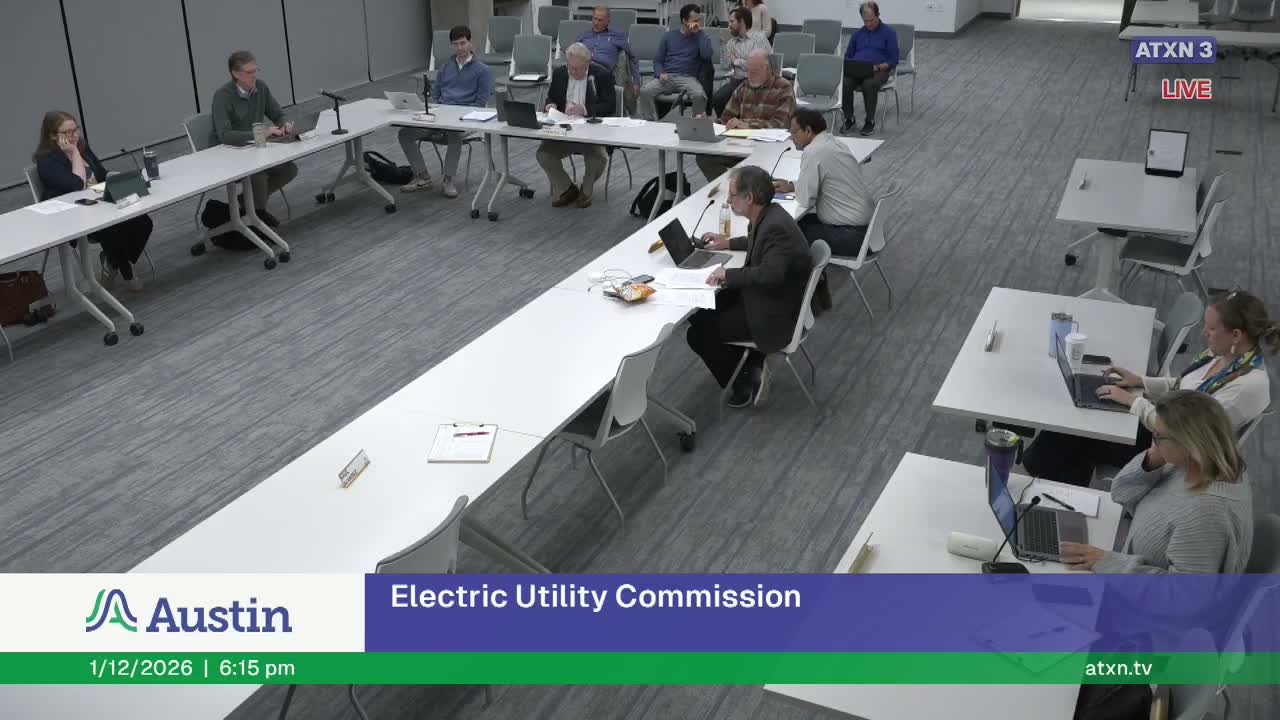
At its Jan. 12 meeting the Electric Utility Commission approved several procurement items after staff answered commissioner questions about scope, cost and timing.
Two separate contracts for customer research were discussed and approved together. Austin Energy staff described a JD Power benchmarking engagement that measures Austin Energy’s performance against peers across six survey dimensions, and a granular consumer‑research contract that captures after‑call surveys, weatherization program feedback and ad‑hoc focus groups. "So a great example is, in the commercial side ... we went from ... number 8 out of 8, and we went to number ... over this last year because of changes we've made in the commercial program," Sandra Escobedo, vice president of customer account management, said to illustrate how survey feedback informs operational changes.
Commissioners pressed about redundancy, alternatives and cost. Staff clarified a fiscal‑note typo: the packet inadvertently showed $2.20 in one place; the correct available fiscal amount for the JD Power line in the packet is $320,000. Staff also said JD Power requires an active contract to access recent data, creating a timing constraint for continued benchmarking.
The commission approved items 2 and 7 (the benchmarking and consumer research contracts) on a motion by Commissioner Cyrus that included a request for a follow‑up staff presentation later in the year on contract effectiveness.
On item 3 staff explained a request to add $15,000,000 to an existing engineering services rotation list contract as a stopgap while a new solicitation is completed. David Tomcheson, vice president for electric system engineering, said the augmentation is intended to avoid gaps between contract cycles and to ensure continued external engineering support for distribution, transmission and substation work. Commissioners discussed where costs fall under Austin's line‑extension policy and staff explained customer 'contribution' rules for new load connections (referred to in the discussion as 'kayak' contributions). Item 3 carried on a motion and vote.
Item 4 covered downtown substations and underground distribution connections to serve new load and to increase operational flexibility; staff said the work is intended for broader community service rather than for a single customer's needs. Commissioners discussed whether some of that work should be borne by customers requesting service versus the utility's capital program; the motion to approve item 4 passed with recorded ayes and at least one abstention.
Item 8 asked approval related to a high‑purity water system fault and its operational risk; Ken Snipes, vice president of power production, explained the protection logic that will fault units if water quality drops below thresholds to protect equipment and meet regulatory standards. The motion passed with at least one commissioner voting no.
The commission asked staff to return later in the year with a presentation on use and results from the benchmarking and consumer‑research contracts so commissioners can judge value for money and potential efficiencies in survey frequency and scope.
Votes at a glance: the record in the meeting transcript shows motions and approvals for items 2 & 7 (approved, one commissioner opposed), item 3 approved, item 4 approved (one abstention recorded), and item 8 approved (one recorded no vote). The commission did not quantify every vote by name in the public record; staff and commissioners confirmed outcomes on the record.
Two separate contracts for customer research were discussed and approved together. Austin Energy staff described a JD Power benchmarking engagement that measures Austin Energy’s performance against peers across six survey dimensions, and a granular consumer‑research contract that captures after‑call surveys, weatherization program feedback and ad‑hoc focus groups. "So a great example is, in the commercial side ... we went from ... number 8 out of 8, and we went to number ... over this last year because of changes we've made in the commercial program," Sandra Escobedo, vice president of customer account management, said to illustrate how survey feedback informs operational changes.
Commissioners pressed about redundancy, alternatives and cost. Staff clarified a fiscal‑note typo: the packet inadvertently showed $2.20 in one place; the correct available fiscal amount for the JD Power line in the packet is $320,000. Staff also said JD Power requires an active contract to access recent data, creating a timing constraint for continued benchmarking.
The commission approved items 2 and 7 (the benchmarking and consumer research contracts) on a motion by Commissioner Cyrus that included a request for a follow‑up staff presentation later in the year on contract effectiveness.
On item 3 staff explained a request to add $15,000,000 to an existing engineering services rotation list contract as a stopgap while a new solicitation is completed. David Tomcheson, vice president for electric system engineering, said the augmentation is intended to avoid gaps between contract cycles and to ensure continued external engineering support for distribution, transmission and substation work. Commissioners discussed where costs fall under Austin's line‑extension policy and staff explained customer 'contribution' rules for new load connections (referred to in the discussion as 'kayak' contributions). Item 3 carried on a motion and vote.
Item 4 covered downtown substations and underground distribution connections to serve new load and to increase operational flexibility; staff said the work is intended for broader community service rather than for a single customer's needs. Commissioners discussed whether some of that work should be borne by customers requesting service versus the utility's capital program; the motion to approve item 4 passed with recorded ayes and at least one abstention.
Item 8 asked approval related to a high‑purity water system fault and its operational risk; Ken Snipes, vice president of power production, explained the protection logic that will fault units if water quality drops below thresholds to protect equipment and meet regulatory standards. The motion passed with at least one commissioner voting no.
The commission asked staff to return later in the year with a presentation on use and results from the benchmarking and consumer‑research contracts so commissioners can judge value for money and potential efficiencies in survey frequency and scope.
Votes at a glance: the record in the meeting transcript shows motions and approvals for items 2 & 7 (approved, one commissioner opposed), item 3 approved, item 4 approved (one abstention recorded), and item 8 approved (one recorded no vote). The commission did not quantify every vote by name in the public record; staff and commissioners confirmed outcomes on the record.
View the Full Meeting & All Its Details
This article offers just a summary. Unlock complete video, transcripts, and insights as a Founder Member.
✓
Watch full, unedited meeting videos
✓
Search every word spoken in unlimited transcripts
✓
AI summaries & real-time alerts (all government levels)
✓
Permanent access to expanding government content
30-day money-back guarantee
