FPR presents FY27 budget; proposes raising Lands & Facilities Trust Fund draw from 5% to 8%
February 05, 2026 | Agriculture, Food Resiliency, & Forestry, HOUSE OF REPRESENTATIVES, Committees, Legislative , Vermont
This article was created by AI summarizing key points discussed. AI makes mistakes, so for full details and context, please refer to the video of the full meeting. Please report any errors so we can fix them. Report an error »
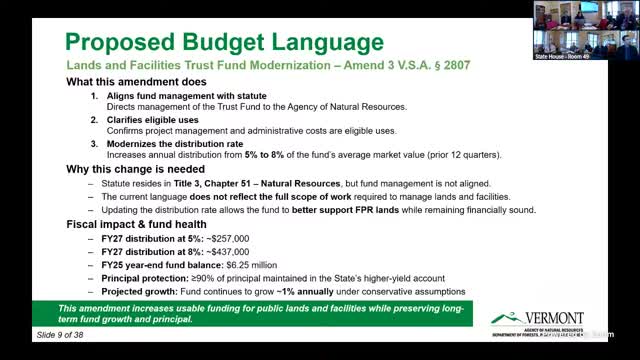
Daniel Fitsko, Commissioner of Forest, Parks and Recreation, and Steve Gomez, chief financial officer for the Agency of Natural Resources, presented FPR's recommended FY27 budget to the committee and described several program and capital priorities.
Fitsko opened by describing FPR's mission to conserve Vermont's forest resources and operate the state's 55 parks, saying the system had "just under 1,000,000 visitors this year" and stressing parks' economic role. "We like to say there's a state park within 20 minutes of every Vermonter," Fitsko said, framing recreation as both a public service and economic driver.
The budget overview: agency staff told the committee the department's consolidated FY27 budget would be about $53.6 million (a roughly $1 million decrease from the prior year driven by timing of a large land acquisition). Funding sources include general fund, a parks special fund, multiple special funds, federal grants and interdepartmental revenues. Officials said about one-third of revenue is federal and noted growing reliance on federal grant dollars (including a new IRA grant captured in Forestry).
Key program and capital items noted in testimony:
- Workforce grants: FPR continues a $500,000 base appropriation to the Serve, Learn, Earn workforce program; staff said a prior one‑time $250,000 appropriation supplemented the base and that in 2025 the program enrolled 128 new participants and served 280 people statewide.
- Wildfire apparatus: Officials described a proposed one‑time $275,000 purchase for a Type 6 wildland fire truck, noting the vehicle is custom and procurement and delivery could take about 12–18 months.
- Lands and Facilities Trust Fund: FPR proposed technical changes to fund language and expanding eligible uses to allow limited administrative support (to cover grant and contracting work) and a change in the allowable draw from 5% to 8% of an averaged principal/interest measure. Gomez said the fund held about $6.25 million at the end of FY25 and that modeling using a conservative 5% assumed return showed an 8% draw would still allow the fund to grow modestly (projected to roughly $7 million by FY34).
- Park operations and deferred maintenance: staff said state parks manage about 600 miles of roads on FPR lands, have sizable seasonal staffing needs (several hundred seasonal employees), and face asset needs they estimate would require roughly $7 million a year to meet depreciation and maintenance. Gomez outlined inflationary pressures on park retail (food/ice) and additional line items including tree removal for emerald ash borer mitigation and boat repairs (a cited $65,000 repair for the "island runner").
- Federal and ARPA funding: testimony said FPR received approximately $3.3 million in ARPA funds to address park infrastructure, including allocations for 3‑acre stormwater projects (19 parks), urban tree planting and park major maintenance; committee members were told about roughly $89,000 remaining unspent but encumbered for stormwater work.
Officials also walked members through internal service and digital service charge shifts: Agency of Digital Services costs were described as rising and being redistributed across divisions, producing notable line‑item increases in several divisions even when top‑line changes were modest.
Why it matters: the proposed trust fund change would free more steady funding for on‑the‑ground stewardship, hazard tree removal and workforce support while managers argue modeling shows the fund would continue to grow under conservative investment assumptions. Committee members asked for clarifications about assumptions, administration of grants and how federal funding cycles affect the department's near‑term revenue picture.
Next steps: presenters said they would supply follow‑up details on several technical questions. The committee recessed for lunch and planned to continue its session later in the day.
Fitsko opened by describing FPR's mission to conserve Vermont's forest resources and operate the state's 55 parks, saying the system had "just under 1,000,000 visitors this year" and stressing parks' economic role. "We like to say there's a state park within 20 minutes of every Vermonter," Fitsko said, framing recreation as both a public service and economic driver.
The budget overview: agency staff told the committee the department's consolidated FY27 budget would be about $53.6 million (a roughly $1 million decrease from the prior year driven by timing of a large land acquisition). Funding sources include general fund, a parks special fund, multiple special funds, federal grants and interdepartmental revenues. Officials said about one-third of revenue is federal and noted growing reliance on federal grant dollars (including a new IRA grant captured in Forestry).
Key program and capital items noted in testimony:
- Workforce grants: FPR continues a $500,000 base appropriation to the Serve, Learn, Earn workforce program; staff said a prior one‑time $250,000 appropriation supplemented the base and that in 2025 the program enrolled 128 new participants and served 280 people statewide.
- Wildfire apparatus: Officials described a proposed one‑time $275,000 purchase for a Type 6 wildland fire truck, noting the vehicle is custom and procurement and delivery could take about 12–18 months.
- Lands and Facilities Trust Fund: FPR proposed technical changes to fund language and expanding eligible uses to allow limited administrative support (to cover grant and contracting work) and a change in the allowable draw from 5% to 8% of an averaged principal/interest measure. Gomez said the fund held about $6.25 million at the end of FY25 and that modeling using a conservative 5% assumed return showed an 8% draw would still allow the fund to grow modestly (projected to roughly $7 million by FY34).
- Park operations and deferred maintenance: staff said state parks manage about 600 miles of roads on FPR lands, have sizable seasonal staffing needs (several hundred seasonal employees), and face asset needs they estimate would require roughly $7 million a year to meet depreciation and maintenance. Gomez outlined inflationary pressures on park retail (food/ice) and additional line items including tree removal for emerald ash borer mitigation and boat repairs (a cited $65,000 repair for the "island runner").
- Federal and ARPA funding: testimony said FPR received approximately $3.3 million in ARPA funds to address park infrastructure, including allocations for 3‑acre stormwater projects (19 parks), urban tree planting and park major maintenance; committee members were told about roughly $89,000 remaining unspent but encumbered for stormwater work.
Officials also walked members through internal service and digital service charge shifts: Agency of Digital Services costs were described as rising and being redistributed across divisions, producing notable line‑item increases in several divisions even when top‑line changes were modest.
Why it matters: the proposed trust fund change would free more steady funding for on‑the‑ground stewardship, hazard tree removal and workforce support while managers argue modeling shows the fund would continue to grow under conservative investment assumptions. Committee members asked for clarifications about assumptions, administration of grants and how federal funding cycles affect the department's near‑term revenue picture.
Next steps: presenters said they would supply follow‑up details on several technical questions. The committee recessed for lunch and planned to continue its session later in the day.
Don't Miss a Word: See the Full Meeting!
Go beyond summaries. Unlock every video, transcript, and key insight with a Founder Membership.
✓
Get instant access to full meeting videos
✓
Search and clip any phrase from complete transcripts
✓
Receive AI-powered summaries & custom alerts
✓
Enjoy lifetime, unrestricted access to government data
30-day money-back guarantee
