Alabama committee delays vote on 'rapid response' school safety bill after funding and device rules questioned
February 05, 2026 | House, Alabama Legislative Sessions, Alabama
This article was created by AI summarizing key points discussed. AI makes mistakes, so for full details and context, please refer to the video of the full meeting. Please report any errors so we can fix them. Report an error »
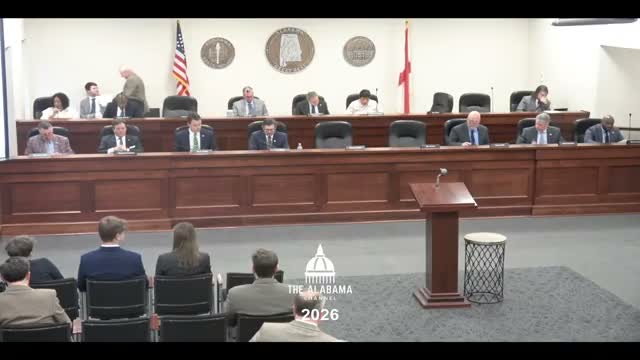
Representative Alan Baker presented House Bill 187 as a school safety "rapid response" measure intended to get immediate help to an exact campus location when staff press a wearable button. Baker said the device is typically "worn around the neck on a lanyard" and that pressing it several times first alerts school officials and, if pressed repeatedly, summons first responders to a precise room or outdoor location.
The sponsor framed the bill as a practical, broadly useful tool. "This is a school safety rapid response bill," Baker said, and he noted that districts such as Baldwin County and systems in his legislative footprint already use similar technology. He cited a superintendent's estimate that a 54-campus district paid about $300,000 per year for a system — roughly $5,000 per campus — and said initial setup costs per campus could be about $15,000 with ongoing costs of $5,000–$8,000.
Supporters and several committee members said they welcomed the bill's focus on safety but pressed Baker on two recurring concerns: whether the law would effectively force districts to spend specified local allocations on the systems, and whether the bill's amendment would bar use of vendors that rely on employees' personal cell phones. Baker explained the amendment removes earlier app/cell‑phone language and replaces it with a definition that places the words "school-issued device" in front of "device," meaning that if an app or phone solution is used it must be provided by the school rather than required to be on a personal device. "We just stripped that language out," he said, describing the change as intended to respond to liability and staff‑device concerns.
Members repeatedly asked about funding language that conditions the requirement on "annual dedicated school safety funds." At one point Baker read the bill's text: "no later than 10/01/2030, and subject to annual dedicated school safety funds, each governing body shall…" Several members worried that wording could leave the mandate toothless if the legislature does not appropriate a new, continuing funding stream. Representative Rosemary Drummond asked whether districts would be required to use specific funds; Baker replied the bill preserves local discretion about which funding source a district uses but that the mandate would not be enforceable if the legislature did not establish annual dedicated funding.
The amendment that makes the system a "school-issued device" also prompted discussion about vendor markets. Representative Faulkner said the change "could force it down" to a narrower set of vendors because some solutions rely on employees' personal phones; Faulkner urged preserving the option for districts to accept employee volunteers to use personal devices if the employee prefers. Baker said the change was responsive to associations representing school boards and superintendents who worried about sustaining the systems without a dedicated funding stream.
Because of those unresolved questions about whether the requirement is contingent on new, dedicated funding and whether the device definition narrows vendor options, the chair proposed carrying the bill over for one week to allow additional vetting. Members agreed to delay a final vote and to return next week with the amendment and funding language reconciled.
The committee did not take a final vote on House Bill 187; the bill was carried over for further consideration next week.
The sponsor framed the bill as a practical, broadly useful tool. "This is a school safety rapid response bill," Baker said, and he noted that districts such as Baldwin County and systems in his legislative footprint already use similar technology. He cited a superintendent's estimate that a 54-campus district paid about $300,000 per year for a system — roughly $5,000 per campus — and said initial setup costs per campus could be about $15,000 with ongoing costs of $5,000–$8,000.
Supporters and several committee members said they welcomed the bill's focus on safety but pressed Baker on two recurring concerns: whether the law would effectively force districts to spend specified local allocations on the systems, and whether the bill's amendment would bar use of vendors that rely on employees' personal cell phones. Baker explained the amendment removes earlier app/cell‑phone language and replaces it with a definition that places the words "school-issued device" in front of "device," meaning that if an app or phone solution is used it must be provided by the school rather than required to be on a personal device. "We just stripped that language out," he said, describing the change as intended to respond to liability and staff‑device concerns.
Members repeatedly asked about funding language that conditions the requirement on "annual dedicated school safety funds." At one point Baker read the bill's text: "no later than 10/01/2030, and subject to annual dedicated school safety funds, each governing body shall…" Several members worried that wording could leave the mandate toothless if the legislature does not appropriate a new, continuing funding stream. Representative Rosemary Drummond asked whether districts would be required to use specific funds; Baker replied the bill preserves local discretion about which funding source a district uses but that the mandate would not be enforceable if the legislature did not establish annual dedicated funding.
The amendment that makes the system a "school-issued device" also prompted discussion about vendor markets. Representative Faulkner said the change "could force it down" to a narrower set of vendors because some solutions rely on employees' personal phones; Faulkner urged preserving the option for districts to accept employee volunteers to use personal devices if the employee prefers. Baker said the change was responsive to associations representing school boards and superintendents who worried about sustaining the systems without a dedicated funding stream.
Because of those unresolved questions about whether the requirement is contingent on new, dedicated funding and whether the device definition narrows vendor options, the chair proposed carrying the bill over for one week to allow additional vetting. Members agreed to delay a final vote and to return next week with the amendment and funding language reconciled.
The committee did not take a final vote on House Bill 187; the bill was carried over for further consideration next week.
Don't Miss a Word: See the Full Meeting!
Go beyond summaries. Unlock every video, transcript, and key insight with a Founder Membership.
✓
Get instant access to full meeting videos
✓
Search and clip any phrase from complete transcripts
✓
Receive AI-powered summaries & custom alerts
✓
Enjoy lifetime, unrestricted access to government data
30-day money-back guarantee
