Committee gives favorable reports to military pay exemption, broadband-equipment tax break, food‑donation credit and lodge exemption
February 05, 2026 | House, Alabama Legislative Sessions, Alabama
This article was created by AI summarizing key points discussed. AI makes mistakes, so for full details and context, please refer to the video of the full meeting. Please report any errors so we can fix them. Report an error »
After postponing final action on the school-safety device bill, the committee moved quickly through several items and gave favorable reports to four bills.
House Bill 341 (Representative Starnes) would exempt the first $5,000 of drill pay earned by traditional members of the Alabama National Guard from state income tax beginning in tax year 2027. Starnes said the exemption is designed to support recruitment and retention; he provided a fiscal estimate of $1.9 million initial cost and $2.6 million ongoing. Representative Collins moved for a favorable report, which the committee approved by voice vote; Representative Keeley clarified the exemption applies to inactive duty training pay.
House Bill 4 (carried for the House by Senator Wood, presented in committee) would exempt commercial broadband equipment and supplies used on BEED Act fiber projects administered by DECA from sales and use tax. The committee adopted a substitute that makes local participation opt in, requires equipment have a 10-year useful life, and maintains a sunset of 08/31/2029 when BDAC funding is expected to be exhausted. The committee gave the bill a favorable report as substituted.
House Bill 175 (Representative Robbins) would create a tax credit to encourage farmers to donate fresh produce and other food to food banks; the sponsor set a $2,000,000 program cap and limited individual producers to a maximum $5,000 credit. The committee approved a technical amendment updating the definition of "food bank" to match recent statutory language and gave the bill a favorable report as amended.
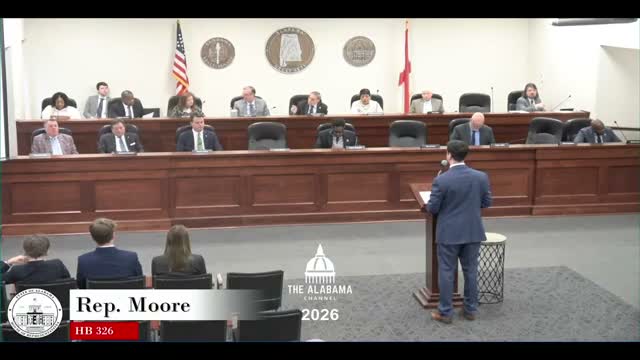
House Bill 326 (Representative Parker Moore) would remove a sunset for a sales-tax exemption for certain Prince Hall / Grand Lodges and included two committee amendments: (1) opt-in language for local governments consistent with prior committee policy, and (2) a Department of Revenue conforming amendment to identify which subordinate lodges qualify. Both amendments were adopted and the bill received a favorable report as amended.
Votes at a glance: all four bills were advanced by voice vote; no roll‑call tallies were recorded in the transcript. Committee members noted fiscal impacts and opt-in provisions and moved the bills forward for further consideration.
House Bill 341 (Representative Starnes) would exempt the first $5,000 of drill pay earned by traditional members of the Alabama National Guard from state income tax beginning in tax year 2027. Starnes said the exemption is designed to support recruitment and retention; he provided a fiscal estimate of $1.9 million initial cost and $2.6 million ongoing. Representative Collins moved for a favorable report, which the committee approved by voice vote; Representative Keeley clarified the exemption applies to inactive duty training pay.
House Bill 4 (carried for the House by Senator Wood, presented in committee) would exempt commercial broadband equipment and supplies used on BEED Act fiber projects administered by DECA from sales and use tax. The committee adopted a substitute that makes local participation opt in, requires equipment have a 10-year useful life, and maintains a sunset of 08/31/2029 when BDAC funding is expected to be exhausted. The committee gave the bill a favorable report as substituted.
House Bill 175 (Representative Robbins) would create a tax credit to encourage farmers to donate fresh produce and other food to food banks; the sponsor set a $2,000,000 program cap and limited individual producers to a maximum $5,000 credit. The committee approved a technical amendment updating the definition of "food bank" to match recent statutory language and gave the bill a favorable report as amended.
House Bill 326 (Representative Parker Moore) would remove a sunset for a sales-tax exemption for certain Prince Hall / Grand Lodges and included two committee amendments: (1) opt-in language for local governments consistent with prior committee policy, and (2) a Department of Revenue conforming amendment to identify which subordinate lodges qualify. Both amendments were adopted and the bill received a favorable report as amended.
Votes at a glance: all four bills were advanced by voice vote; no roll‑call tallies were recorded in the transcript. Committee members noted fiscal impacts and opt-in provisions and moved the bills forward for further consideration.
Don't Miss a Word: See the Full Meeting!
Go beyond summaries. Unlock every video, transcript, and key insight with a Founder Membership.
✓
Get instant access to full meeting videos
✓
Search and clip any phrase from complete transcripts
✓
Receive AI-powered summaries & custom alerts
✓
Enjoy lifetime, unrestricted access to government data
30-day money-back guarantee
