Athens planning commission to draft zoning, permitting rules after residents raise concerns about unlicensed recovery houses
February 05, 2026 | Athens Planning Commission, Athens , Athens County, Ohio
This article was created by AI summarizing key points discussed. AI makes mistakes, so for full details and context, please refer to the video of the full meeting. Please report any errors so we can fix them. Report an error »
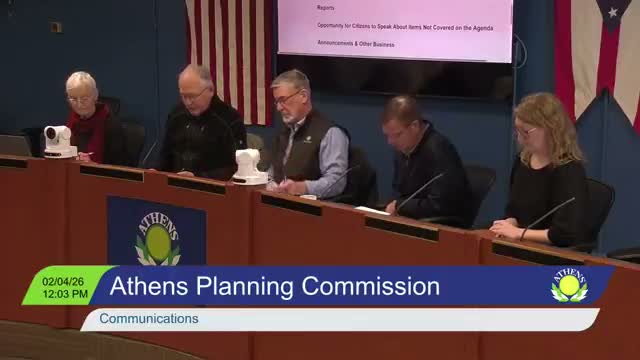
ATHENS — The Athens City Planning Commission on Feb. 4 opened a broad discussion about where and how to allow recovery housing and residential health care facilities after residents reported safety and licensing problems at two properties.
Director David Riggs told commissioners the city’s zoning code lacks clear definitions for both “residential health care facilities” and “recovery housing,” and recommended using the Ohio Revised Code’s definitions as a starting point. He asked the commission for direction on which zones to permit recovery houses and whether to supplement state oversight with a local permit and inspections under Title 29.
The commission’s deliberations focused on two separate legal categories: state-licensed residential health care facilities (which Ohio law often preempts local zoning for) and recovery housing registered or certified under Ohio’s recovery housing rules. Riggs and staff noted three classes of residential facilities in state law (small facilities, B-type facilities permitting roughly 1–5 unrelated residents, and larger C-type facilities for roughly 6–16 residents) and said local code needs cleanup where the same use appears in both R1 and R3 lists.
Public comment underscored the urgency. Diane Fapp, executive director of the Alcohol, Drug Addiction and Mental Health Services Board, said certified recovery houses meet robust state standards and offered the board’s help arranging site visits to well-run programs. Resident Paul Mullins told the commission his neighborhood had repeated police calls and an overdose and said the operator at two houses, Next Level, “is not on their registry and has never applied for certification.” Jack Stoffer urged stricter spacing than the 500-foot figure discussed, suggesting 1,000–1,500 feet between facilities in R1 neighborhoods.
Alan Swank, a city council member and planning committee chair, provided procedural context and said some long-standing programs such as Clem House and Timothy House have operated successfully in R3 zones. Attorney and longtime resident Anne Rubin criticized the city’s prior reliance on incorrect legal interpretations and urged commissioners to seek the city law director’s guidance and extensive neighborhood engagement before finalizing code changes.
Staff outlined a near-term regulatory approach: adopt the state definitions for residential health care facilities, correct local code inconsistencies, and for recovery houses propose to allow them first in R3, business (B) and manufacturing (M) zones while establishing a local permitting and inspection program in Title 29 to verify registration, certification, certificates of occupancy and basic fire/safety compliance. The staff recommendation included using the state certificate of occupancy to determine lawful occupancy and relying on state licensing thresholds (sprinkler/fire-suppression requirements for larger occupancies).
Commissioners and staff said they had issued notices of violation to 51 Madison and 34 Lorraine for failing to pull required use permits and that the properties had until the coming Friday to submit paperwork. Riggs also confirmed the city filed formal complaints with the Ohio Department of Behavioral Health regarding both properties.
As next steps, staff committed to drafting ordinance language and permitting procedures and bringing a fully developed case back to the commission (with materials circulated at least 48–72 hours in advance). Mayor Patterson said he has contacted the governor’s office and may testify in Columbus about local impacts; commissioners scheduled further consideration at the Feb. 18 meeting.
The commission did not make final zoning changes at the Feb. 4 meeting; it directed staff to prepare draft legislation and seek legal review and public input before any vote.
Director David Riggs told commissioners the city’s zoning code lacks clear definitions for both “residential health care facilities” and “recovery housing,” and recommended using the Ohio Revised Code’s definitions as a starting point. He asked the commission for direction on which zones to permit recovery houses and whether to supplement state oversight with a local permit and inspections under Title 29.
The commission’s deliberations focused on two separate legal categories: state-licensed residential health care facilities (which Ohio law often preempts local zoning for) and recovery housing registered or certified under Ohio’s recovery housing rules. Riggs and staff noted three classes of residential facilities in state law (small facilities, B-type facilities permitting roughly 1–5 unrelated residents, and larger C-type facilities for roughly 6–16 residents) and said local code needs cleanup where the same use appears in both R1 and R3 lists.
Public comment underscored the urgency. Diane Fapp, executive director of the Alcohol, Drug Addiction and Mental Health Services Board, said certified recovery houses meet robust state standards and offered the board’s help arranging site visits to well-run programs. Resident Paul Mullins told the commission his neighborhood had repeated police calls and an overdose and said the operator at two houses, Next Level, “is not on their registry and has never applied for certification.” Jack Stoffer urged stricter spacing than the 500-foot figure discussed, suggesting 1,000–1,500 feet between facilities in R1 neighborhoods.
Alan Swank, a city council member and planning committee chair, provided procedural context and said some long-standing programs such as Clem House and Timothy House have operated successfully in R3 zones. Attorney and longtime resident Anne Rubin criticized the city’s prior reliance on incorrect legal interpretations and urged commissioners to seek the city law director’s guidance and extensive neighborhood engagement before finalizing code changes.
Staff outlined a near-term regulatory approach: adopt the state definitions for residential health care facilities, correct local code inconsistencies, and for recovery houses propose to allow them first in R3, business (B) and manufacturing (M) zones while establishing a local permitting and inspection program in Title 29 to verify registration, certification, certificates of occupancy and basic fire/safety compliance. The staff recommendation included using the state certificate of occupancy to determine lawful occupancy and relying on state licensing thresholds (sprinkler/fire-suppression requirements for larger occupancies).
Commissioners and staff said they had issued notices of violation to 51 Madison and 34 Lorraine for failing to pull required use permits and that the properties had until the coming Friday to submit paperwork. Riggs also confirmed the city filed formal complaints with the Ohio Department of Behavioral Health regarding both properties.
As next steps, staff committed to drafting ordinance language and permitting procedures and bringing a fully developed case back to the commission (with materials circulated at least 48–72 hours in advance). Mayor Patterson said he has contacted the governor’s office and may testify in Columbus about local impacts; commissioners scheduled further consideration at the Feb. 18 meeting.
The commission did not make final zoning changes at the Feb. 4 meeting; it directed staff to prepare draft legislation and seek legal review and public input before any vote.
Don't Miss a Word: See the Full Meeting!
Go beyond summaries. Unlock every video, transcript, and key insight with a Founder Membership.
✓
Get instant access to full meeting videos
✓
Search and clip any phrase from complete transcripts
✓
Receive AI-powered summaries & custom alerts
✓
Enjoy lifetime, unrestricted access to government data
30-day money-back guarantee
