Kane County board removes landscaping contract from consent after performance concerns; approves emergency purchases and marketing contract amendment
February 05, 2026 | Kane County, Illinois
This article was created by AI summarizing key points discussed. AI makes mistakes, so for full details and context, please refer to the video of the full meeting. Please report any errors so we can fix them. Report an error »
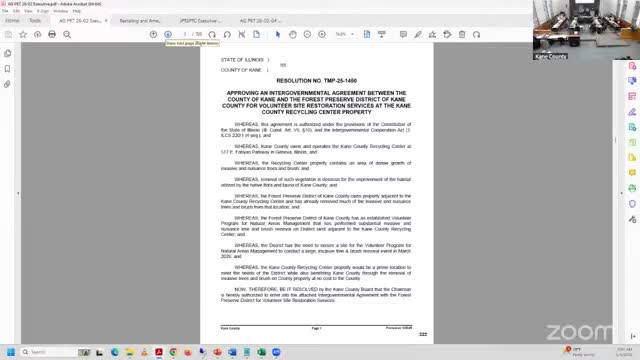
The Kane County Executive Committee debated procurement and contract performance Feb. 4, pulling one item from the consent agenda over past poor landscaping service and approving emergency‑purchase affidavits and other contract measures.
Chair Caius moved six items for consent. Commissioner Chuby asked to remove item C — a resolution authorizing a lawn‑maintenance and landscaping contract with Ratliff Landscaping — citing prior poor performance (weeds and uncleaned landscape material). Chuby said she could not support renewing a contract after observing "weeds in all of our beds" and "knee‑high thistle" during the last contract term.
Roger Fonstock, who identified himself as IT and buildings staff, explained the emergency‑purchase affidavits supporting two consent items: the county had budgeted two F‑250 trucks but the original supplier could not deliver units in time for winter operations, and the county needed an immediate remediation contractor to extract water and repair damage after a burst sprinkler in a sheriff’s office area. Fonstock said state statute provides the emergency procurement mechanism used to secure available vehicles and urgent remediation services.
After amending the consent package to remove the landscaping contract, the board approved the remaining consent items (A, B, D, E and F) on the record. The lawn‑maintenance contract was then taken up off‑consent; Fonstock said the new request added weed‑treatment and other items to the base contract so the scope now requires regular weed control rather than on‑call pricing, and that Ratliff was the lowest responsible bidder. Commissioners discussed the option of awarding to the second‑lowest bidder if they wanted to change contractors.
Following debate, the board approved the landscaping contract to proceed (roll call recorded). The meeting also included a motion to amend a contract extension for GMCI, the county’s marketing consultant for the Fabulous Fox National Water Trail, raising the not‑to‑exceed amount from $100,000 to $200,000 after staff said the county had secured an additional state grant to leverage the marketing work. The amendment and the amended resolution passed.
No civil penalties or litigated claims were introduced during the discussion; commissioners focused on procurement language, the narrow statutory meaning of “emergency” and ensuring future contracts include clearer base‑scope language to avoid the contractor performance problems cited by Chuby.
The board moved on after the votes; several members asked staff to seek alternative phrasing for the word “emergency” where possible and to provide clearer public explanations for emergency‑procurement usage.
Chair Caius moved six items for consent. Commissioner Chuby asked to remove item C — a resolution authorizing a lawn‑maintenance and landscaping contract with Ratliff Landscaping — citing prior poor performance (weeds and uncleaned landscape material). Chuby said she could not support renewing a contract after observing "weeds in all of our beds" and "knee‑high thistle" during the last contract term.
Roger Fonstock, who identified himself as IT and buildings staff, explained the emergency‑purchase affidavits supporting two consent items: the county had budgeted two F‑250 trucks but the original supplier could not deliver units in time for winter operations, and the county needed an immediate remediation contractor to extract water and repair damage after a burst sprinkler in a sheriff’s office area. Fonstock said state statute provides the emergency procurement mechanism used to secure available vehicles and urgent remediation services.
After amending the consent package to remove the landscaping contract, the board approved the remaining consent items (A, B, D, E and F) on the record. The lawn‑maintenance contract was then taken up off‑consent; Fonstock said the new request added weed‑treatment and other items to the base contract so the scope now requires regular weed control rather than on‑call pricing, and that Ratliff was the lowest responsible bidder. Commissioners discussed the option of awarding to the second‑lowest bidder if they wanted to change contractors.
Following debate, the board approved the landscaping contract to proceed (roll call recorded). The meeting also included a motion to amend a contract extension for GMCI, the county’s marketing consultant for the Fabulous Fox National Water Trail, raising the not‑to‑exceed amount from $100,000 to $200,000 after staff said the county had secured an additional state grant to leverage the marketing work. The amendment and the amended resolution passed.
No civil penalties or litigated claims were introduced during the discussion; commissioners focused on procurement language, the narrow statutory meaning of “emergency” and ensuring future contracts include clearer base‑scope language to avoid the contractor performance problems cited by Chuby.
The board moved on after the votes; several members asked staff to seek alternative phrasing for the word “emergency” where possible and to provide clearer public explanations for emergency‑procurement usage.
View the Full Meeting & All Its Details
This article offers just a summary. Unlock complete video, transcripts, and insights as a Founder Member.
✓
Watch full, unedited meeting videos
✓
Search every word spoken in unlimited transcripts
✓
AI summaries & real-time alerts (all government levels)
✓
Permanent access to expanding government content
30-day money-back guarantee
