DEC briefs committee on Brownfields report, flags $10M gap for 36 shovel‑ready sites
February 05, 2026 | Economic Development, Housing & General Affairs, SENATE, Committees, Legislative , Vermont
This article was created by AI summarizing key points discussed. AI makes mistakes, so for full details and context, please refer to the video of the full meeting. Please report any errors so we can fix them. Report an error »
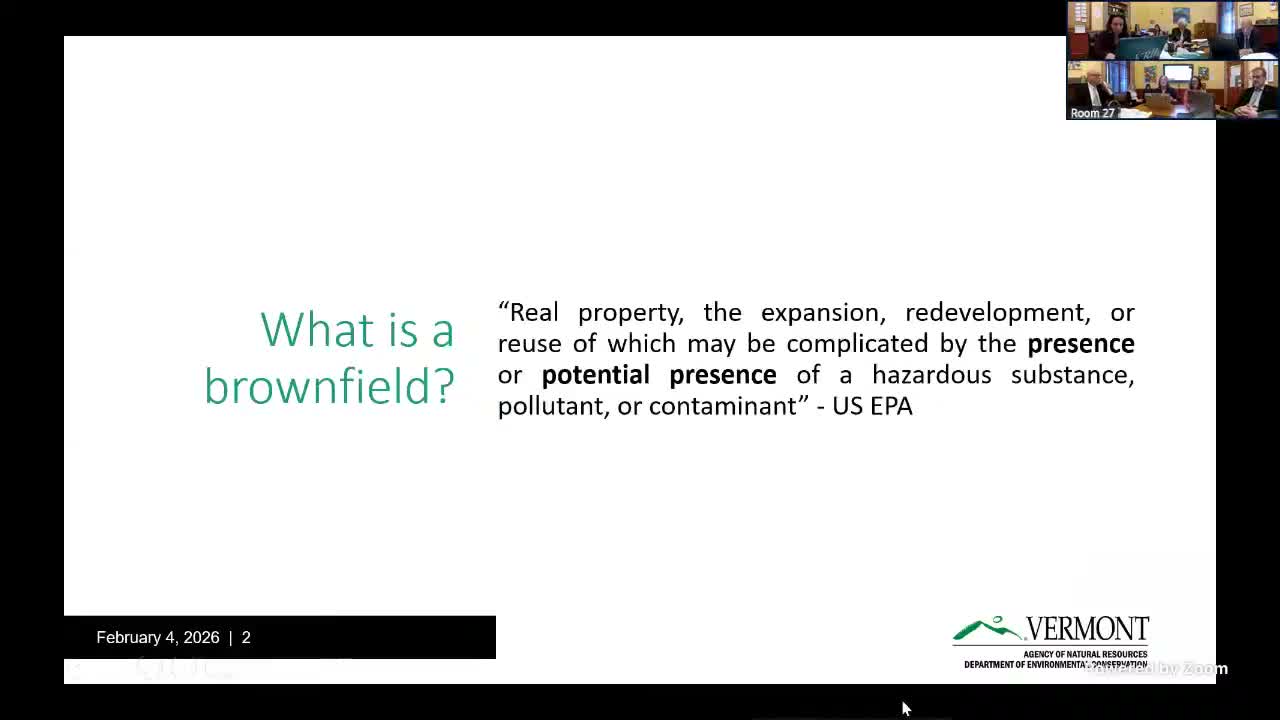
State Department of Environmental Conservation staff presented their Brownfields report to the Economic Development, Housing & General Affairs committee on Feb. 4, describing program strengths, time‑frame constraints and funding gaps for redevelopment projects.
Sarah, Brownfields program coordinator, and Trish Capalino, senior program manager for the contaminated‑sites program, told the committee the state-run Brownfields Reviews and Environmental Liabilities Act provides liability protection to prospective purchasers who complete assessment and cleanup work; the state release does not replace federal liability requirements but it can unlock access to state and federal funding.
Staff summarized stakeholder-survey findings that show participants value liability protection, access to funding, and DEC collaboration, but identified recurring challenges: contaminated‑soil management, regulatory overlap across state and federal programs, long review and implementation timeframes, and insufficient cleanup funds. "We have somewhere in the realm of 240 active Brella sites right now. There are 36 of them that are at the point in their process where they could be implementing the CAP ... and for those 36 only, we're looking at a need of about $10,000,000," staff said. The presenters added that 15 of those 36 include a housing component.
Staff recommended several steps: pilot and expand new contaminated‑soil management options, create an online hub for soil guidance, target fast-track options for privately or state‑funded projects (not federal HUD/EPA funded projects), collect better data on review times and funding needs, and continue to work with federal partners to seek flexibility on sequencing of reviews where possible. Committee members asked for more detail on regulatory overlaps and welcomed additional analysis of streamlining options. No appropriation was approved at the hearing.
Sarah, Brownfields program coordinator, and Trish Capalino, senior program manager for the contaminated‑sites program, told the committee the state-run Brownfields Reviews and Environmental Liabilities Act provides liability protection to prospective purchasers who complete assessment and cleanup work; the state release does not replace federal liability requirements but it can unlock access to state and federal funding.
Staff summarized stakeholder-survey findings that show participants value liability protection, access to funding, and DEC collaboration, but identified recurring challenges: contaminated‑soil management, regulatory overlap across state and federal programs, long review and implementation timeframes, and insufficient cleanup funds. "We have somewhere in the realm of 240 active Brella sites right now. There are 36 of them that are at the point in their process where they could be implementing the CAP ... and for those 36 only, we're looking at a need of about $10,000,000," staff said. The presenters added that 15 of those 36 include a housing component.
Staff recommended several steps: pilot and expand new contaminated‑soil management options, create an online hub for soil guidance, target fast-track options for privately or state‑funded projects (not federal HUD/EPA funded projects), collect better data on review times and funding needs, and continue to work with federal partners to seek flexibility on sequencing of reviews where possible. Committee members asked for more detail on regulatory overlaps and welcomed additional analysis of streamlining options. No appropriation was approved at the hearing.
View the Full Meeting & All Its Details
This article offers just a summary. Unlock complete video, transcripts, and insights as a Founder Member.
✓
Watch full, unedited meeting videos
✓
Search every word spoken in unlimited transcripts
✓
AI summaries & real-time alerts (all government levels)
✓
Permanent access to expanding government content
30-day money-back guarantee
