Resident urges Carmel-by-the-Sea to adopt 0–5‑foot ember‑resistant defensible‑space standard
February 05, 2026 | Carmel-by-the-Sea, Monterey County, California
This article was created by AI summarizing key points discussed. AI makes mistakes, so for full details and context, please refer to the video of the full meeting. Please report any errors so we can fix them. Report an error »
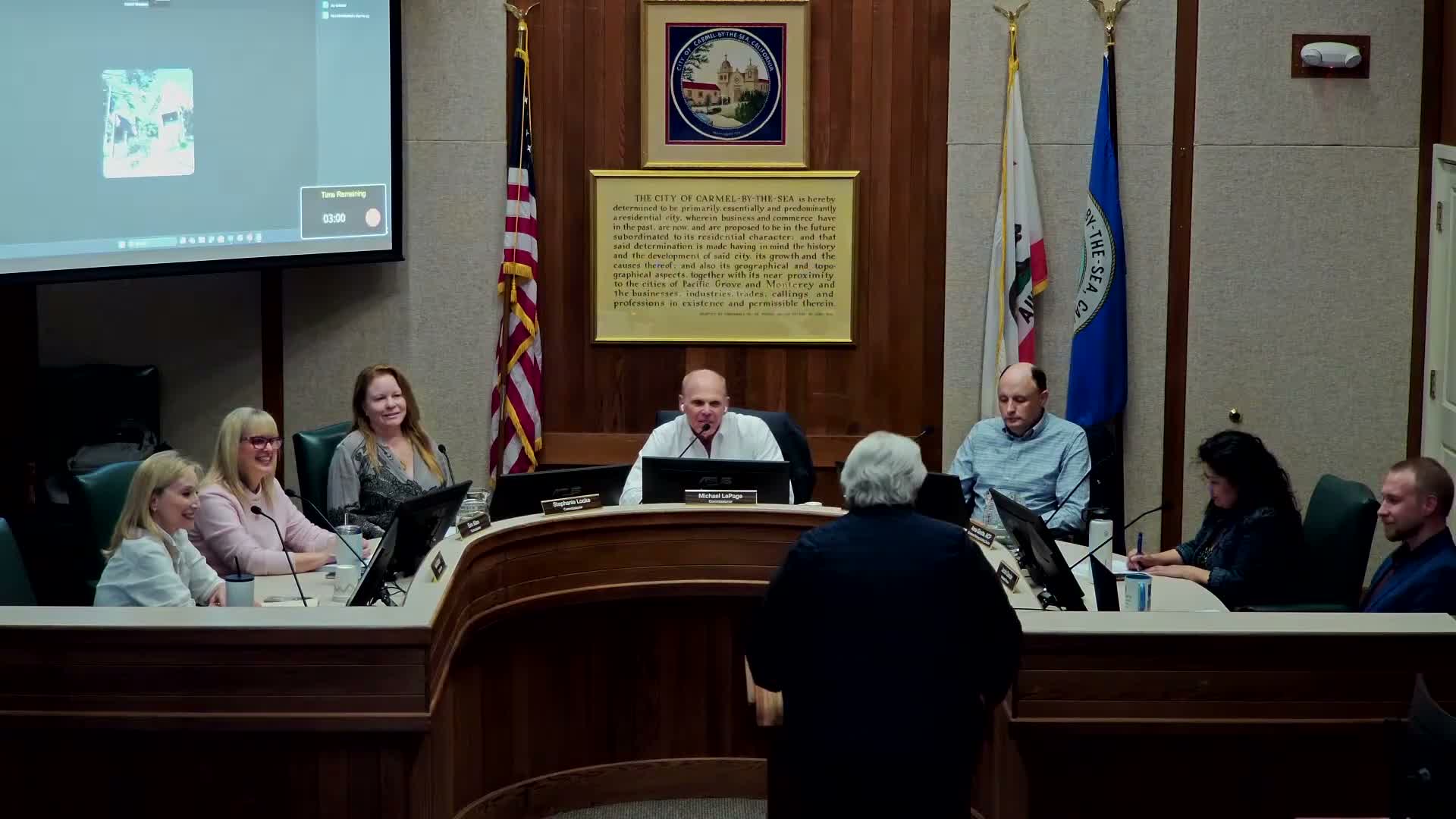
Frank Perry urged the Carmel-by-the-Sea Planning Commission to adopt a 0–5‑foot ember‑resistant defensible‑space standard during public comment at a special meeting. He said embers, not direct flame, most often cause home ignition and recommended allowing noncombustible alternatives such as hardscaping and pavers in the immediate perimeter to reduce ignition risk while preserving aesthetics.
Perry, who identified himself as a Carmel‑by‑the‑Sea resident, said communities like Carmel‑by‑the‑Sea are especially vulnerable because of dense vegetation, older and smaller lots, narrow streets and a number of second homes. Citing guidance from Cal Fire and the California State Fire Marshal, he argued that bare dirt as a 0–5‑foot treatment is “generally discouraged because it is ineffective and potentially harmful,” and that wind‑blown embers commonly ignite mulch, leaf litter and dense plantings adjacent to structures.
“Wildfires in communities like ours do not destroy homes primarily through walls of flame. They destroy homes through wind driven embers,” Perry said. He listed practical concerns with a bare‑earth approach — aesthetics, maintenance burden, and potential insurance difficulties — and recommended allowing noncombustible surfaces and explicit lot‑coverage allowances in Wildland‑Urban Interface (WUI) areas so homeowners can comply without losing functional landscaping.
Renata Perry, who identified herself as Frank Perry’s wife, offered a longer written version of their remarks and asked where to submit supplemental materials; the commission invited them to provide the documents to staff.
The comment was part of a short public‑comment period; the commission did not take action on the proposal at the meeting. Chair LePage noted that the commission would discuss related residential design guidelines at a Feb. 18 meeting.
Perry, who identified himself as a Carmel‑by‑the‑Sea resident, said communities like Carmel‑by‑the‑Sea are especially vulnerable because of dense vegetation, older and smaller lots, narrow streets and a number of second homes. Citing guidance from Cal Fire and the California State Fire Marshal, he argued that bare dirt as a 0–5‑foot treatment is “generally discouraged because it is ineffective and potentially harmful,” and that wind‑blown embers commonly ignite mulch, leaf litter and dense plantings adjacent to structures.
“Wildfires in communities like ours do not destroy homes primarily through walls of flame. They destroy homes through wind driven embers,” Perry said. He listed practical concerns with a bare‑earth approach — aesthetics, maintenance burden, and potential insurance difficulties — and recommended allowing noncombustible surfaces and explicit lot‑coverage allowances in Wildland‑Urban Interface (WUI) areas so homeowners can comply without losing functional landscaping.
Renata Perry, who identified herself as Frank Perry’s wife, offered a longer written version of their remarks and asked where to submit supplemental materials; the commission invited them to provide the documents to staff.
The comment was part of a short public‑comment period; the commission did not take action on the proposal at the meeting. Chair LePage noted that the commission would discuss related residential design guidelines at a Feb. 18 meeting.
Don't Miss a Word: See the Full Meeting!
Go beyond summaries. Unlock every video, transcript, and key insight with a Founder Membership.
✓
Get instant access to full meeting videos
✓
Search and clip any phrase from complete transcripts
✓
Receive AI-powered summaries & custom alerts
✓
Enjoy lifetime, unrestricted access to government data
30-day money-back guarantee
