Vermont State Colleges chancellor asks for targeted funding as enrollment and workforce needs shift
February 05, 2026 | Education, HOUSE OF REPRESENTATIVES, Committees, Legislative , Vermont
This article was created by AI summarizing key points discussed. AI makes mistakes, so for full details and context, please refer to the video of the full meeting. Please report any errors so we can fix them. Report an error »
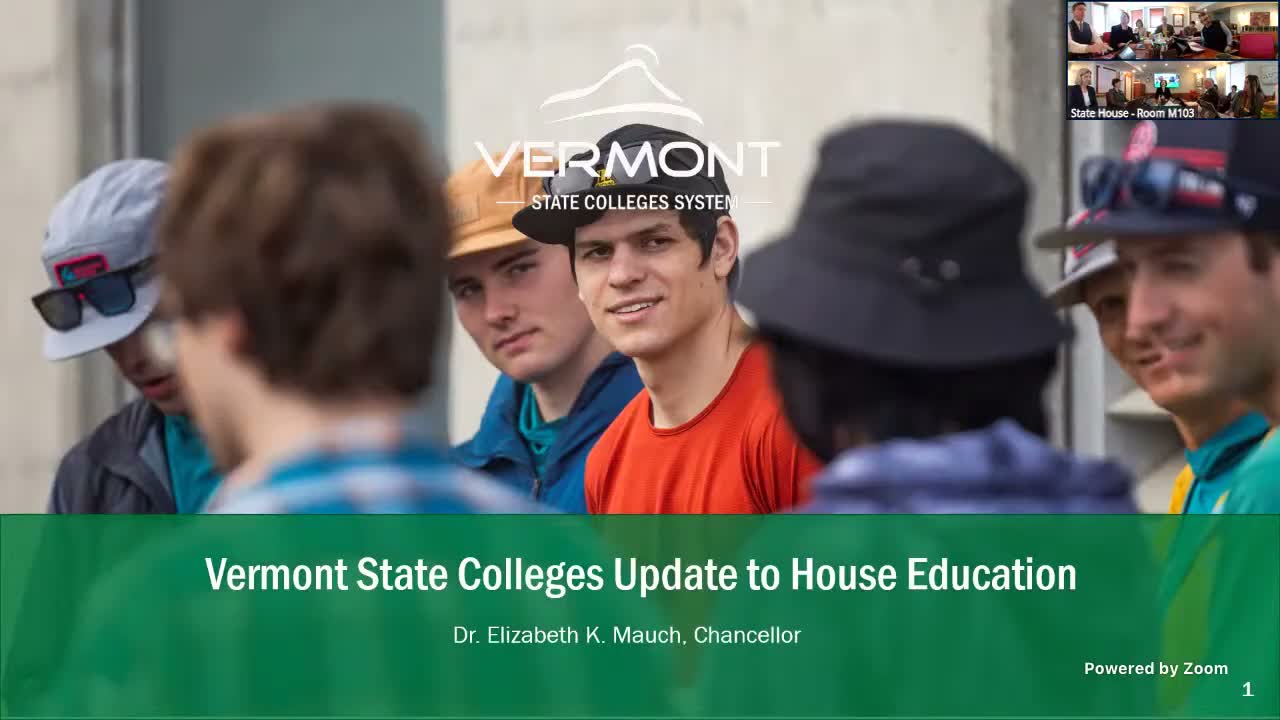
The chancellor of the Vermont State Colleges System told the House Education Committee on Feb. 4 that the system is seeing modest enrollment growth, strong licensure outcomes in nursing and a shift toward online and workforce-focused programs that will shape the FY27 budget request.
The presentation said 83% of students are Vermont residents and that the system’s nursing students take the NCLEX in Vermont at rates above 90 percent; first-attempt pass rates were described as "nearly a 100% for some students" and generally "in the high nineties." Enrollment rose about 1.4% last fall, and the chancellor said distance-education enrollments increased roughly 10% as more older, working students pursue flexible, fully remote study options. "We want to ensure that Vermont and Vermonters have access to high quality higher education regardless of their income or their location," the chancellor said.
On workforce training, the chancellor highlighted the Career Pathway Entry Program (referred to in the presentation as CPIP/CPEP), a Community College of Vermont initiative that places students with multiple internships while they earn credit; she said 21 employers currently participate. The system also has expanded training for plumbers and electricians and launched an "English for health care" course to help new Americans enter healthcare professions. The chancellor said the system is exploring microcredentials as a workforce driver.
For teacher preparation, the chancellor described a stackable credential pathway—paraeducator certificate to associate degree to Vermont State University elementary education degree—developed with the Agency of Education and Department of Labor. She cited an estimate from "Vermont's Most Promising Jobs" (a Department of Labor and McClure Foundation collaboration) that the state will need about 7,400 teachers over the next decade; she said even half that number would represent a substantial demand.
The FY27 budget request includes a 3% base increase that the governor recommended, one-time funding proposals for a microcredential certificate (not included in the governor’s recommendation), a capital request of $1,000,000 to prepare a Johnson campus apartment site, and allied-health funding. The chancellor said the system requested $4,000,000 for allied health but historically has received $1,500,000; the FY27 recommendation included $1,500,000. "This request would allow us to... fund our nursing faculty at a level that would allow them to... become a college faculty member," the chancellor said about the allied-health ask.
The chancellor also said Johnson’s McClellan Building is being repurposed with senior housing through a Downstreet community development block grant for disaster relief and additional support referenced from "Senator Sanders," and that the Johnson Health Center plans to offer services on campus, creating potential student internship opportunities. She said existing Johnson student apartments are full and the system is exploring additional apartments that could serve students and community members.
The chancellor expressed support for the Vermont Student Assistance Corporation (VSAC) proposal for "Freedom and Unity" scholarships at Vermont State University, noting a one-time $1,500,000 allocation this academic year and that VSAC has requested $2,300,000 to expand the program. The chancellor said affordability programs at the Community College of Vermont that cover tuition for families earning $100,000 or less have driven enrollment increases there.
Committee members asked about advising for stackable credentials, the per-student cost of dual-enrollment vouchers (the chancellor said staff would follow up with a number), and the end of prior bridge funding. The committee set a reconvene time of 1:15 to pursue outstanding questions.
What happens next: committee members said they will meet with legislative counsel to resolve outstanding technical questions and the committee will reconvene at 1:15. The chancellor said staff will provide follow-up details on dual-enrollment finance on request.
The presentation said 83% of students are Vermont residents and that the system’s nursing students take the NCLEX in Vermont at rates above 90 percent; first-attempt pass rates were described as "nearly a 100% for some students" and generally "in the high nineties." Enrollment rose about 1.4% last fall, and the chancellor said distance-education enrollments increased roughly 10% as more older, working students pursue flexible, fully remote study options. "We want to ensure that Vermont and Vermonters have access to high quality higher education regardless of their income or their location," the chancellor said.
On workforce training, the chancellor highlighted the Career Pathway Entry Program (referred to in the presentation as CPIP/CPEP), a Community College of Vermont initiative that places students with multiple internships while they earn credit; she said 21 employers currently participate. The system also has expanded training for plumbers and electricians and launched an "English for health care" course to help new Americans enter healthcare professions. The chancellor said the system is exploring microcredentials as a workforce driver.
For teacher preparation, the chancellor described a stackable credential pathway—paraeducator certificate to associate degree to Vermont State University elementary education degree—developed with the Agency of Education and Department of Labor. She cited an estimate from "Vermont's Most Promising Jobs" (a Department of Labor and McClure Foundation collaboration) that the state will need about 7,400 teachers over the next decade; she said even half that number would represent a substantial demand.
The FY27 budget request includes a 3% base increase that the governor recommended, one-time funding proposals for a microcredential certificate (not included in the governor’s recommendation), a capital request of $1,000,000 to prepare a Johnson campus apartment site, and allied-health funding. The chancellor said the system requested $4,000,000 for allied health but historically has received $1,500,000; the FY27 recommendation included $1,500,000. "This request would allow us to... fund our nursing faculty at a level that would allow them to... become a college faculty member," the chancellor said about the allied-health ask.
The chancellor also said Johnson’s McClellan Building is being repurposed with senior housing through a Downstreet community development block grant for disaster relief and additional support referenced from "Senator Sanders," and that the Johnson Health Center plans to offer services on campus, creating potential student internship opportunities. She said existing Johnson student apartments are full and the system is exploring additional apartments that could serve students and community members.
The chancellor expressed support for the Vermont Student Assistance Corporation (VSAC) proposal for "Freedom and Unity" scholarships at Vermont State University, noting a one-time $1,500,000 allocation this academic year and that VSAC has requested $2,300,000 to expand the program. The chancellor said affordability programs at the Community College of Vermont that cover tuition for families earning $100,000 or less have driven enrollment increases there.
Committee members asked about advising for stackable credentials, the per-student cost of dual-enrollment vouchers (the chancellor said staff would follow up with a number), and the end of prior bridge funding. The committee set a reconvene time of 1:15 to pursue outstanding questions.
What happens next: committee members said they will meet with legislative counsel to resolve outstanding technical questions and the committee will reconvene at 1:15. The chancellor said staff will provide follow-up details on dual-enrollment finance on request.
Don't Miss a Word: See the Full Meeting!
Go beyond summaries. Unlock every video, transcript, and key insight with a Founder Membership.
✓
Get instant access to full meeting videos
✓
Search and clip any phrase from complete transcripts
✓
Receive AI-powered summaries & custom alerts
✓
Enjoy lifetime, unrestricted access to government data
30-day money-back guarantee
