Hawaii P‑20 tells Senate committee it is expanding literacy, FAFSA and CTE supports
January 31, 2026 | Senate Committee on Education, Senate, Legislative , Hawaii
This article was created by AI summarizing key points discussed. AI makes mistakes, so for full details and context, please refer to the video of the full meeting. Please report any errors so we can fix them. Report an error »
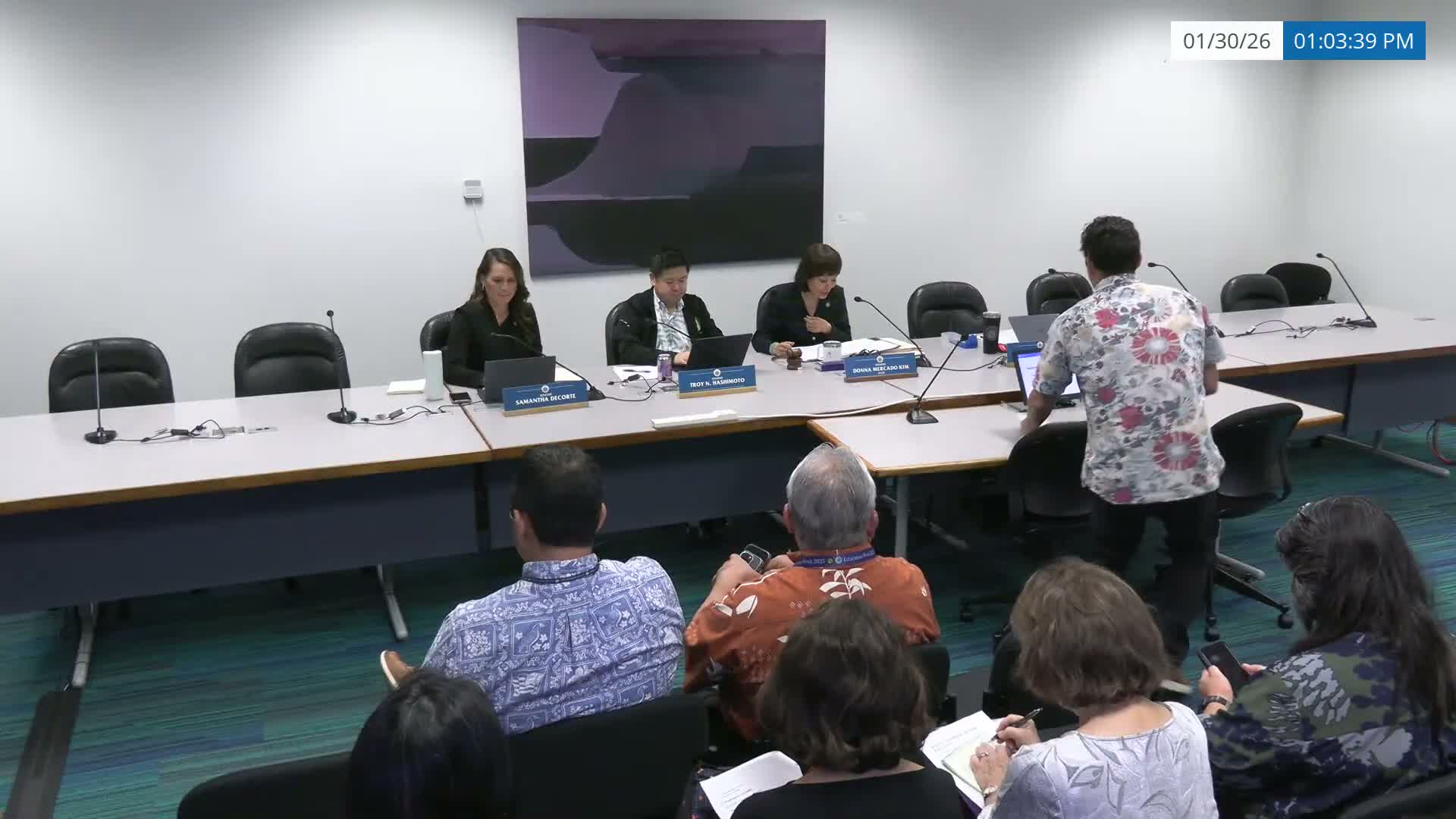
Steven Shotts, executive director of Hawaii P‑20 Partnerships for Education, told the Senate Committee on Education on Jan. 30 that P‑20’s core purpose is “to strengthen the educational pipeline,” focusing on transitions from early education through workforce entry. Shotts said the organization combines a convening role—working with the University of Hawaii, the K‑12 public school system and the Executive Office of Early Learning—with direct services such as the federal GEAR UP grant and pathway supports.
Shotts listed four strategic areas: early care and education; postsecondary readiness and success; career pathways (including career and technical education); and education‑workforce data. He said P‑20 helped develop a statewide literacy plan that laid groundwork for multimillion‑dollar federal grants and piloted a summer‑start kindergarten transition program now operating at about 85 schools after philanthropic seeding and DOE adoption.
On postsecondary access, Shotts said P‑20 has supported FAFSA completion efforts across the state and helped build data sharing infrastructure for direct admissions programs. “We help with FAFSA completion across the state,” he said, adding that Hawaii ranked highly in FAFSA completion during the period covered by his testimony.
Shotts described the federal GEAR UP grant as operating in 27 DOE schools (12 high schools and 15 middle schools) and cited an external evaluation that he said found GEAR UP activities significantly predict on‑time graduation and immediate college enrollment. Angela Jackson, identified in testimony as the GEAR UP director, accompanied Shotts.
Shotts also said every senior graduating from a GEAR UP high school will be eligible for a scholarship aligned to the federal Pell program (administration and award mechanics were not finalized in testimony). He framed ninth‑grade math readiness as a priority for the next GEAR UP cycle and said summer academic components will be mandatory for participating schools.
On career pathways, Shotts said P‑20 has completed CTE pathway maps but that the maps currently serve counselors and CTE leads better than parents or students. He welcomed recent legislative funding to integrate those maps into an easier‑to‑navigate career platform and credited Warren Kawano and other staff for the work. Shotts also described career navigators—P‑20 staff assigned to one to three schools to help seniors plan postsecondary or workforce paths—and said initial qualitative and engagement data looked promising.
Shotts closed by describing a lieutenant‑governor‑requested convening on the teacher shortage and by noting pilot efforts to build teacher pipelines on neighbor islands, including educator‑rising clubs in eight high schools and a “stay at home, grow your own” pathway with UH West Oʻahu and Leeward Community College.
Why it matters: Senators pressing P‑20 sought clearer, public performance metrics. Committee members asked for evidence that pathways and programs lead to local job placements and for aggregate reporting on the number of students served. Shotts acknowledged data limits in some areas (for example, workforce placement detail) and urged continued, cross‑sector coordination. The committee closed P‑20’s briefing and moved to DOE testimony.
Ending: The committee thanked P‑20 for the briefing and said it would request additional outcome metrics and follow‑up material showing how P‑20 ties programs to state workforce needs.
Shotts listed four strategic areas: early care and education; postsecondary readiness and success; career pathways (including career and technical education); and education‑workforce data. He said P‑20 helped develop a statewide literacy plan that laid groundwork for multimillion‑dollar federal grants and piloted a summer‑start kindergarten transition program now operating at about 85 schools after philanthropic seeding and DOE adoption.
On postsecondary access, Shotts said P‑20 has supported FAFSA completion efforts across the state and helped build data sharing infrastructure for direct admissions programs. “We help with FAFSA completion across the state,” he said, adding that Hawaii ranked highly in FAFSA completion during the period covered by his testimony.
Shotts described the federal GEAR UP grant as operating in 27 DOE schools (12 high schools and 15 middle schools) and cited an external evaluation that he said found GEAR UP activities significantly predict on‑time graduation and immediate college enrollment. Angela Jackson, identified in testimony as the GEAR UP director, accompanied Shotts.
Shotts also said every senior graduating from a GEAR UP high school will be eligible for a scholarship aligned to the federal Pell program (administration and award mechanics were not finalized in testimony). He framed ninth‑grade math readiness as a priority for the next GEAR UP cycle and said summer academic components will be mandatory for participating schools.
On career pathways, Shotts said P‑20 has completed CTE pathway maps but that the maps currently serve counselors and CTE leads better than parents or students. He welcomed recent legislative funding to integrate those maps into an easier‑to‑navigate career platform and credited Warren Kawano and other staff for the work. Shotts also described career navigators—P‑20 staff assigned to one to three schools to help seniors plan postsecondary or workforce paths—and said initial qualitative and engagement data looked promising.
Shotts closed by describing a lieutenant‑governor‑requested convening on the teacher shortage and by noting pilot efforts to build teacher pipelines on neighbor islands, including educator‑rising clubs in eight high schools and a “stay at home, grow your own” pathway with UH West Oʻahu and Leeward Community College.
Why it matters: Senators pressing P‑20 sought clearer, public performance metrics. Committee members asked for evidence that pathways and programs lead to local job placements and for aggregate reporting on the number of students served. Shotts acknowledged data limits in some areas (for example, workforce placement detail) and urged continued, cross‑sector coordination. The committee closed P‑20’s briefing and moved to DOE testimony.
Ending: The committee thanked P‑20 for the briefing and said it would request additional outcome metrics and follow‑up material showing how P‑20 ties programs to state workforce needs.
Don't Miss a Word: See the Full Meeting!
Go beyond summaries. Unlock every video, transcript, and key insight with a Founder Membership.
✓
Get instant access to full meeting videos
✓
Search and clip any phrase from complete transcripts
✓
Receive AI-powered summaries & custom alerts
✓
Enjoy lifetime, unrestricted access to government data
30-day money-back guarantee
