MEPRI: special-education funding under stress; urges regional planning and limits on step-6 spending adjustment
February 03, 2026 | 2026 Legislature ME, Maine
This article was created by AI summarizing key points discussed. AI makes mistakes, so for full details and context, please refer to the video of the full meeting. Please report any errors so we can fix them. Report an error »
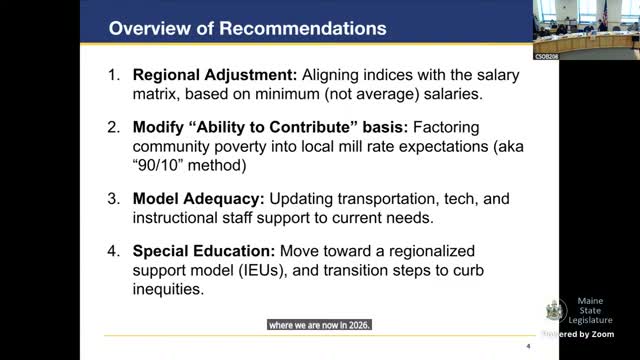
MEPRI told the Legislatures education committee that special-education funding is the most stressed and unevenly distributed portion of the states EPS model.
"Special education is the one area of the model that we've been saying is the most under stress," Amy Johnson said, summarizing MEPRIs review. She explained that the states special-education allocation uses a multi-part cost model but that a later "step 6" maintenance-of-effort/expenditure adjustment effectively brings some SAUs up to their prior spending levels, creating a reimbursement-like element that has grown and now disproportionately benefits wealthier districts.
MEPRI presented two narrow transition options and a longer-term strategy. Short-term options included freezing or reducing step-6 growth (a targeted cap or partial funding of the gap instead of full reimbursement). Long-term options focused on building regionalized special-education infrastructure so districts without scale could access shared programs and related services. MEPRI said it is preparing a separate regional special-education report with concrete options and examples from other states.
Costs and evidence: MEPRI said the step-6 adjustment has been growing year-over-year and provided a presenter estimate of roughly $40 million of cumulative growth in that expenditure-based adjustment; the institute recommended at minimum stopping further growth while policymakers consider structural reforms. MEPRI also described transition tools (hardship criteria adjustments, spring true-up reconsideration) to reduce incentives for out-of-district placements and to provide more flexible midyear assistance.
Why it matters: Committee members said special-ed costs drive local budget pressures and affect program access, least-restrictive-environment considerations, and local taxation. MEPRI cautioned the committee that regionalization is complex, requires statutory and funding-structure decisions, and will likely take time to implement.
Next steps: MEPRI will deliver a separate regional special-education report (draft due late February) with more concrete simulations and options; the committee indicated it would use that report to evaluate statutory or programmatic changes.
Ending: The committee agreed to review MEPRIs regional special-education report in a future meeting and discuss possible follow-up legislation if policymakers decide to pursue the reforms.
"Special education is the one area of the model that we've been saying is the most under stress," Amy Johnson said, summarizing MEPRIs review. She explained that the states special-education allocation uses a multi-part cost model but that a later "step 6" maintenance-of-effort/expenditure adjustment effectively brings some SAUs up to their prior spending levels, creating a reimbursement-like element that has grown and now disproportionately benefits wealthier districts.
MEPRI presented two narrow transition options and a longer-term strategy. Short-term options included freezing or reducing step-6 growth (a targeted cap or partial funding of the gap instead of full reimbursement). Long-term options focused on building regionalized special-education infrastructure so districts without scale could access shared programs and related services. MEPRI said it is preparing a separate regional special-education report with concrete options and examples from other states.
Costs and evidence: MEPRI said the step-6 adjustment has been growing year-over-year and provided a presenter estimate of roughly $40 million of cumulative growth in that expenditure-based adjustment; the institute recommended at minimum stopping further growth while policymakers consider structural reforms. MEPRI also described transition tools (hardship criteria adjustments, spring true-up reconsideration) to reduce incentives for out-of-district placements and to provide more flexible midyear assistance.
Why it matters: Committee members said special-ed costs drive local budget pressures and affect program access, least-restrictive-environment considerations, and local taxation. MEPRI cautioned the committee that regionalization is complex, requires statutory and funding-structure decisions, and will likely take time to implement.
Next steps: MEPRI will deliver a separate regional special-education report (draft due late February) with more concrete simulations and options; the committee indicated it would use that report to evaluate statutory or programmatic changes.
Ending: The committee agreed to review MEPRIs regional special-education report in a future meeting and discuss possible follow-up legislation if policymakers decide to pursue the reforms.
View the Full Meeting & All Its Details
This article offers just a summary. Unlock complete video, transcripts, and insights as a Founder Member.
✓
Watch full, unedited meeting videos
✓
Search every word spoken in unlimited transcripts
✓
AI summaries & real-time alerts (all government levels)
✓
Permanent access to expanding government content
30-day money-back guarantee
