Glendale council approves ASOZ amendments for animated signs; critics say process sidestepped historic review
February 04, 2026 | Glendale, Los Angeles County, California
This article was created by AI summarizing key points discussed. AI makes mistakes, so for full details and context, please refer to the video of the full meeting. Please report any errors so we can fix them. Report an error »
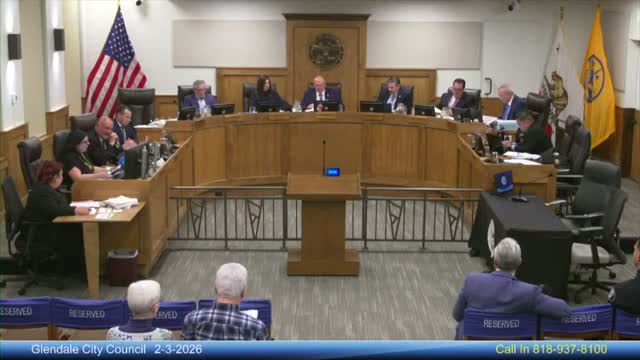
The Glendale City Council on Feb. 3 adopted zoning amendments to expand an Advertising Signage Overlay Zone (ASOZ) and permit two animated wall signs on properties in the Americana/Galleria area, after an often‑heated public hearing that focused on historic preservation, process transparency and the city’s budget need for revenue.
Staff described the amendments (Case PZC‑14‑2025) as an expansion of the ASOZ to incorporate 230–238 S. Brand Boulevard and said a companion statutory development agreement would memorialize public benefits. Several residents and preservation experts urged postponing action, arguing the staff and applicant‑hired consultant's report was incomplete and that the Historic Preservation Commission (HPC) was not given a full advisory review.
"This ordinance is tailor‑made for a billionaire developer of the Americana," speaker Beth Brooks said, urging the council not to prioritize a private applicant over the public interest. Several speakers said pages of the Architectural Resources Group (ARG) historic consultant report were missing from earlier agenda materials, which staff confirmed was an administrative duplication/duplexing error when the packet was prepared; staff subsequently uploaded the full report.
Daniel Paul, chair of the Historic Preservation Commission and an architectural historian, told the council he had not received the complete ARG report and said he found limited analysis specific to LED/digital sign impacts on the historic resource. He requested the item be postponed for HPC review.
Applicant representatives, including Chris Robertson of the Caruso organization and the applicant’s counsel, argued the project had planning‑commission support, would generate revenue and community benefits at no cost to the city, and that staff and ARG concluded the signs were compatible with the Secretary of the Interior’s Standards for Rehabilitation.
Council debate split along lines of process and pragmatism. Several councilmembers said they would have preferred an HPC review and clearer documentation of lighting and PSA commitments; others said the city faces a significant budget gap and the project could help generate revenue without public capital outlay. City staff explained that, under the municipal code, the threshold for mandatory HPC review is defined by the code’s major‑alteration criteria (e.g., additions exceeding specified square footage) and that the proposed sign attachments qualified as minor alterations and were therefore not required to go before the HPC. Staff noted the ARG report and a lighting analysis informed that determination.
Council voted to adopt the two ordinances to amend the code and expand the ASOZ boundary. On the related development agreement, the council directed staff to negotiate improved terms addressing revenue share, the number/frequency and timing of public service announcements on the signs, and lighting/illumination limits, and authorized the city manager and city attorney to finalize the agreement language for execution and to return the signed development agreement for the record.
Councilmembers asked staff to seek clearer commitments on the amount and timing of city PSAs, to tighten lighting limits to reduce night‑time spill and glare, and to pursue a more favorable revenue share or minimum guaranteed payment as part of the development agreement negotiations. The motion to adopt the zoning changes carried in roll‑call votes; the development agreement will return after staff and the applicant conclude those negotiations.
Staff described the amendments (Case PZC‑14‑2025) as an expansion of the ASOZ to incorporate 230–238 S. Brand Boulevard and said a companion statutory development agreement would memorialize public benefits. Several residents and preservation experts urged postponing action, arguing the staff and applicant‑hired consultant's report was incomplete and that the Historic Preservation Commission (HPC) was not given a full advisory review.
"This ordinance is tailor‑made for a billionaire developer of the Americana," speaker Beth Brooks said, urging the council not to prioritize a private applicant over the public interest. Several speakers said pages of the Architectural Resources Group (ARG) historic consultant report were missing from earlier agenda materials, which staff confirmed was an administrative duplication/duplexing error when the packet was prepared; staff subsequently uploaded the full report.
Daniel Paul, chair of the Historic Preservation Commission and an architectural historian, told the council he had not received the complete ARG report and said he found limited analysis specific to LED/digital sign impacts on the historic resource. He requested the item be postponed for HPC review.
Applicant representatives, including Chris Robertson of the Caruso organization and the applicant’s counsel, argued the project had planning‑commission support, would generate revenue and community benefits at no cost to the city, and that staff and ARG concluded the signs were compatible with the Secretary of the Interior’s Standards for Rehabilitation.
Council debate split along lines of process and pragmatism. Several councilmembers said they would have preferred an HPC review and clearer documentation of lighting and PSA commitments; others said the city faces a significant budget gap and the project could help generate revenue without public capital outlay. City staff explained that, under the municipal code, the threshold for mandatory HPC review is defined by the code’s major‑alteration criteria (e.g., additions exceeding specified square footage) and that the proposed sign attachments qualified as minor alterations and were therefore not required to go before the HPC. Staff noted the ARG report and a lighting analysis informed that determination.
Council voted to adopt the two ordinances to amend the code and expand the ASOZ boundary. On the related development agreement, the council directed staff to negotiate improved terms addressing revenue share, the number/frequency and timing of public service announcements on the signs, and lighting/illumination limits, and authorized the city manager and city attorney to finalize the agreement language for execution and to return the signed development agreement for the record.
Councilmembers asked staff to seek clearer commitments on the amount and timing of city PSAs, to tighten lighting limits to reduce night‑time spill and glare, and to pursue a more favorable revenue share or minimum guaranteed payment as part of the development agreement negotiations. The motion to adopt the zoning changes carried in roll‑call votes; the development agreement will return after staff and the applicant conclude those negotiations.
Don't Miss a Word: See the Full Meeting!
Go beyond summaries. Unlock every video, transcript, and key insight with a Founder Membership.
✓
Get instant access to full meeting videos
✓
Search and clip any phrase from complete transcripts
✓
Receive AI-powered summaries & custom alerts
✓
Enjoy lifetime, unrestricted access to government data
30-day money-back guarantee
