El Paso council directs staff to study ways to block ICE detention facilities, votes unanimously
February 04, 2026 | El Paso City, El Paso County, Texas
This article was created by AI summarizing key points discussed. AI makes mistakes, so for full details and context, please refer to the video of the full meeting. Please report any errors so we can fix them. Report an error »
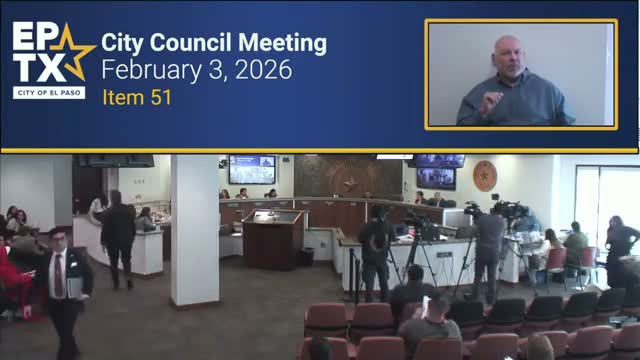
El Paso City Council on Feb. 3 voted unanimously to direct the city manager and city attorney to develop a plan of action aimed at preventing the installation of any Immigration and Customs Enforcement detention facilities in the city and to coordinate with El Paso County.
The final motion, as amended, also directs staff to report back within 60 days on three specific items: create and present a protocol that would prevent federal law enforcement officers from entering any city facility to search, detain or arrest a person without a signed judicial warrant; explore a moratorium on permitting, zoning and licensing for ICE facilities; and produce a report listing all points of cooperation between the City of El Paso and ICE.
The item was introduced by Representative Limon and Representative Canales. Limon framed the measure as a legal and political plan to oppose any future detention sites, saying the city must be ready and proactive even where it does not have unilateral authority. Representative Limon said, “ICE, you’re not welcome in the city of El Paso,” and urged council to direct staff to identify lawful tools to push back where possible.
Supporters and opponents raised limits on local authority in the debate. Renee Leon, a representative from El Paso Water, told council the utility could advise staff on water-service questions but asked not to be listed as a formal supporter: “we would request to be removed from any item supporting this,” she said, noting state law limits the utility’s authority to deny service. The body agreed to an amendment to strike El Paso Water from the language and instead seek its informational support; that amendment passed 4-3.
Representative Acevedo proposed — and the council adopted unanimously — a second amendment adding the detailed 60‑day research and report-back tasks described above. City Attorney staff said they can provide initial legal analysis within the requested time frame and clarified that the motion directs study and recommendations rather than immediate prohibitions.
The council heard extensive public comment from dozens of residents and advocacy groups during a sustained public-comment period. Speakers who supported the motion cited reported deaths, alleged abuses, and poor conditions at existing detention centers in the area, and warned of local public-safety and economic impacts if a large warehousing-style detention site were sited nearby. Charlotte Weiss of the Texas Civil Rights Project said her organization has documented repeated medical and safety failures at existing facilities and called for the council to act. Carmelo Brolick told the council, “The actions of ICE are inhumane and unjust,” and urged adoption of protections. Several speakers urged the council to use every lawful tool and to demand transparency and timelines from staff.
Council members repeatedly stressed that the direction given is investigatory and procedural, not a city-level ban that could violate federal supremacy. Representative Canales, one of the motion’s sponsors, said the item is meant to identify what tools the city can lawfully use and to ensure the city will not be caught off-guard. “We can set forth a policy that says loudly and clearly, ICE, you’re not welcome in the city of El Paso,” Canales said, while acknowledging legal limits and the need to coordinate with other jurisdictions and agencies.
The final vote approved the motion as amended unanimously. Council members also recorded several related votes earlier in the meeting on housing resolutions, appointments and procurement items.
Votes at a glance
- Item 34 (directive to city manager and city attorney regarding ICE facilities, includes 60‑day report language): Passed unanimously (vote recorded after public comment).
- Amendments: Strike “El Paso Water” from the motion — passed 4-3; add 60‑day research and reporting tasks — passed unanimously.
- Other votes that day included resolutions supporting Cielo Towers 2, East Side Crossings 2 and Siesta Garden (approved), and several contract awards and appointments (see meeting minutes).
What happens next
City management and the city attorney will research legal and operational options and return to council with a report within the 60‑day timeframe specified in the amendment. The report is expected to include the protocol language, an assessment of the legality and feasibility of a moratorium on permitting/zoning/licensing for ICE facilities, and an inventory of cooperative touchpoints between the city and ICE. Council members said they expect public updates and additional opportunities for community input when staff returns with recommendations.
Reporting note: Quotes and attributions are drawn from the official meeting transcript and public comments recorded during the council meeting. The motion language adopted by council is procedural in scope; the council did not claim new legal authority beyond the research and coordination tasks described.
The final motion, as amended, also directs staff to report back within 60 days on three specific items: create and present a protocol that would prevent federal law enforcement officers from entering any city facility to search, detain or arrest a person without a signed judicial warrant; explore a moratorium on permitting, zoning and licensing for ICE facilities; and produce a report listing all points of cooperation between the City of El Paso and ICE.
The item was introduced by Representative Limon and Representative Canales. Limon framed the measure as a legal and political plan to oppose any future detention sites, saying the city must be ready and proactive even where it does not have unilateral authority. Representative Limon said, “ICE, you’re not welcome in the city of El Paso,” and urged council to direct staff to identify lawful tools to push back where possible.
Supporters and opponents raised limits on local authority in the debate. Renee Leon, a representative from El Paso Water, told council the utility could advise staff on water-service questions but asked not to be listed as a formal supporter: “we would request to be removed from any item supporting this,” she said, noting state law limits the utility’s authority to deny service. The body agreed to an amendment to strike El Paso Water from the language and instead seek its informational support; that amendment passed 4-3.
Representative Acevedo proposed — and the council adopted unanimously — a second amendment adding the detailed 60‑day research and report-back tasks described above. City Attorney staff said they can provide initial legal analysis within the requested time frame and clarified that the motion directs study and recommendations rather than immediate prohibitions.
The council heard extensive public comment from dozens of residents and advocacy groups during a sustained public-comment period. Speakers who supported the motion cited reported deaths, alleged abuses, and poor conditions at existing detention centers in the area, and warned of local public-safety and economic impacts if a large warehousing-style detention site were sited nearby. Charlotte Weiss of the Texas Civil Rights Project said her organization has documented repeated medical and safety failures at existing facilities and called for the council to act. Carmelo Brolick told the council, “The actions of ICE are inhumane and unjust,” and urged adoption of protections. Several speakers urged the council to use every lawful tool and to demand transparency and timelines from staff.
Council members repeatedly stressed that the direction given is investigatory and procedural, not a city-level ban that could violate federal supremacy. Representative Canales, one of the motion’s sponsors, said the item is meant to identify what tools the city can lawfully use and to ensure the city will not be caught off-guard. “We can set forth a policy that says loudly and clearly, ICE, you’re not welcome in the city of El Paso,” Canales said, while acknowledging legal limits and the need to coordinate with other jurisdictions and agencies.
The final vote approved the motion as amended unanimously. Council members also recorded several related votes earlier in the meeting on housing resolutions, appointments and procurement items.
Votes at a glance
- Item 34 (directive to city manager and city attorney regarding ICE facilities, includes 60‑day report language): Passed unanimously (vote recorded after public comment).
- Amendments: Strike “El Paso Water” from the motion — passed 4-3; add 60‑day research and reporting tasks — passed unanimously.
- Other votes that day included resolutions supporting Cielo Towers 2, East Side Crossings 2 and Siesta Garden (approved), and several contract awards and appointments (see meeting minutes).
What happens next
City management and the city attorney will research legal and operational options and return to council with a report within the 60‑day timeframe specified in the amendment. The report is expected to include the protocol language, an assessment of the legality and feasibility of a moratorium on permitting/zoning/licensing for ICE facilities, and an inventory of cooperative touchpoints between the city and ICE. Council members said they expect public updates and additional opportunities for community input when staff returns with recommendations.
Reporting note: Quotes and attributions are drawn from the official meeting transcript and public comments recorded during the council meeting. The motion language adopted by council is procedural in scope; the council did not claim new legal authority beyond the research and coordination tasks described.
View the Full Meeting & All Its Details
This article offers just a summary. Unlock complete video, transcripts, and insights as a Founder Member.
✓
Watch full, unedited meeting videos
✓
Search every word spoken in unlimited transcripts
✓
AI summaries & real-time alerts (all government levels)
✓
Permanent access to expanding government content
30-day money-back guarantee
