Santa Ana council approves three-drone police pilot and vehicle camera updates after heated debate on privacy
February 04, 2026 | Santa Ana , Orange County, California
This article was created by AI summarizing key points discussed. AI makes mistakes, so for full details and context, please refer to the video of the full meeting. Please report any errors so we can fix them. Report an error »
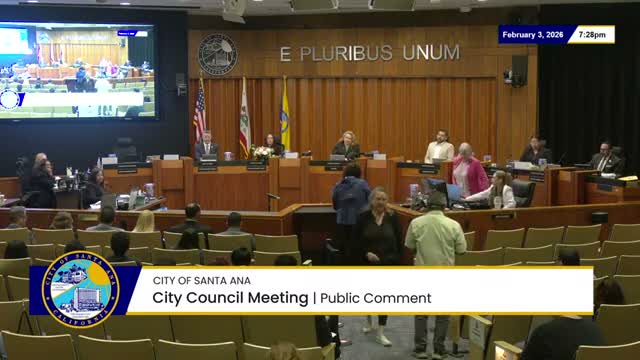
The Santa Ana City Council voted on Feb. 3 to approve a limited police drone pilot and to move forward with vehicle-camera planning after an extended presentation by Police Chief Robert Rodríguez and more than an hour of public comments. The vote followed intense debate about privacy safeguards, data retention and vendor selection.
Police Chief Robert Rodríguez told the council the proposal would field three first-response drones plus two smaller patrol/portable units and that the program is intended to improve officer and public safety by providing real‑time aerial information before officers arrive. Rodríguez said the drones are not intended to be used for continuous surveillance, would not perform facial recognition and would be operated by trained personnel under a department policy (policy draft 606) that limits uses to defined calls for service, search-and-rescue, fires, barricades and comparable incidents. He added the city must obtain an FAA beyond‑visual‑line‑of‑sight exception for full implementation.
Rodríguez framed the program as a cost-saving complement to contracted sheriff air support, noting those contracts can cost roughly "medio 1,000,000 de dólares al año" and that local drones could reduce that expense. He demonstrated vendor models (Skydio R10 and larger remote-response platforms) and described audit logs, evidence handling consistent with body-worn camera practice and limited access to recorded footage.
Opponents in the audience and on Zoom raised repeated privacy and civil‑liberties concerns. Multiple residents said the proposed policy text was "vague and irresponsible" on data retention, review and expansion; others warned about potential sharing of footage with federal agencies, including ICE. One commenter alleged that some drone manufacturers had been used in military contexts abroad; another speaker said the ongoing program costs could grow from initial grants to annual expenditures exceeding $600,000. Those concerns prompted councilmembers to press staff for clearer policy language, transparency and civil‑oversight mechanisms.
Councilmembers asked detailed operational questions: when drones would be activated (chiefly in response to officer calls), maximum flight durations (the chief mentioned examples up to about 49 minutes in some uses), whether footage becomes a public record (the city attorney said recorded evidence would be treated like other police records with SB 54 and other statutory limits applicable), and how mutual-aid or assisted-agency deployments would be handled.
Several councilmembers urged the police to bring the policy back for additional review by the Police Oversight Commission or to incorporate community input before full rollout. A substitute motion to remove item 15 from tonight's agenda failed; the original motion to authorize the acquisition and pilot proceeded and passed (Council approval with four affirmative votes). The council asked staff to return with implementation details, a clear process for public reporting, and an annual audit of the program.
Separately, the council received and filed an informational report on vehicle and body-worn cameras, with members asking that full cost and staffing estimates be folded into future budget discussions.
The council asked staff to: provide a public-facing audit portal or clear access process for drone uses consistent with body-camera practice, confirm SB 54 compliance and any other state privacy obligations, identify the FAA exception timeline, and outline training, background checks and oversight criteria for drone operators. Several members also encouraged a community demonstration of the equipment to demystify capabilities.
The Council did not adopt a final drone policy tonight; instead it approved purchase authority to begin the pilot procurement and directed further work on transparency, vendor review and Police Oversight Commission involvement. The council also scheduled follow-up reporting and budgetary steps as part of the implementation plan.
Police Chief Robert Rodríguez told the council the proposal would field three first-response drones plus two smaller patrol/portable units and that the program is intended to improve officer and public safety by providing real‑time aerial information before officers arrive. Rodríguez said the drones are not intended to be used for continuous surveillance, would not perform facial recognition and would be operated by trained personnel under a department policy (policy draft 606) that limits uses to defined calls for service, search-and-rescue, fires, barricades and comparable incidents. He added the city must obtain an FAA beyond‑visual‑line‑of‑sight exception for full implementation.
Rodríguez framed the program as a cost-saving complement to contracted sheriff air support, noting those contracts can cost roughly "medio 1,000,000 de dólares al año" and that local drones could reduce that expense. He demonstrated vendor models (Skydio R10 and larger remote-response platforms) and described audit logs, evidence handling consistent with body-worn camera practice and limited access to recorded footage.
Opponents in the audience and on Zoom raised repeated privacy and civil‑liberties concerns. Multiple residents said the proposed policy text was "vague and irresponsible" on data retention, review and expansion; others warned about potential sharing of footage with federal agencies, including ICE. One commenter alleged that some drone manufacturers had been used in military contexts abroad; another speaker said the ongoing program costs could grow from initial grants to annual expenditures exceeding $600,000. Those concerns prompted councilmembers to press staff for clearer policy language, transparency and civil‑oversight mechanisms.
Councilmembers asked detailed operational questions: when drones would be activated (chiefly in response to officer calls), maximum flight durations (the chief mentioned examples up to about 49 minutes in some uses), whether footage becomes a public record (the city attorney said recorded evidence would be treated like other police records with SB 54 and other statutory limits applicable), and how mutual-aid or assisted-agency deployments would be handled.
Several councilmembers urged the police to bring the policy back for additional review by the Police Oversight Commission or to incorporate community input before full rollout. A substitute motion to remove item 15 from tonight's agenda failed; the original motion to authorize the acquisition and pilot proceeded and passed (Council approval with four affirmative votes). The council asked staff to return with implementation details, a clear process for public reporting, and an annual audit of the program.
Separately, the council received and filed an informational report on vehicle and body-worn cameras, with members asking that full cost and staffing estimates be folded into future budget discussions.
The council asked staff to: provide a public-facing audit portal or clear access process for drone uses consistent with body-camera practice, confirm SB 54 compliance and any other state privacy obligations, identify the FAA exception timeline, and outline training, background checks and oversight criteria for drone operators. Several members also encouraged a community demonstration of the equipment to demystify capabilities.
The Council did not adopt a final drone policy tonight; instead it approved purchase authority to begin the pilot procurement and directed further work on transparency, vendor review and Police Oversight Commission involvement. The council also scheduled follow-up reporting and budgetary steps as part of the implementation plan.
View the Full Meeting & All Its Details
This article offers just a summary. Unlock complete video, transcripts, and insights as a Founder Member.
✓
Watch full, unedited meeting videos
✓
Search every word spoken in unlimited transcripts
✓
AI summaries & real-time alerts (all government levels)
✓
Permanent access to expanding government content
30-day money-back guarantee
