New Canaan subcommittee sets late‑April public meeting to show three affordable‑housing options, seeks public trade‑off input
February 04, 2026 | New Canaan, Fairfield, Connecticut
This article was created by AI summarizing key points discussed. AI makes mistakes, so for full details and context, please refer to the video of the full meeting. Please report any errors so we can fix them. Report an error »
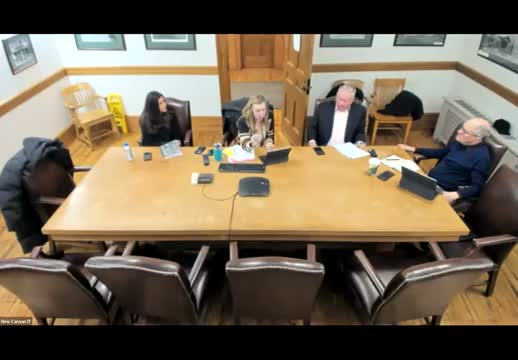
Krista, a member of the Town of New Canaan Affordable Housing Committee Project Development Subcommittee, said the group will hold a public meeting the week of April 20 to show three conceptual site schemes (Locust Avenue, the Lumberyard and Richmond Hill) and solicit public feedback on the trade‑offs involved in delivering the units needed to meet town moratorium goals.
Why it matters: The subcommittee’s work will inform a recommendation to the full Affordable Housing Committee and then to the board of selectmen, board of finance and town council, which has ultimate authority over town land and any project approvals. Members said they want the meeting to be educational—showing how the committee narrowed options and asking residents to rank which trade‑offs they will tolerate—rather than to finalize a single preferred plan.
What the subcommittee presented: Krista gave high‑level cost assumptions the group is using for planning: “based on just a generic $550,000 per unit and $30,000 per parking spot,” and used those assumptions to produce ballpark ranges. Under that approach she said Locust Avenue concepts come in around $48 million to $56 million, while Lumberyard schemes are in the $104 million to $108 million range. She cautioned these were preliminary orders of magnitude and that parking structures, commercial space and constructability could push per‑unit costs higher or lower.
What members asked staff to do: The committee agreed to ask town staff who attended the site walk (named in the meeting as Tiger, Maria Coplett, Sarah Carey and Kathleen Holland) to review the concept drawings and provide feedback on constructability, parking and infrastructure. Members also asked the parking administrator (staff) for data on current parking usage and trends—commuter permits, employee permits and any waiting lists—for each site so the public meeting can present clear information about short‑ and long‑term parking impacts.
Finance homework: Members assigned the finance subcommittee to begin assembling funding‑pathway scenarios and ballpark town exposure. Krista said one plausible mix to consider could include low‑income housing tax credits alongside grants and town bond funding; she emphasized the subcommittee’s role is to produce high‑level financing options rather than firm bids.
How the public meeting will be run: The group agreed it should show the conceptual drawings to give residents a sense of scale, explain how the three options were selected, and focus audience feedback on defined trade‑offs (for example: traffic, parking access, ability to phase construction, and cost). The subcommittee also plans to upload briefing materials online before the meeting and to run a follow‑up survey for roughly three weeks (target close May 18) so residents who do not attend can still provide input.
Items for the consultant to fix: The subcommittee asked the consultant to remove or redraw any scenario elements that rely on private property the town does not own (Krista noted Locust Scheme 2 shows access across non‑town land and asked the drawing be revised so the scheme stands on town‑owned parcels alone unless ownership is confirmed).
Next steps and schedule: The subcommittee will convene internal follow‑ups in March (members agreed to meet March 4 and to hold another subcommittee meeting before the public session) and to coordinate with the full Affordable Housing Committee to determine whether the full committee should co‑host the public meeting. The public meeting is targeted for the week of April 20, with outreach materials and a possible press notice to be posted beforehand.
Meeting close: The meeting ended after a motion to adjourn was made and seconded; the committee left scheduling and coordination tasks to upcoming subcommittee meetings and to staff follow‑up.
Why it matters: The subcommittee’s work will inform a recommendation to the full Affordable Housing Committee and then to the board of selectmen, board of finance and town council, which has ultimate authority over town land and any project approvals. Members said they want the meeting to be educational—showing how the committee narrowed options and asking residents to rank which trade‑offs they will tolerate—rather than to finalize a single preferred plan.
What the subcommittee presented: Krista gave high‑level cost assumptions the group is using for planning: “based on just a generic $550,000 per unit and $30,000 per parking spot,” and used those assumptions to produce ballpark ranges. Under that approach she said Locust Avenue concepts come in around $48 million to $56 million, while Lumberyard schemes are in the $104 million to $108 million range. She cautioned these were preliminary orders of magnitude and that parking structures, commercial space and constructability could push per‑unit costs higher or lower.
What members asked staff to do: The committee agreed to ask town staff who attended the site walk (named in the meeting as Tiger, Maria Coplett, Sarah Carey and Kathleen Holland) to review the concept drawings and provide feedback on constructability, parking and infrastructure. Members also asked the parking administrator (staff) for data on current parking usage and trends—commuter permits, employee permits and any waiting lists—for each site so the public meeting can present clear information about short‑ and long‑term parking impacts.
Finance homework: Members assigned the finance subcommittee to begin assembling funding‑pathway scenarios and ballpark town exposure. Krista said one plausible mix to consider could include low‑income housing tax credits alongside grants and town bond funding; she emphasized the subcommittee’s role is to produce high‑level financing options rather than firm bids.
How the public meeting will be run: The group agreed it should show the conceptual drawings to give residents a sense of scale, explain how the three options were selected, and focus audience feedback on defined trade‑offs (for example: traffic, parking access, ability to phase construction, and cost). The subcommittee also plans to upload briefing materials online before the meeting and to run a follow‑up survey for roughly three weeks (target close May 18) so residents who do not attend can still provide input.
Items for the consultant to fix: The subcommittee asked the consultant to remove or redraw any scenario elements that rely on private property the town does not own (Krista noted Locust Scheme 2 shows access across non‑town land and asked the drawing be revised so the scheme stands on town‑owned parcels alone unless ownership is confirmed).
Next steps and schedule: The subcommittee will convene internal follow‑ups in March (members agreed to meet March 4 and to hold another subcommittee meeting before the public session) and to coordinate with the full Affordable Housing Committee to determine whether the full committee should co‑host the public meeting. The public meeting is targeted for the week of April 20, with outreach materials and a possible press notice to be posted beforehand.
Meeting close: The meeting ended after a motion to adjourn was made and seconded; the committee left scheduling and coordination tasks to upcoming subcommittee meetings and to staff follow‑up.
View the Full Meeting & All Its Details
This article offers just a summary. Unlock complete video, transcripts, and insights as a Founder Member.
✓
Watch full, unedited meeting videos
✓
Search every word spoken in unlimited transcripts
✓
AI summaries & real-time alerts (all government levels)
✓
Permanent access to expanding government content
30-day money-back guarantee
