Laurens County debates open‑space residential rules; planning commission proposes density cap of 2 homes per acre
February 03, 2026 | Laurens County, South Carolina
This article was created by AI summarizing key points discussed. AI makes mistakes, so for full details and context, please refer to the video of the full meeting. Please report any errors so we can fix them. Report an error »
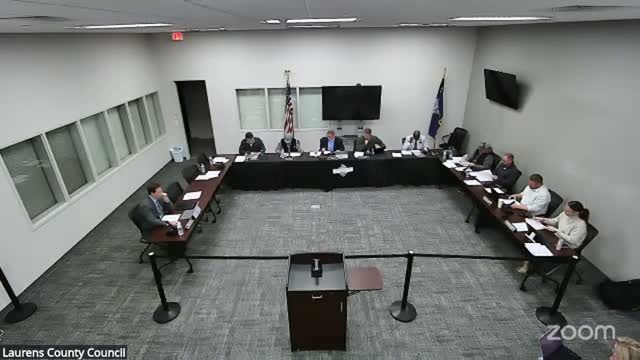
Laurens County commissioners and planning commissioners held a joint discussion of proposed amendments to the county’s subdivision regulations that would change how open‑space residential developments are measured and regulated.
Staff and the planning commission described three proposed amendments (11, 12 and 13) to Ordinance 991, which amends Ordinance 926. Amendments 11 and 12 would replace minimum lot‑width metrics with a maximum density approach: planning representatives explained the draft sets a maximum of two homes per acre across a subdivision, with open‑space carve‑outs counted before calculating net buildable area. "The maximum density would be 2 homes per acre in the entire... subdivision property," one planning representative said, using a worked example to show how a 200‑acre tract could yield 400 homes before open‑space deductions.
Supporters said the density metric simplifies review and gives the planning department and builders a clear, adjustable parameter. As one planning commissioner put it, the approach "gives you something that's pretty obvious that you're trying to hit regardless of how you do it with all the other requirements that are being proposed."
Opponents and some commissioners raised concerns about whether the change would actually make open‑space development more attractive than conventional subdivision design. Commissioners asked for a clearer explanation of how open‑space yield, setbacks and net buildable area interact, and they repeatedly requested map examples and a side‑by‑side comparison showing how the 2‑homes‑per‑acre rule would apply in real parcels.
Amendment 13 would change the ordinance’s numeric setback specifications to defer to the most current standards in the International Building Code (IBC) that the county adopts. Commissioners requested a comparison of current county setback minima with the range of IBC minima (several speakers mentioned figures like 3.5 to 7 feet as possible minima depending on structure type) and asked that the county fire marshal attend the Monday meeting to address technical enforcement and fire‑safety implications.
Commissioners and planning staff also debated the meaning of the phrase "directly accessible" natural open space (how many lots must have clear access to open space) and noted that staff removed a previous requirement that every lot touch open space; planning staff urged clearer definitions to avoid subjective interpretation and future variance disputes.
No votes were taken; the commission scheduled a follow‑up at the council meeting on Monday when mapping examples, technical memos and fire‑marshal input will be provided.
Staff and the planning commission described three proposed amendments (11, 12 and 13) to Ordinance 991, which amends Ordinance 926. Amendments 11 and 12 would replace minimum lot‑width metrics with a maximum density approach: planning representatives explained the draft sets a maximum of two homes per acre across a subdivision, with open‑space carve‑outs counted before calculating net buildable area. "The maximum density would be 2 homes per acre in the entire... subdivision property," one planning representative said, using a worked example to show how a 200‑acre tract could yield 400 homes before open‑space deductions.
Supporters said the density metric simplifies review and gives the planning department and builders a clear, adjustable parameter. As one planning commissioner put it, the approach "gives you something that's pretty obvious that you're trying to hit regardless of how you do it with all the other requirements that are being proposed."
Opponents and some commissioners raised concerns about whether the change would actually make open‑space development more attractive than conventional subdivision design. Commissioners asked for a clearer explanation of how open‑space yield, setbacks and net buildable area interact, and they repeatedly requested map examples and a side‑by‑side comparison showing how the 2‑homes‑per‑acre rule would apply in real parcels.
Amendment 13 would change the ordinance’s numeric setback specifications to defer to the most current standards in the International Building Code (IBC) that the county adopts. Commissioners requested a comparison of current county setback minima with the range of IBC minima (several speakers mentioned figures like 3.5 to 7 feet as possible minima depending on structure type) and asked that the county fire marshal attend the Monday meeting to address technical enforcement and fire‑safety implications.
Commissioners and planning staff also debated the meaning of the phrase "directly accessible" natural open space (how many lots must have clear access to open space) and noted that staff removed a previous requirement that every lot touch open space; planning staff urged clearer definitions to avoid subjective interpretation and future variance disputes.
No votes were taken; the commission scheduled a follow‑up at the council meeting on Monday when mapping examples, technical memos and fire‑marshal input will be provided.
View the Full Meeting & All Its Details
This article offers just a summary. Unlock complete video, transcripts, and insights as a Founder Member.
✓
Watch full, unedited meeting videos
✓
Search every word spoken in unlimited transcripts
✓
AI summaries & real-time alerts (all government levels)
✓
Permanent access to expanding government content
30-day money-back guarantee
