Fremont County proposal: Riverton hears plan for 0.75% sales tax to shore up ambulance, air and bus services
February 04, 2026 | Riverton, Fremont County, Wyoming
This article was created by AI summarizing key points discussed. AI makes mistakes, so for full details and context, please refer to the video of the full meeting. Please report any errors so we can fix them. Report an error »
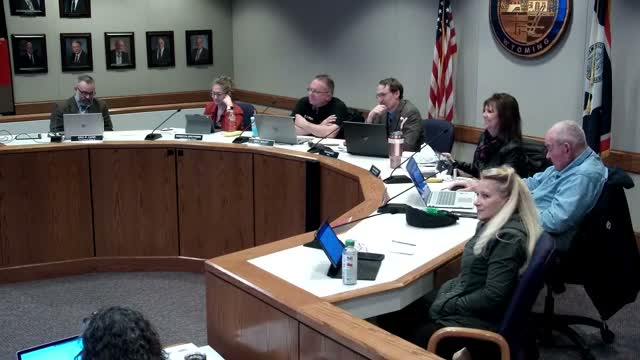
City staff and the Fremont County Action Group (FCAG) presented a proposal on Feb. 3 for an optional economic development sales tax to be considered countywide by ballot. The committee modeled a three‑quarter percent (0.75%) levy on retail sales and estimated roughly $6.5 million in gross proceeds (vs. $4.4 million at 0.5%) to support three specified core services: ground ambulance, commercial air service and public ground transportation (WRTA and others).
Under the committee model, proceeds from a 0.75% tax were modeled to be distributed roughly 54% for ambulance ($3.5M estimate), 31% for air service ($2.0M) and 15% for ground transit ($1.0M). Committee members and staff emphasized that the ambulance estimate represents projected operating cost needed to sustain countywide emergency response capacity (analysis used statewide comparative data and a model assuming six peak ambulances). The county commission holds Frontier Ambulance’s current contract and must confirm actual contract costs and how proceeds would be budgeted; FCAG and staff said more detailed contractual figures are required before a formal municipal resolution is finalized.
Process and timing: Under Wyoming statute the measure may go forward by (a) a county resolution plus a majority of municipalities’ resolutions or (b) by petition from 5% of qualified electors. Staff said the resolution route requires county commission approval and majority municipal support; with the primary election timetable looming the committee encouraged rapid inter‑jurisdictional coordination. Councilmembers expressed concerns about messaging (‘economic development’ vs. ‘essential services’), asked for an itemized explanation of how ambulance proceeds would be used (capital replacement, staffing, parachute coverage for remote areas), and supported clarifying ballot language and an MOA for direct remittance of proceeds to the named service recipients if voters approve.
What council decided: Riverton did not adopt a final resolution at the Feb. 3 meeting but discussed supporting a 0.75% option and directed staff to coordinate with the county and peer municipalities on timing and MOA language; staff emphasized additional ambulance cost detail is needed from the county for voter education prior to any vote.
Context: Presenters noted that prior revenue declines at the county level (notably from major property taxpayers) reduced county flexibility and that without alternative revenue streams providers such as Frontier Ambulance and WRTA face operational and capital pressures. If approved, the tax would be collected by the Department of Revenue, remitted to municipalities, and distributed under a memorandum of agreement.
Under the committee model, proceeds from a 0.75% tax were modeled to be distributed roughly 54% for ambulance ($3.5M estimate), 31% for air service ($2.0M) and 15% for ground transit ($1.0M). Committee members and staff emphasized that the ambulance estimate represents projected operating cost needed to sustain countywide emergency response capacity (analysis used statewide comparative data and a model assuming six peak ambulances). The county commission holds Frontier Ambulance’s current contract and must confirm actual contract costs and how proceeds would be budgeted; FCAG and staff said more detailed contractual figures are required before a formal municipal resolution is finalized.
Process and timing: Under Wyoming statute the measure may go forward by (a) a county resolution plus a majority of municipalities’ resolutions or (b) by petition from 5% of qualified electors. Staff said the resolution route requires county commission approval and majority municipal support; with the primary election timetable looming the committee encouraged rapid inter‑jurisdictional coordination. Councilmembers expressed concerns about messaging (‘economic development’ vs. ‘essential services’), asked for an itemized explanation of how ambulance proceeds would be used (capital replacement, staffing, parachute coverage for remote areas), and supported clarifying ballot language and an MOA for direct remittance of proceeds to the named service recipients if voters approve.
What council decided: Riverton did not adopt a final resolution at the Feb. 3 meeting but discussed supporting a 0.75% option and directed staff to coordinate with the county and peer municipalities on timing and MOA language; staff emphasized additional ambulance cost detail is needed from the county for voter education prior to any vote.
Context: Presenters noted that prior revenue declines at the county level (notably from major property taxpayers) reduced county flexibility and that without alternative revenue streams providers such as Frontier Ambulance and WRTA face operational and capital pressures. If approved, the tax would be collected by the Department of Revenue, remitted to municipalities, and distributed under a memorandum of agreement.
View the Full Meeting & All Its Details
This article offers just a summary. Unlock complete video, transcripts, and insights as a Founder Member.
✓
Watch full, unedited meeting videos
✓
Search every word spoken in unlimited transcripts
✓
AI summaries & real-time alerts (all government levels)
✓
Permanent access to expanding government content
30-day money-back guarantee
