Wheat Ridge council agrees to advance rules allowing up to four digital billboards with strict spacing and light controls
February 03, 2026 | Wheat Ridge City, Jefferson County, Colorado
This article was created by AI summarizing key points discussed. AI makes mistakes, so for full details and context, please refer to the video of the full meeting. Please report any errors so we can fix them. Report an error »
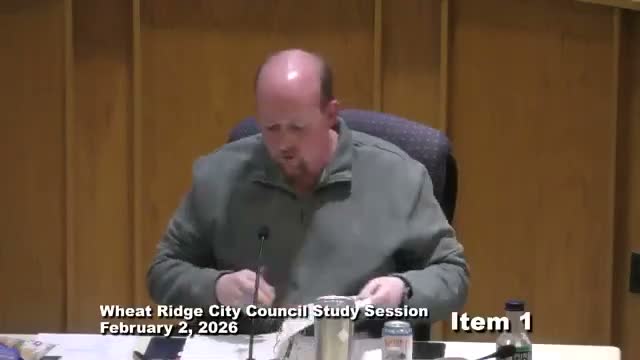
Wheat Ridge City Council on Feb. 2 directed staff to draft regulations that would allow up to four existing static billboards along the I‑70/I‑76 corridors to be converted to digital signs under tight operational limits and spacing requirements.
Planning manager Jana Easley reviewed the city's billboard history and technical options before the council, noting that the code has long prohibited digital billboards and that prior rounds reduced the inventory from 16 to 15 static signs. Easley said new light‑mitigating technology and operational standards could reduce off‑site glare while preserving viewability for the intended highway audience: "When I started in planning 20 plus years ago, digital billboards had no illumination controls. The technology has actually come quite a long way," she said.
Industry representatives who spoke during public comment said they want clarity on conversion rules. "We own 7 of the 15 billboards that are currently there along the I‑70 Corridor," said Steve Shin of Outfront Media, and asked about the lottery process, maximum heights and the number of allowable conversions. Representatives from Mile High Outdoor and Lamar Advertising echoed interest in spacing details and the lottery mechanism.
Council members raised safety and neighborhood concerns, focusing on proximity to residential areas, rotation speed and light pollution. Mayor Pro Tem Holting said she is not a fan of billboards but would consider allowing conversions provided the rules address public‑health and safety concerns, including the pace of rotation: "One of my biggest concerns is the visual distractions on the interstate," she said. Several councilors asked staff to ensure CDOT spacing rules and adjacent‑jurisdiction digital signs are considered when measuring separation.
After discussion the council recorded unanimous consensus on a package of directives for staff: measure spacing to include adjacent‑jurisdiction digital signage; cap conversions at four single‑faced signs; set a 2,500‑foot minimum separation as the council’s preferred starting point (staff had noted CDOT’s 1,000‑foot minimum for digital signs); require a minimum 10‑second message hold; and write operational standards for automatic dimming and residential light adjustments. The council also directed staff to pursue a lottery process for allocation if billboard operators cannot reach an equitable distribution among themselves, and to research how a public‑benefit message (for example, rotating emergency messages) might be codified.
Easley and other staff said the conversion would be to existing locations only (not additional billboard sites), that permitting and permit fees would apply as with other commercial signs, and that the city receives property tax on the underlying land but not direct tax revenue from billboard operations. Staff will return with draft code language and implementation details, including enforcement and any legal analysis required for public‑benefit messaging.
Next steps: staff will draft regulatory language and present it at future hearings for formal code updates and any required votes by the council.
Planning manager Jana Easley reviewed the city's billboard history and technical options before the council, noting that the code has long prohibited digital billboards and that prior rounds reduced the inventory from 16 to 15 static signs. Easley said new light‑mitigating technology and operational standards could reduce off‑site glare while preserving viewability for the intended highway audience: "When I started in planning 20 plus years ago, digital billboards had no illumination controls. The technology has actually come quite a long way," she said.
Industry representatives who spoke during public comment said they want clarity on conversion rules. "We own 7 of the 15 billboards that are currently there along the I‑70 Corridor," said Steve Shin of Outfront Media, and asked about the lottery process, maximum heights and the number of allowable conversions. Representatives from Mile High Outdoor and Lamar Advertising echoed interest in spacing details and the lottery mechanism.
Council members raised safety and neighborhood concerns, focusing on proximity to residential areas, rotation speed and light pollution. Mayor Pro Tem Holting said she is not a fan of billboards but would consider allowing conversions provided the rules address public‑health and safety concerns, including the pace of rotation: "One of my biggest concerns is the visual distractions on the interstate," she said. Several councilors asked staff to ensure CDOT spacing rules and adjacent‑jurisdiction digital signs are considered when measuring separation.
After discussion the council recorded unanimous consensus on a package of directives for staff: measure spacing to include adjacent‑jurisdiction digital signage; cap conversions at four single‑faced signs; set a 2,500‑foot minimum separation as the council’s preferred starting point (staff had noted CDOT’s 1,000‑foot minimum for digital signs); require a minimum 10‑second message hold; and write operational standards for automatic dimming and residential light adjustments. The council also directed staff to pursue a lottery process for allocation if billboard operators cannot reach an equitable distribution among themselves, and to research how a public‑benefit message (for example, rotating emergency messages) might be codified.
Easley and other staff said the conversion would be to existing locations only (not additional billboard sites), that permitting and permit fees would apply as with other commercial signs, and that the city receives property tax on the underlying land but not direct tax revenue from billboard operations. Staff will return with draft code language and implementation details, including enforcement and any legal analysis required for public‑benefit messaging.
Next steps: staff will draft regulatory language and present it at future hearings for formal code updates and any required votes by the council.
View the Full Meeting & All Its Details
This article offers just a summary. Unlock complete video, transcripts, and insights as a Founder Member.
✓
Watch full, unedited meeting videos
✓
Search every word spoken in unlimited transcripts
✓
AI summaries & real-time alerts (all government levels)
✓
Permanent access to expanding government content
30-day money-back guarantee
