Basalt P&Z continues 555 Basalt Avenue hearing amid traffic, floodplain and housing questions
February 04, 2026 | Basalt Town, Eagle County, Colorado
This article was created by AI summarizing key points discussed. AI makes mistakes, so for full details and context, please refer to the video of the full meeting. Please report any errors so we can fix them. Report an error »
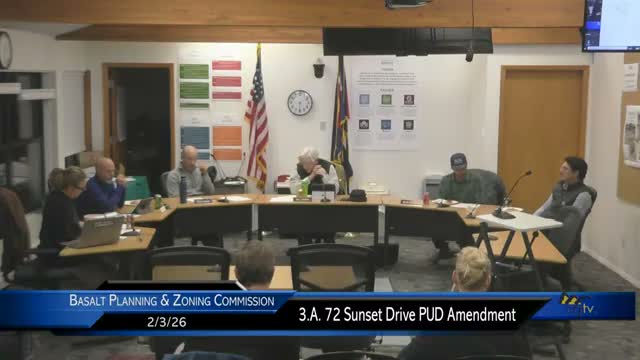
The Basalt Planning and Zoning Commission on Feb. 3 continued the public hearing for a proposed redevelopment of the Myers and Company site at 555 Basalt Avenue after hearing updated materials from staff and the applicant.
Staff said the 4.8‑acre proposal from MREH LLC would remove existing buildings and construct commercial storage on the south half of the site and multifamily housing on the north. The application requests several land‑use actions, including a PUD amendment, a master‑plan amendment and a special review because the property is in the Basalt Business Center South PUD and partly within the South Side floodplain. "The process requires review by BACH, P&Z and Town Council," staff said as it outlined draft conditions and identified outstanding items.
The commission and reviewers focused on three technical questions: traffic, affordable‑housing mitigation and floodplain management. Staff and a third‑party reviewer flagged limits in the traffic analysis: the development's traffic generation relied in part on a single‑day count conducted May 21, 2025, and reviewers recommended a broader multi‑day approach to capture school and peak seasonal traffic. "The goal here is for the applicant to demonstrate that the new use is not going to increase the amount of traffic that exists today," staff said. Residents and commissioners disagreed about whether that metric adequately captures neighborhood safety concerns.
Multiple public commenters said neighborhood traffic and pedestrian safety remain acute. Laurel Fox, who said she lives near Meadowview, told the commission, "We're afraid people are gonna get hurt," citing high‑school and daytime peak movements. Few Lane residents asked the commission to require that roadway become one‑way or to add stop controls and additional pedestrian infrastructure at key crossings.
The applicant's architect, Justin Frias, described design changes made since the prior hearing: updated renderings, revised unit mixes to include two‑bedroom deed‑restricted units, and a reduction in total residential units from a previously stated 48 to 45 while maintaining 12 deed‑restricted units. Frias said revised parking calculations lowered the project's residential parking requirement to 81 spaces and that the applicant has provided a construction management plan and renderings showing the proposed building materials and parapet/elevator treatments.
CDOT coordination remains outstanding. Staff said the CDOT access easement on Cody Lane currently limits the number of allowed vehicular trips (staff noted a five‑trip limit on that easement) and the applicant has requested an increase to route residential traffic to Cody Lane pending CDOT approval. Staff and the applicant also described alternatives if CDOT denies the request, including routing more site traffic to the Few Lane roundabout.
Other issues on the table include a waiver request for storage‑unit requirements in the town's affordable‑housing guidelines, proposed PUD conditions intended to prevent storage units from becoming business operations, and a building‑height request that would allow a 38‑foot top‑of‑parapet where the PUD limit is 35 feet. Staff said the master‑plan and typology map must be amended to allow the proposed separation of storage and residential uses in the work‑mixed‑use typology.
After commissioner questions, public comment and applicant responses, the commission voted to continue the hearing to Feb. 17 with direction that staff and the applicant pursue a more comprehensive traffic analysis (to better capture school and seasonal peaks), return with BACH recommendations on affordable‑housing mixes and address outstanding CDOT access issues.
The hearing will reconvene Feb. 17 and will include further review of traffic counts, BACH's recommendations on unit mix and storage‑use waivers, and any CDOT responses to the access‑easement request.
Staff said the 4.8‑acre proposal from MREH LLC would remove existing buildings and construct commercial storage on the south half of the site and multifamily housing on the north. The application requests several land‑use actions, including a PUD amendment, a master‑plan amendment and a special review because the property is in the Basalt Business Center South PUD and partly within the South Side floodplain. "The process requires review by BACH, P&Z and Town Council," staff said as it outlined draft conditions and identified outstanding items.
The commission and reviewers focused on three technical questions: traffic, affordable‑housing mitigation and floodplain management. Staff and a third‑party reviewer flagged limits in the traffic analysis: the development's traffic generation relied in part on a single‑day count conducted May 21, 2025, and reviewers recommended a broader multi‑day approach to capture school and peak seasonal traffic. "The goal here is for the applicant to demonstrate that the new use is not going to increase the amount of traffic that exists today," staff said. Residents and commissioners disagreed about whether that metric adequately captures neighborhood safety concerns.
Multiple public commenters said neighborhood traffic and pedestrian safety remain acute. Laurel Fox, who said she lives near Meadowview, told the commission, "We're afraid people are gonna get hurt," citing high‑school and daytime peak movements. Few Lane residents asked the commission to require that roadway become one‑way or to add stop controls and additional pedestrian infrastructure at key crossings.
The applicant's architect, Justin Frias, described design changes made since the prior hearing: updated renderings, revised unit mixes to include two‑bedroom deed‑restricted units, and a reduction in total residential units from a previously stated 48 to 45 while maintaining 12 deed‑restricted units. Frias said revised parking calculations lowered the project's residential parking requirement to 81 spaces and that the applicant has provided a construction management plan and renderings showing the proposed building materials and parapet/elevator treatments.
CDOT coordination remains outstanding. Staff said the CDOT access easement on Cody Lane currently limits the number of allowed vehicular trips (staff noted a five‑trip limit on that easement) and the applicant has requested an increase to route residential traffic to Cody Lane pending CDOT approval. Staff and the applicant also described alternatives if CDOT denies the request, including routing more site traffic to the Few Lane roundabout.
Other issues on the table include a waiver request for storage‑unit requirements in the town's affordable‑housing guidelines, proposed PUD conditions intended to prevent storage units from becoming business operations, and a building‑height request that would allow a 38‑foot top‑of‑parapet where the PUD limit is 35 feet. Staff said the master‑plan and typology map must be amended to allow the proposed separation of storage and residential uses in the work‑mixed‑use typology.
After commissioner questions, public comment and applicant responses, the commission voted to continue the hearing to Feb. 17 with direction that staff and the applicant pursue a more comprehensive traffic analysis (to better capture school and seasonal peaks), return with BACH recommendations on affordable‑housing mixes and address outstanding CDOT access issues.
The hearing will reconvene Feb. 17 and will include further review of traffic counts, BACH's recommendations on unit mix and storage‑use waivers, and any CDOT responses to the access‑easement request.
View the Full Meeting & All Its Details
This article offers just a summary. Unlock complete video, transcripts, and insights as a Founder Member.
✓
Watch full, unedited meeting videos
✓
Search every word spoken in unlimited transcripts
✓
AI summaries & real-time alerts (all government levels)
✓
Permanent access to expanding government content
30-day money-back guarantee
