Rhinebeck planning board pauses SEQR for proposed Type I development amid groundwater, wastewater and rock-removal concerns
February 04, 2026 | Rhinebeck, Dutchess County, New York
This article was created by AI summarizing key points discussed. AI makes mistakes, so for full details and context, please refer to the video of the full meeting. Please report any errors so we can fix them. Report an error »
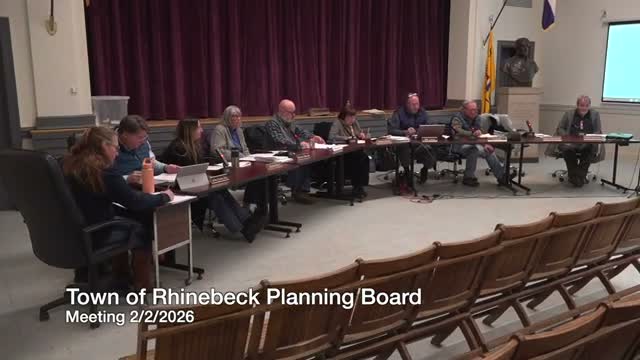
The Town of Rhinebeck Planning Board on Jan. 23 continued its review of a Type I development proposal after hearing detailed presentations on geology, wastewater and water-supply plans and sustained concerns from board members and neighbors.
Christian Ward, the applicant’s planning/engineering consultant, walked the board through Part 2 of the State Environmental Quality Review (EAF), describing proposed land use, groundwater drawdown testing, two wetland crossings, and an on-site package wastewater plant with an anticipated daily sanitary flow of about 7,200 gallons. Ward said the project team prepared a stormwater pollution prevention plan and had submitted data to Dutchess County Department of Health and DEC for their reviews. “We are in the receipt of an updated EAF dated 01/23/2026,” Ward said as he summarized the materials provided to the board.
Board members focused on three practical uncertainties: how much shallow bedrock would need removal, whether the proposed single private well (stated capacity about 9.6 gallons per minute) and storage strategy would protect neighboring domestic wells, and the downstream effects of a package-treatment plant discharging to a small tributary. Christian and his engineering team acknowledged the site contains areas of shallow bedrock and that excavation quantities have not yet been fully quantified. They said additional spot borings and cut/fill analyses are planned during preliminary design.
Neighbors and board members said the existing information—primarily a 72-hour drawdown test and concept-level grading plans—was not sufficient to make a significance determination. One board member said, “I don’t think it’s been explained to me,” and urged that the project needs more field probes; another member called the EAF discussion “the very gritty, detailed sections” that require targeted data. Neighbors raised the prospect that peak daily demands (morning showers across multiple units) could stress local wells even if average daily numbers appear modest.
On wastewater and regulatory oversight, the project team said the county health department issued a letter finding the proposed 7,200 gpd package-treatment approach acceptable subject to DEC review; the board discussed the limited local authority to impose treatment standards beyond DEC requirements unless the town adopts a separate local law. Consultants emphasized that DEC’s permitting and WAC/VAC analyses are the appropriate venue to assess treatment-level monitoring requirements and ecological consequences of any discharge.
On rock removal and grading, consultants estimated that handling rock could require substantial truck trips depending on material type and the depth of overburden; Christian said they will provide a cut/fill analysis and additional test pits to quantify excavation volumes. The board flagged this as a construction-phase concern that could alter erosion, noise and traffic impacts and recommended more precise information before concluding significance under SEQR.
Given those outstanding items—additional borings/test pits, a quantified cut/fill estimate, highway-department signoff on the shared driveway connection, fire-inspector signoff, clarification on the DEC jurisdictional determination, and final easement language—the board voted to continue the public hearing and SEQR review to the Planning Board meeting on March 2 so the applicant can supply the requested documentation.
Next steps: the applicant will provide geotechnical probes/cut-fill estimates, all correspondence with DEC and Dutchess County Department of Health, highway and fire-department comments and an updated erosion-control/staging plan. The board encouraged neighbors to indicate whether they would participate in any additional well monitoring needed for an expanded drawdown test.
Christian Ward, the applicant’s planning/engineering consultant, walked the board through Part 2 of the State Environmental Quality Review (EAF), describing proposed land use, groundwater drawdown testing, two wetland crossings, and an on-site package wastewater plant with an anticipated daily sanitary flow of about 7,200 gallons. Ward said the project team prepared a stormwater pollution prevention plan and had submitted data to Dutchess County Department of Health and DEC for their reviews. “We are in the receipt of an updated EAF dated 01/23/2026,” Ward said as he summarized the materials provided to the board.
Board members focused on three practical uncertainties: how much shallow bedrock would need removal, whether the proposed single private well (stated capacity about 9.6 gallons per minute) and storage strategy would protect neighboring domestic wells, and the downstream effects of a package-treatment plant discharging to a small tributary. Christian and his engineering team acknowledged the site contains areas of shallow bedrock and that excavation quantities have not yet been fully quantified. They said additional spot borings and cut/fill analyses are planned during preliminary design.
Neighbors and board members said the existing information—primarily a 72-hour drawdown test and concept-level grading plans—was not sufficient to make a significance determination. One board member said, “I don’t think it’s been explained to me,” and urged that the project needs more field probes; another member called the EAF discussion “the very gritty, detailed sections” that require targeted data. Neighbors raised the prospect that peak daily demands (morning showers across multiple units) could stress local wells even if average daily numbers appear modest.
On wastewater and regulatory oversight, the project team said the county health department issued a letter finding the proposed 7,200 gpd package-treatment approach acceptable subject to DEC review; the board discussed the limited local authority to impose treatment standards beyond DEC requirements unless the town adopts a separate local law. Consultants emphasized that DEC’s permitting and WAC/VAC analyses are the appropriate venue to assess treatment-level monitoring requirements and ecological consequences of any discharge.
On rock removal and grading, consultants estimated that handling rock could require substantial truck trips depending on material type and the depth of overburden; Christian said they will provide a cut/fill analysis and additional test pits to quantify excavation volumes. The board flagged this as a construction-phase concern that could alter erosion, noise and traffic impacts and recommended more precise information before concluding significance under SEQR.
Given those outstanding items—additional borings/test pits, a quantified cut/fill estimate, highway-department signoff on the shared driveway connection, fire-inspector signoff, clarification on the DEC jurisdictional determination, and final easement language—the board voted to continue the public hearing and SEQR review to the Planning Board meeting on March 2 so the applicant can supply the requested documentation.
Next steps: the applicant will provide geotechnical probes/cut-fill estimates, all correspondence with DEC and Dutchess County Department of Health, highway and fire-department comments and an updated erosion-control/staging plan. The board encouraged neighbors to indicate whether they would participate in any additional well monitoring needed for an expanded drawdown test.
Don't Miss a Word: See the Full Meeting!
Go beyond summaries. Unlock every video, transcript, and key insight with a Founder Membership.
✓
Get instant access to full meeting videos
✓
Search and clip any phrase from complete transcripts
✓
Receive AI-powered summaries & custom alerts
✓
Enjoy lifetime, unrestricted access to government data
30-day money-back guarantee
