U.S. proposes preferential trade zone and unveils major financing, stockpiling and permitting moves to shore up critical-minerals supply
February 04, 2026 | US Department of State
This article was created by AI summarizing key points discussed. AI makes mistakes, so for full details and context, please refer to the video of the full meeting. Please report any errors so we can fix them. Report an error »
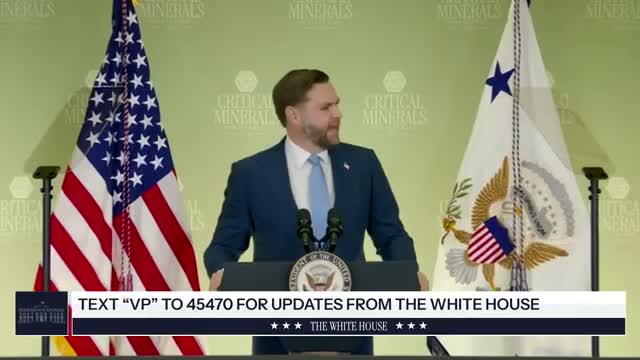
Vice President Vance proposed a new allied trading bloc and several U.S. measures intended to stabilize global critical-minerals markets and speed domestic production.
In an opening address to ministers and delegates, Vice President Vance said the administration would “establish reference prices for critical minerals at each stage of production” and maintain those floors for members of a proposed preferential trade zone through “adjustable tariffs.” He framed the plan as a way to prevent sudden foreign-market flooding that he said causes projects to fail and discourages long-term investment.
The proposal accompanies a suite of U.S. actions officials described as already underway or announced: a reported $100,000,000,000 in lending authority for critical-minerals investments to the Office of Strategic Capital, an earlier Congressional allocation of $2,000,000,000 for the national defense stockpile, and “Project Vault,” described in the transcript as a $12,000,000,000 Export-Import Bank vehicle to serve as a national strategic critical-minerals reserve. David Copley, special assistant to the president and senior director for global supply chains at the National Security Council, summarized four U.S. priorities: investing in projects, stockpiling materials, protecting domestic producers from distortive pricing, and reforming permitting.
Why this matters: Critical minerals are inputs for semiconductors, batteries, magnets and advanced manufacturing. U.S. officials at the ministerial said fragile supply chains and concentrated processing capacity create national-security and economic risks. Vice President Vance told the room that roughly two-thirds of global GDP was represented and urged allied cooperation to make markets more predictable.
Details and claims made by officials: Copley listed recent investment partners and projects by name, including MP Materials and Lithium Americas, and said the administration would deploy both debt and equity to “get projects going.” He said stockpiling had been expanded and called Project Vault “the first time in the history of the United States we’ve ever stockpiled minerals for our civilian economy” (quote from transcript). Officials repeatedly pointed to permitting delays in the United States — citing a figure that average mine development timelines run about 29 years — and said reforms and a federal priority list had been used to accelerate more than 50 projects.
Questions from reporters and responses: In the press briefing, Alex Salvi of Newsmax asked whether U.S. interest in Ukraine’s mineral resources is part of ongoing talks; Secretary Rubio said there was no announcement on the NuStar treaty and described trilateral technical teams meeting in Abu Dhabi as an encouraging sign of engagement. Journalists also asked about the mechanics of the trade-framework proposal and how reference prices and tariffs would be adjusted; officials described the mechanism as a proposed bargaining tool for allied countries rather than a finalized treaty.
Limitations and next steps: Officials emphasized that the preferential zone remains a proposal to be negotiated with partners; no legislative vote or international agreement was announced in the briefing. Several policy elements — including the precise legal mechanism for enforceable price floors and the operational design of Project Vault under the Export-Import Bank — were described at a high level in the transcript and will require further specification and interagency coordination.
The ministerial moved next into plenary sessions involving development-finance agencies and export-credit institutions. Officials said they planned to sign critical-minerals frameworks with partners later in the day.
In an opening address to ministers and delegates, Vice President Vance said the administration would “establish reference prices for critical minerals at each stage of production” and maintain those floors for members of a proposed preferential trade zone through “adjustable tariffs.” He framed the plan as a way to prevent sudden foreign-market flooding that he said causes projects to fail and discourages long-term investment.
The proposal accompanies a suite of U.S. actions officials described as already underway or announced: a reported $100,000,000,000 in lending authority for critical-minerals investments to the Office of Strategic Capital, an earlier Congressional allocation of $2,000,000,000 for the national defense stockpile, and “Project Vault,” described in the transcript as a $12,000,000,000 Export-Import Bank vehicle to serve as a national strategic critical-minerals reserve. David Copley, special assistant to the president and senior director for global supply chains at the National Security Council, summarized four U.S. priorities: investing in projects, stockpiling materials, protecting domestic producers from distortive pricing, and reforming permitting.
Why this matters: Critical minerals are inputs for semiconductors, batteries, magnets and advanced manufacturing. U.S. officials at the ministerial said fragile supply chains and concentrated processing capacity create national-security and economic risks. Vice President Vance told the room that roughly two-thirds of global GDP was represented and urged allied cooperation to make markets more predictable.
Details and claims made by officials: Copley listed recent investment partners and projects by name, including MP Materials and Lithium Americas, and said the administration would deploy both debt and equity to “get projects going.” He said stockpiling had been expanded and called Project Vault “the first time in the history of the United States we’ve ever stockpiled minerals for our civilian economy” (quote from transcript). Officials repeatedly pointed to permitting delays in the United States — citing a figure that average mine development timelines run about 29 years — and said reforms and a federal priority list had been used to accelerate more than 50 projects.
Questions from reporters and responses: In the press briefing, Alex Salvi of Newsmax asked whether U.S. interest in Ukraine’s mineral resources is part of ongoing talks; Secretary Rubio said there was no announcement on the NuStar treaty and described trilateral technical teams meeting in Abu Dhabi as an encouraging sign of engagement. Journalists also asked about the mechanics of the trade-framework proposal and how reference prices and tariffs would be adjusted; officials described the mechanism as a proposed bargaining tool for allied countries rather than a finalized treaty.
Limitations and next steps: Officials emphasized that the preferential zone remains a proposal to be negotiated with partners; no legislative vote or international agreement was announced in the briefing. Several policy elements — including the precise legal mechanism for enforceable price floors and the operational design of Project Vault under the Export-Import Bank — were described at a high level in the transcript and will require further specification and interagency coordination.
The ministerial moved next into plenary sessions involving development-finance agencies and export-credit institutions. Officials said they planned to sign critical-minerals frameworks with partners later in the day.
View the Full Meeting & All Its Details
This article offers just a summary. Unlock complete video, transcripts, and insights as a Founder Member.
✓
Watch full, unedited meeting videos
✓
Search every word spoken in unlimited transcripts
✓
AI summaries & real-time alerts (all government levels)
✓
Permanent access to expanding government content
30-day money-back guarantee
