Iowa House introduces a slate of first‑reading bills on education, family law, public safety and more
February 04, 2026 | 2026 House of Representatives, Legislative, Iowa
This article was created by AI summarizing key points discussed. AI makes mistakes, so for full details and context, please refer to the video of the full meeting. Please report any errors so we can fix them. Report an error »
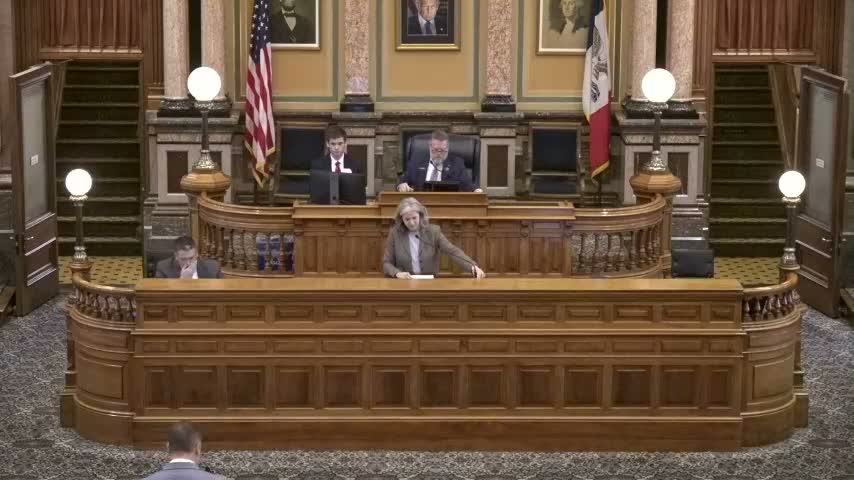
The Iowa House of Representatives read a group of first‑reading bills into the record and sent them to committee on Tuesday, including measures on education, family law, public safety and tax credits.
Rep. Gustaf was listed as author of multiple bills, including House File 2271, described as "a bill for an act modifying provisions related to world language instruction," and House File 2272, described as a bill to modify renewal requirements for licenses issued by the Department of Educational Examiners. The clerk/unidentified reader also introduced House File 2273 by Rep. Rinker to adjust investigations of insurance fraud related to adjusters and appraisers, and House File 2274 by Rep. Gustaf, described in the reading as requiring operators of certain websites and applications that contain material pornographic for minors to perform reasonable age verification. Each bill was read for the first time and referred to the committee named during the reading.
Other bills introduced included measures by Rep. Fisher on child support source verification (HF 2275) and parental financial responsibilities after termination of parental rights (HF 2276); a Uniform Family Law Arbitration Act by Reps. Dunwell and Bain (HF 2277); Rep. Gearhart's measure on law‑enforcement training for reserve officers (HF 2278); Rep. Bowden's proposal to mark driver’s licenses to reflect veteran status (HF 2279); Rep. Amier's bill to modify an individual income tax credit for emergency medical service personnel, including retroactive provisions (HF 2280); Rep. Hora's bill related to hours alcoholic beverages may be sold or consumed at commercial service airports (HF 2281); and a bill by Rep. Fisher concerning sales of certain school district buildings or structures (HF 2282). For bills where the reading provided only a short description, additional substantive details were not specified in the record.
Why it matters: first readings place bills into the legislative pipeline. Referral to committee determines where each proposal will receive further review and possible public hearings. The House did not debate or vote on these bills during this session; they were introduced and sent to committee for consideration.
Next steps: Each introduced House file will appear on the docket of the committee to which it was referred, where members may schedule hearings, take testimony and consider amendments.
Rep. Gustaf was listed as author of multiple bills, including House File 2271, described as "a bill for an act modifying provisions related to world language instruction," and House File 2272, described as a bill to modify renewal requirements for licenses issued by the Department of Educational Examiners. The clerk/unidentified reader also introduced House File 2273 by Rep. Rinker to adjust investigations of insurance fraud related to adjusters and appraisers, and House File 2274 by Rep. Gustaf, described in the reading as requiring operators of certain websites and applications that contain material pornographic for minors to perform reasonable age verification. Each bill was read for the first time and referred to the committee named during the reading.
Other bills introduced included measures by Rep. Fisher on child support source verification (HF 2275) and parental financial responsibilities after termination of parental rights (HF 2276); a Uniform Family Law Arbitration Act by Reps. Dunwell and Bain (HF 2277); Rep. Gearhart's measure on law‑enforcement training for reserve officers (HF 2278); Rep. Bowden's proposal to mark driver’s licenses to reflect veteran status (HF 2279); Rep. Amier's bill to modify an individual income tax credit for emergency medical service personnel, including retroactive provisions (HF 2280); Rep. Hora's bill related to hours alcoholic beverages may be sold or consumed at commercial service airports (HF 2281); and a bill by Rep. Fisher concerning sales of certain school district buildings or structures (HF 2282). For bills where the reading provided only a short description, additional substantive details were not specified in the record.
Why it matters: first readings place bills into the legislative pipeline. Referral to committee determines where each proposal will receive further review and possible public hearings. The House did not debate or vote on these bills during this session; they were introduced and sent to committee for consideration.
Next steps: Each introduced House file will appear on the docket of the committee to which it was referred, where members may schedule hearings, take testimony and consider amendments.
View the Full Meeting & All Its Details
This article offers just a summary. Unlock complete video, transcripts, and insights as a Founder Member.
✓
Watch full, unedited meeting videos
✓
Search every word spoken in unlimited transcripts
✓
AI summaries & real-time alerts (all government levels)
✓
Permanent access to expanding government content
30-day money-back guarantee
